
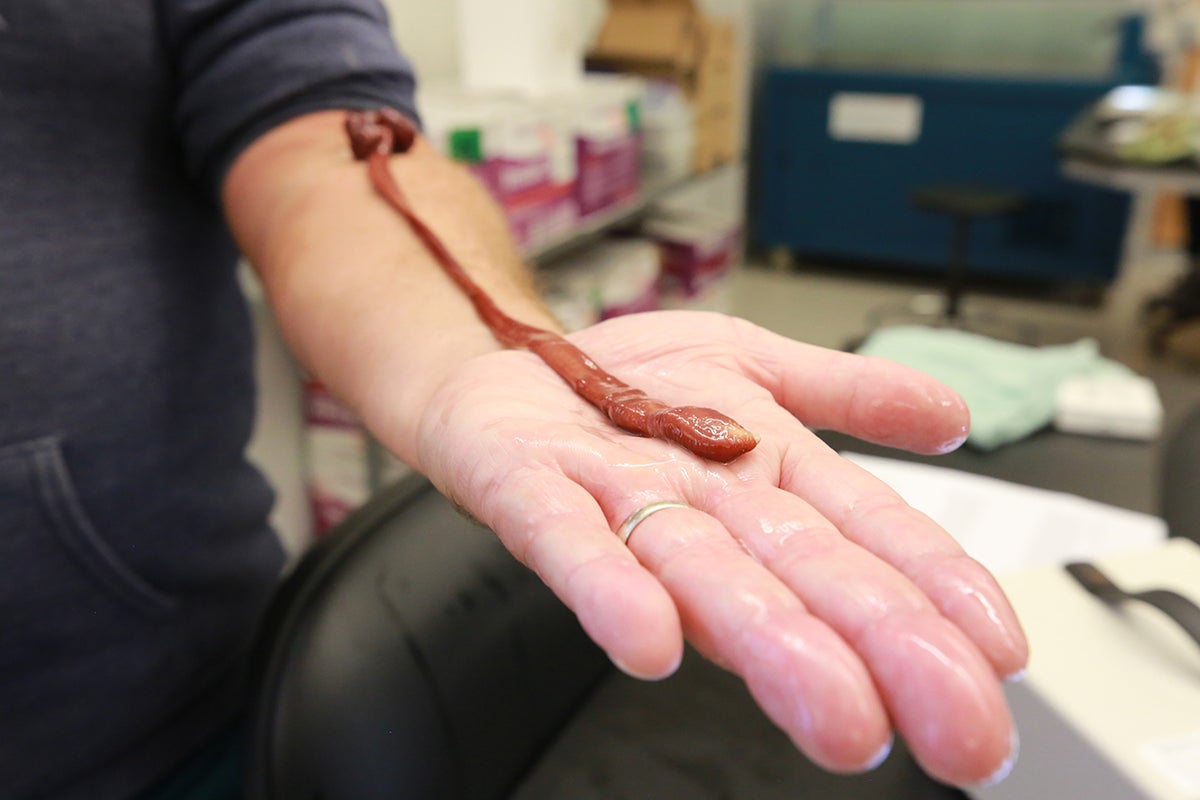

Meet ‘Baseodiscus the Eldest,’ a record-setting worm more than 27 years old
Ribbon worms can grow to enormous lengths, and one named Baseodiscus the Eldest is showing how little we know about them—including how long they live
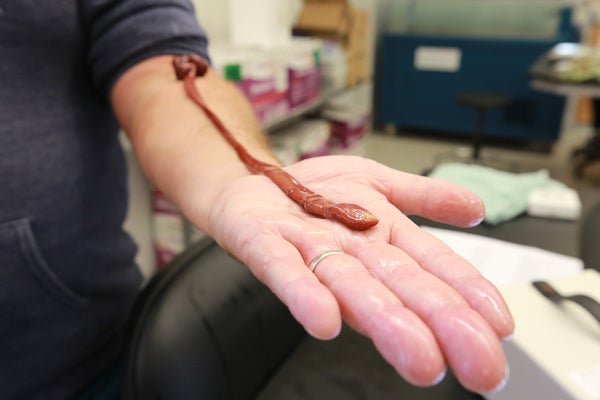
Jon Allen holds the world’s oldest known ribbon worm on record for a class of his students.
Each year Jon Allen, an associate professor of marine biology at William & Mary, gingerly removes the anemones and brittle stars from a saltwater tank. He then sifts through the mud for his nearly meter-long ribbon worm, named Baseodiscus the Eldest after its genus, to show his invertebrate zoology class.
When people imagine worms, they often picture everyday earthworms, but ribbon worms wriggle on a distant evolutionary branch and mostly burrow in seafloors or rocky shores. Most of the roughly 1,300 species of ribbon worms are just a few millimeters wide and can be quite long—one species, Lineus longissimus, can measure up to 55 meters, or twice the average length of a blue whale. “They’re basically these long, pretty flat, ribbon-shaped worms,” Allen says. “They’re really voracious predators in the marine system.”
Baseodiscus the Eldest, or B, as it is called for short, was fished from the wild between 1996 and 1998 and kept in a tank at the University of North Carolina at Chapel Hill. It came into Allen’s possession when the building it was kept at was renovated.
On supporting science journalism
If you’re enjoying this article, consider supporting our award-winning journalism by subscribing. By purchasing a subscription you are helping to ensure the future of impactful stories about the discoveries and ideas shaping our world today.
When Allen showed B to his class in 2023, then undergraduate student Chloe Goodsell was surprised. She had been taking care of the anemones and urchins sharing B’s tank and didn’t even know the worm lived there. She began asking Allen questions such as how old the worm was. It turned out that neither Allen nor any other scientist knew the answer.
The inquiry prompted Allen and Goodsell to publish a paper in the Journal of Experimental Zoology estimating B’s age: at minimum, the worm is 27 years old. It’s a new record for ribbon worms; the previous record holder was three years old. “B is older than my co-author,” Allen says with a chuckle. The worm’s longevity sheds new light on what the life expectancy of ribbon worms is and how little we know about them.
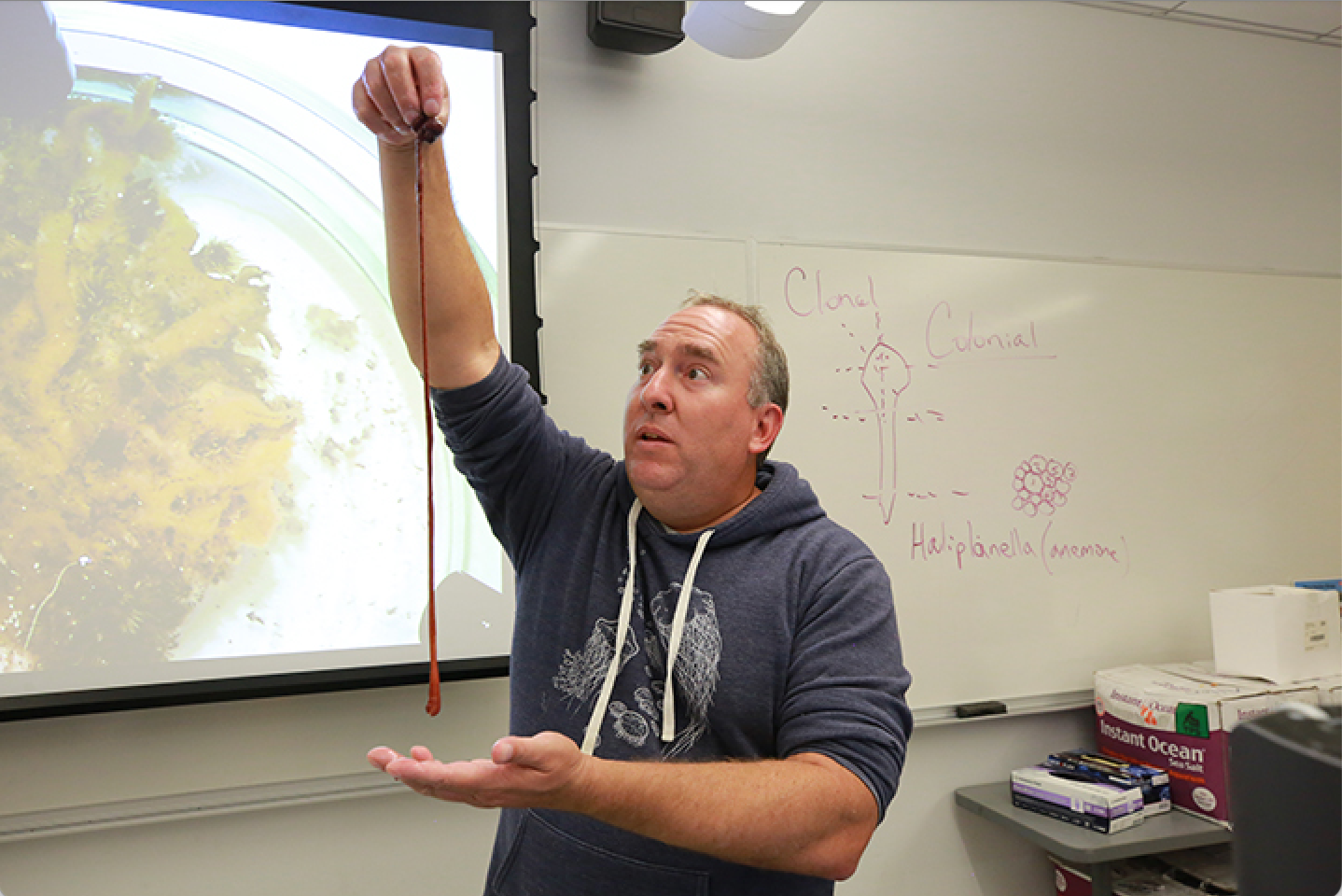
Jon Allen holds Baseodiscus the Eldest up for his class.
The upper age limit for these worms is not yet known, and B’s own age could be decades older than the current estimate of their maximum life span, Allen says. He thinks B is probably average for its species because he doesn’t give the worm any special care or feeding on Allen’s part (B has likely been surviving off a population of peanut worms that coexist in the tank). Many marine invertebrates can live incredible lifespans, with some deep-sea tube worms reaching 300 years old and one clam off the coast of Iceland having been found to be more than 500. Ribbon worms are also relatively large and top predators, as are many longer-lived species. “Who’s to say that a ribbon worm can’t live to 100 or 200 or 300 years?” Allen asks.
“It’s kind of interesting to think why different organisms are evolving long lifespans and how they can live so long,” says Goodsell, now a Ph.D. student at the University of California, Irvine. “There’s a lot to learn from the worms of the world.”
Eric Sanford, a marine ecologist at the University of California, Davis, who was not involved with the study, says that age is crucial baseline information for scientists who might be interested in studying how many offspring the worms can have over their lifetimes and how worm populations might affect other animals that they prey on.
Meanwhile B is constantly extending the known lifespan of its species—but for how much longer is anyone’s guess. “Every year it’s a bit of a mystery—will he still be there?” Allen says.
It’s Time to Stand Up for Science
If you enjoyed this article, I’d like to ask for your support. Scientific American has served as an advocate for science and industry for 180 years, and right now may be the most critical moment in that two-century history.
I’ve been a Scientific American subscriber since I was 12 years old, and it helped shape the way I look at the world. SciAm always educates and delights me, and inspires a sense of awe for our vast, beautiful universe. I hope it does that for you, too.
If you subscribe to Scientific American, you help ensure that our coverage is centered on meaningful research and discovery; that we have the resources to report on the decisions that threaten labs across the U.S.; and that we support both budding and working scientists at a time when the value of science itself too often goes unrecognized.
In return, you get essential news, captivating podcasts, brilliant infographics, can’t-miss newsletters, must-watch videos, challenging games, and the science world’s best writing and reporting. You can even gift someone a subscription.
There has never been a more important time for us to stand up and show why science matters. I hope you’ll support us in that mission.