

SpaceX plans to launch one million satellites to power orbital AI data center
Elon Musk’s SpaceX is set to massively expand its orbital footprint in a bid to power next-generation artificial intelligence
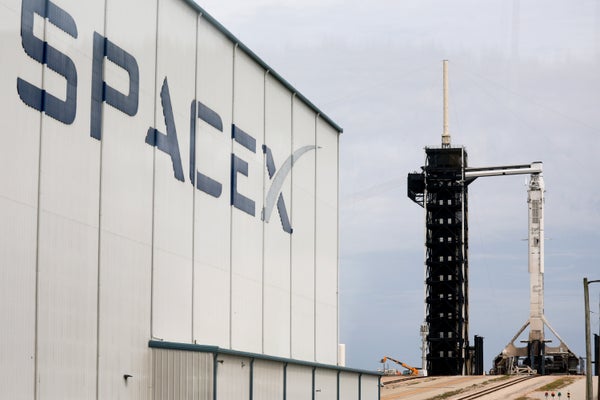
Elon Musk’s SpaceX has filed plans with U.S. regulators to launch up to one million satellites into low-Earth orbit. Together, these satellites will act as an orbital data center to power artificial intelligence.
SpaceX currently operates between 9,300 and 9,600 of the 14,000 or so active satellites that are orbiting Earth; those SpaceX satellites provide the company’s Starlink Internet service to millions of customers worldwide. The scale of the new proposal is far and away the largest of any planned satellite constellation. Including this filing, there are an estimated 1.7 million proposed satellites worldwide, according to a social media post from astronomer Jonathan McDowell, who tracks satellite constellations via his blog.
“I think it is going to be extremely difficult to operate such a huge number of satellites safely,” McDowell says. “This is a factor-of-100 increase over the already large number extant today, so a factor of 10,000 in the number of close approaches in the absence of careful station keeping.”
On supporting science journalism
If you’re enjoying this article, consider supporting our award-winning journalism by subscribing. By purchasing a subscription you are helping to ensure the future of impactful stories about the discoveries and ideas shaping our world today.
SpaceX offers few details about the satellites, such as their size, specific orbits or even cost. But the company does say it plans to stick the satellites in “largely unused orbital altitudes” within an altitude range of 500 to 2,000 kilometers.
The spacecraft would be positioned to maximize time in the sun so that they could run on solar power. That’s a major argument in favor of orbital data centers that has been frequently cited by AI leaders, including Musk, who also owns xAI, the start-up behind the chatbot Grok. The build-out could also boost SpaceX’s plan to go public later this year—and to potentially merge with xAI.
“Freed from the constraints of terrestrial deployment, within a few years, the lowest cost to generate AI compute will be in space,” wrote SpaceX in the filing. The company did not immediately respond to a request for comment.
Despite SpaceX’s bullishness on the potential for AI, the proposal has been met with concern by some in the astronomy community. Peter Plavchan, a professor of astronomy at George Mason University, wrote in a social media post that whoever can occupy most of the usable orbits around Earth first will effectively prevent any other company or nation from hosting satellites in those orbits. “It’s the ultimate first-mover territorial claim strategy in lieu of off-world space regulations,” Plavchan wrote.
Editor’s Note (2/2/26): This article was edited after posting to include comments from Jonathan McDowell and to correct the descriptions of his social media post and the number of active satellites that are orbiting Earth.
It’s Time to Stand Up for Science
If you enjoyed this article, I’d like to ask for your support. Scientific American has served as an advocate for science and industry for 180 years, and right now may be the most critical moment in that two-century history.
I’ve been a Scientific American subscriber since I was 12 years old, and it helped shape the way I look at the world. SciAm always educates and delights me, and inspires a sense of awe for our vast, beautiful universe. I hope it does that for you, too.
If you subscribe to Scientific American, you help ensure that our coverage is centered on meaningful research and discovery; that we have the resources to report on the decisions that threaten labs across the U.S.; and that we support both budding and working scientists at a time when the value of science itself too often goes unrecognized.
In return, you get essential news, captivating podcasts, brilliant infographics, can’t-miss newsletters, must-watch videos, challenging games, and the science world’s best writing and reporting. You can even gift someone a subscription.
There has never been a more important time for us to stand up and show why science matters. I hope you’ll support us in that mission.