

Automation is a no-brainer, yes, but we have far progressed from that question. Workflow automation vs AI automation vs autonomous agents – now that’s a more relevant issue. Why?
Most organizations adopted automation to reduce manual effort and improve speed. Early gains came quickly, especially for structured and repeatable work. Over time, process variation, system changes, and exception handling started to erode those gains.
That’s why leaders are stepping back and asking a harder question: Do we need automation, AI, or systems that can act on their own? The choice directly affects operating efficiency, cost control, and how quickly teams respond when conditions change. Automation today supports better decisions, not only faster execution.
Let’s get into the world of automation: workflow automation vs AI automation vs autonomous agents. Sounds intriguing? It’s more than that. This knowledge is business-sustaining.
Harness AI for Your Business with Zero Complexities. Explore Our Quick Wins AI Adoption Strategies.
Learn More
What is Workflow Automation?
Workflow automation follows a fixed path. You design the steps once, and the system runs them the same way, every time, across teams and tools. In practice, workflow automation follows rules and conditions. When one step completes, the next begins automatically, without interpretation or judgment.
This model assumes things stay stable. Inputs remain structured, steps change infrequently, and outcomes are predictable. Among the three choices available to you: AI Automation, Independent Agents, and Workflow Automation, this approach offers the most control and the least flexibility.
Key Benefits of Workflow Automation
Workflow automation is built for control. Leaders use it when doing the same thing the same way matters more than adjusting on the fly.
Organizations typically use workflow automation to:
- Reduce manual handoffs between teams
- Shorten turnaround time for routine requests
- Enforce compliance and audit requirements
It also makes oversight simpler. Leaders can see where approvals sit, how work flows, and where delays occur.
Workflow Automation – Use Cases and Examples
Some processes don’t benefit from intelligence or autonomy. Workflow automation continues to perform well when steps are clear and outcomes are known.
Common examples include:
- Employee onboarding triggering payroll, access, and equipment setup
- Purchase requests routed through predefined approval hierarchies
- IT service tickets assigned based on category and priority
In finance, workflow automation routes invoices for approval when formats stay consistent, often cutting approval delays by days. In HR, it ensures the required steps happen in sequence, reducing compliance gaps.
As automation moves from fixed workflows toward intelligence and autonomy, this approach fits best where predictability outweighs interpretation.
What Is AI Automation?
AI automation brings judgment into automated workflows. AI does not replace workflows. It upgrades their intelligence. Teams set boundaries, and the system operates within them under human oversight.
Key Benefits of AI Automation
AI automation handles variation without constant redesign. It reduces the effort teams spend interpreting information while keeping accountability in human hands.
Key benefits include:
- Processing unstructured inputs like emails and documents
- Reducing manual review and triage work
- Improving accuracy as models learn from outcomes
McKinsey reports that 88% of companies are currently employing AI in at least one area of their operations, primarily in finance and operations. AI automation has become an integral aspect of everyday tasks, no longer just a side project.
In workflow automation compared to AI automation and autonomous agents, AI automation suits processes where decision-making is critical, but complete autonomy would pose a risk.
AI Automation – Use Cases and Examples
AI automation performs best when inputs vary, but objectives stay clear. It steps in where humans repeatedly interpret data before taking action.
Typical examples include:
- Invoice data extraction across vendors with different layouts
- Customer support case classification and routing
- Transaction monitoring for unusual activity
For accounts payable teams, AI extracts invoice data regardless of format and flags exceptions for review. Many teams see faster processing times without losing control over approvals.
As organizations grow comfortable letting systems interpret data and make bounded decisions, the next step is allowing software to manage outcomes rather than individual tasks.
What Are Autonomous Agents?
Autonomous agents shift automation from task execution to outcome ownership. Leaders set the goal and the boundaries. The system figures out how to get there. Instead of mapping every step, teams focus on the outcome. The agent plans actions, executes them, checks progress, and adjusts when conditions change.
Autonomous agents represent the highest level of automation maturity because they reduce ongoing coordination rather than adding process complexity.
Key Benefits of Autonomous Agents
Autonomous agents matter most when speed and coordination directly affect results. The delays are caused by handoffs, escalations, or even manual follow-ups. These agents reduce such delays.
Key advantages include:
- Managing multi-step processes end-to-end
- Responding to change without waiting for human intervention
- Reducing downtime and escalation loops
It is noted that growing enterprise interest in agent-based AI for supply chain and IT operations, where slow responses translate directly into financial risk.
Autonomous Agents – Use Cases and Examples
Autonomous agents operate well in environments where conditions shift frequently.
Examples include:
- Supply chain monitoring with automatic supplier rebalancing
- IT operations issue detection, resolution, and validation
- Financial forecasting that updates continuously as data changes
In procurement, agents monitor supplier performance and initiate corrective actions when risks appear. In IT, agents resolve incidents without waiting in ticket queues, reducing service disruption.
Workflow Automation vs RPA: A Quick Look at the Difference
Robotic Process Automation, unlike workflow automation, mimics human actions in user interfaces. Teams often use it when systems lack integration options.
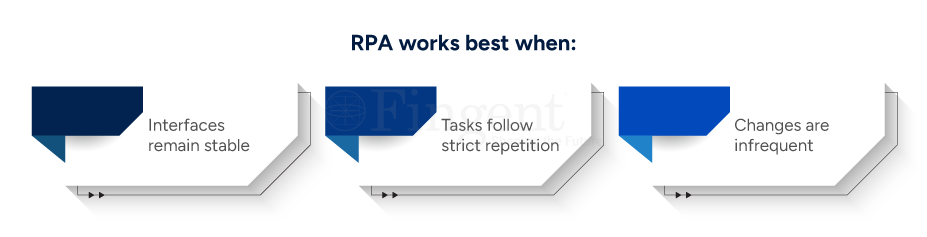
RPA fits within workflow automation. Numerous organizations are currently implementing AI in conjunction with it to prevent automation from failing when interfaces are modified.
Where Each One Fits – Workflow Automation Vs AI Automation Vs Autonomous Agents
When to use Workflow Automation, AI Automation, or Autonomous Agents? Let’s solve this burning question.
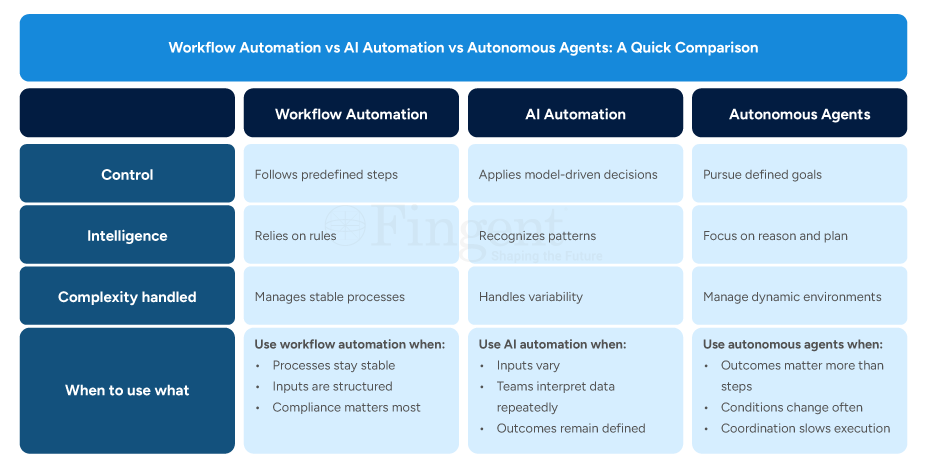
Viewed together, workflow automation, AI automation, and autonomous agents serve very different purposes. A comparison between Workflow Automation Vs AI Automation Vs Autonomous Agents helps identify the best solutions.
Although the right automation model is a balance between process stability and business risk. You may notice that a majority of companies ultimately use all three.
Still Wondering Which Business Automation Path to Choose? Our Experts Can Help!
FAQ
1. What does AI automation mean?
A. AI automation uses ML to analyze data. Thus, aid decision-making is within automated processes. It does not just execute steps. It helps decide which step comes next.
2. When should businesses use AI automation?
A. Use AI automation when variability increases, and manual judgment starts slowing things down.
In short, when rules alone are no longer enough.
3. What are autonomous AI agents?
A. Autonomous AI agents own outcomes. They plan, decide, and execute actions on their own, within clearly defined limits.
4. What is workflow automation?
A. Workflow automation executes set procedures to ensure speed and uniformity. It performs the identical task, in the exact manner, each time.
5. How are autonomous agents different from AI automation?
A. AI automation supports decisions. Autonomous agents manage execution. Autonomous agents work independently to achieve specified goals. Whereas AI automation runs on set rules.
6. Is AI automation better than workflow automation?
A. If your purpose is to automate redundant tasks based on pre-defined set rules, then workflow automation works best. But if you want a process that’s flexible, supports decision making, and removes workflow complexities, then AI automation is what you need.
Choosing the Right Automation Strategy and How Fingent Can Help
The real decision in Workflow Automation vs AI Automation vs Autonomous Agents comes down to fit. Applying intelligence or autonomy where it isn’t needed often creates more friction than value.
Stable work favors rules. Variable work favors learning. Dynamic environments favor agents.
At Fingent, we help organizations align automation choices with how work actually flows. The focus stays practical, removing friction, improving decisions, and building systems that adapt as the business changes.
Workflow automation vs. AI automation vs. autonomous agents: The wrong choice slows teams. The right one removes friction.
Connect with our tech experts today, and get step-by-step guidance on choosing the right automation strategy for your business.