
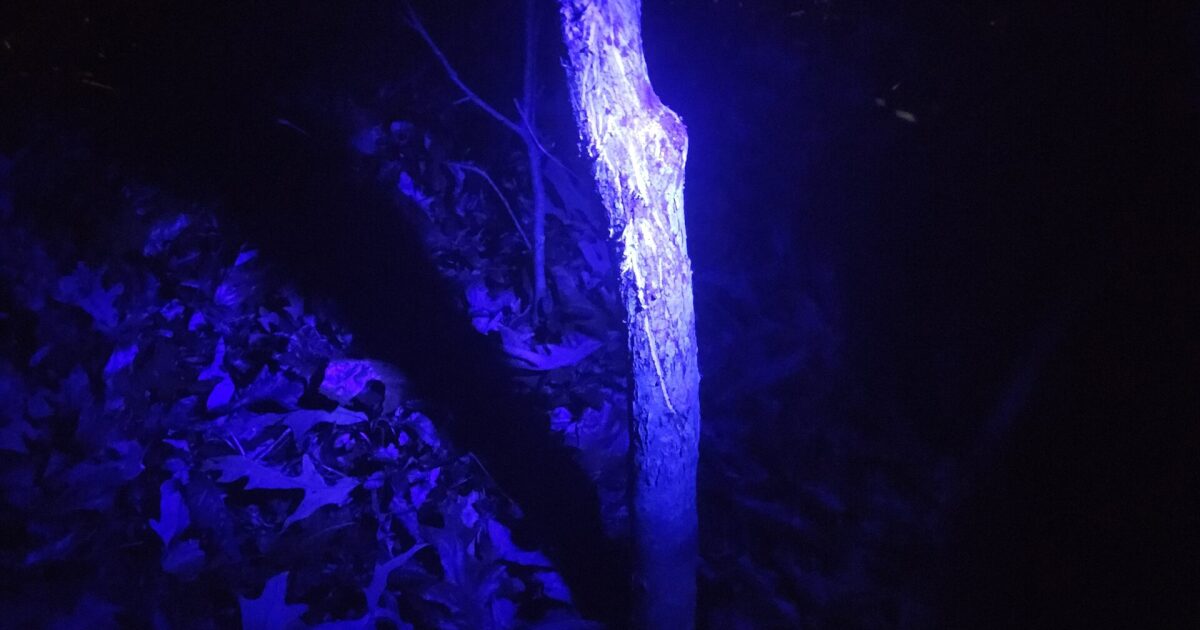
When a predator like a lion walks through the grasslands, it makes its presence known by roaring, which can be heard miles away. Since the lion is at the top of the food chain, it doesn’t particularly require privacy. But for animals like deer, making loud sounds isn’t exactly the safest way to communicate. So, to get noticed, deer mark areas with rubs and scrapes, known as signposts. Now, a new study in Ecology and Evolution reports that these signposts hold a hidden glow, and other deer can see it.
In the study the researchers describe this hidden glow as photoluminescence, the process by which an organic object absorbs light of a short wavelength and re-emits it at a longer wavelength.
“This study offers an interesting first look at how UV‑excited light emission might appear on deer signposts in the field,” says Jonathan Goldenberg, an ecologist at the University of Oslo, who wasn’t involved in the study.
Most prior research on photoluminescence in mammals has focused on the animals themselves, such as in their fur or skin, with little attention to environmental photoluminescence. To investigate how the environment might glow in response to animal behaviors, the lead author of the study, Daniel DeRose-Broeckert, and his colleagues surveyed an 800-acre area in the Whitehall Forest and located white-tailed deer’s (Odocoileus virginianus) active signposts.
The team marked those signposts with flagging tapes and GPS points. From the sites, they analyzed 109 antler rubs, 37 scrapes, and 20 urinated spots. The light measurements revealed that these markers emit light in wavelengths that stand out against the surrounding environment when exposed to ultraviolet (UV) rays.
In an interview DeRose-Broeckert told us that deer are more sensitive to blue wavelengths and UV light than humans. A deer’s eye sensitivity picks up the wavelengths emitted by the glow, i.e., 450-460 nm and 537 nm ranges. Also, deer are most active at dawn and dusk, when the sunlight is low and visible light fades, making ultraviolet wavelengths more prominent.
White-tailed deer rub their antlers and forehead gland on the tree bark to remove the outer layer of the trunk. These exposed “underbark” parts of the tree glow under the UV light. However, the researchers are unsure whether it’s the rubs that generate the glow or the exposed part of the tree.
Another signpost tracked in study was deer scrapes. This is when deer go underneath a low-hanging branch, probably one to two meters off the ground, and paw up the soil beneath using their hooves. When they do this, they deposit scent particles from their interdigital gland, located between the hooves. The compounds released by this gland are known to be photoluminescent. Additionally, deer urinate on the same area. Urine also glows due to the presence of porphyrins and amino acids.
“Signposts are kind of a community board,” DeRose-Broeckert told us in an interview. “Deer go, and they smell it just to see who’s in the area and also check their breeding statuses.”
The team observed the signposts glowing brighter during the breeding season. The scientists hypothesize more intensive rubbing generates this brighter glow.
DeRose-Broeckert told us that white-tailed deer make these signposts in the environment as a form of cryptic communication. Essentially we still don’t really know what exactly is being communicated.
Goldenberg cautions that “any interpretation of communication should be approached with the tempered understanding that photoluminescence can be widespread without being functional.”
The study has been published in Ecology and Evolution.