

How do deep-sea fish see in dark water? This new study could hold the clue
Three species of Red Sea fish appear to rely on special “hybrid” retina cells to see in dim environments
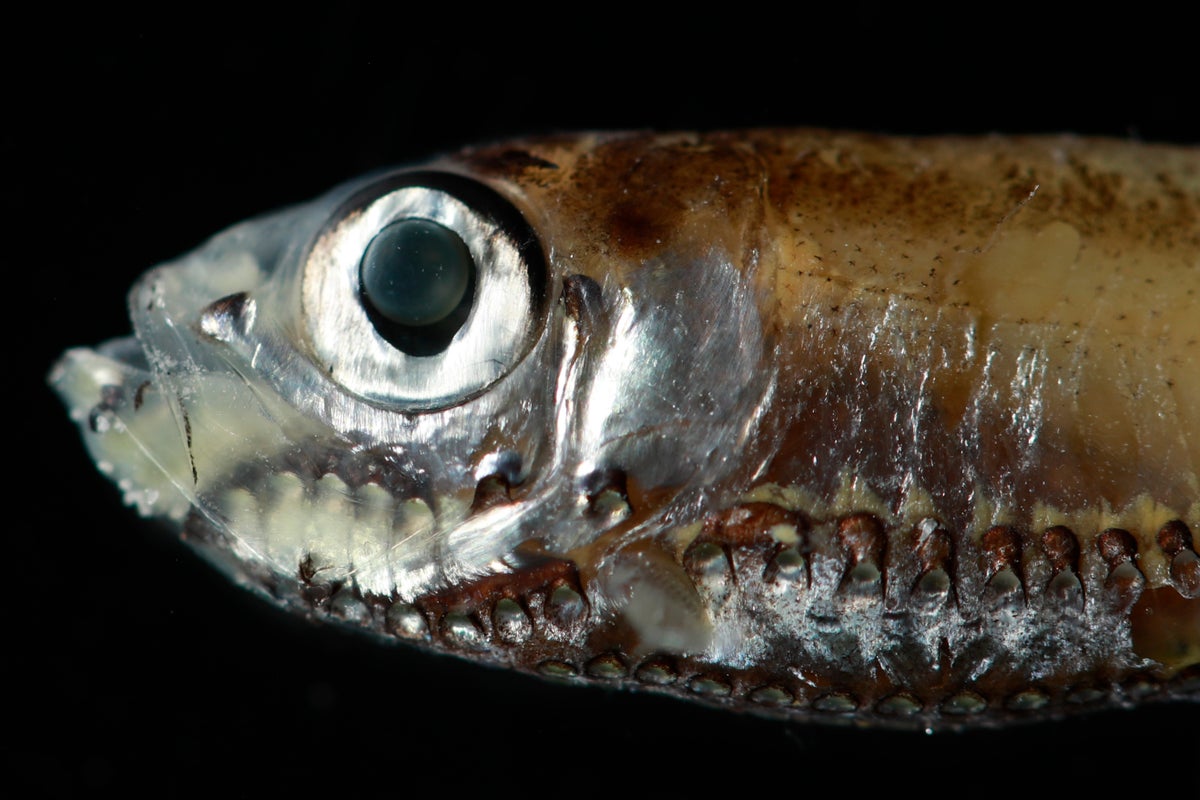
Maurolicus mucronatus, a hatchetfish.
Some deep-sea fish may be able to see light in a different way from most other vertebrates, according to a new study. The fish, found in the Red Sea, have what the scientists behind the new study describe as “hybrid” photoreceptors—light-sensing cells in the retina that combine elements of two distinct kinds of photoreceptors, cones and rods.
In human retinas, cone cells enable us to see in bright environments, detecting color and fine detail, while rods are sensitive to low light, enabling us to see in the dark. But not all animals’ eyes work that way.
Scientists found the hybrid photoreceptors in larvae from three species of fish found in the Red Sea—members of the hatchetfish, lanternfish and lightfish groups, all of which live in mostly dark, deep water. One of the fish, a hatchetfish, maintains these hybrid cells into adulthood.
On supporting science journalism
If you’re enjoying this article, consider supporting our award-winning journalism by subscribing. By purchasing a subscription you are helping to ensure the future of impactful stories about the discoveries and ideas shaping our world today.
The ocean’s twilight zone isn’t an ideal environment for either rod or cone cells, explains Lily Fogg, a postdoctoral researcher at the University of Basel in Switzerland and the lead author of the study. “From a visual perspective, that’s a bit of a nightmare,” she says.
Yet many deep-sea fish often start their lives there, which raised the question: “How do these tiny larvae see well enough to feed, avoid predators, and survive in the murky midwater depths?” Fogg says.
The answer lied in the back of their eyes. By examining the retinas of the fish larvae, Fogg and her colleagues found cells with features of both rods and cones. While hatchetfish hold on to these cells as adults, lanternfish and lightfish seem to lose them, developing only rods. The findings suggest photoreceptors don’t exist as two rigid categories—rods and cones—Fogg says, “but rather along a spectrum.”
The findings, published Wednesday in Science Advances, could add to researchers’ understanding about how sight developed in vertebrates.
Similar photoreceptors have been found in other species, including jawless fishes and some reptiles and amphibians, Fogg says. Taken together, the evidence “hints that this flexibility may be a deeply rooted feature of vertebrate vision rather than an odd exception.”
“It’s a reminder that biology is rarely as simple as we think it is,” she says.
It’s Time to Stand Up for Science
If you enjoyed this article, I’d like to ask for your support. Scientific American has served as an advocate for science and industry for 180 years, and right now may be the most critical moment in that two-century history.
I’ve been a Scientific American subscriber since I was 12 years old, and it helped shape the way I look at the world. SciAm always educates and delights me, and inspires a sense of awe for our vast, beautiful universe. I hope it does that for you, too.
If you subscribe to Scientific American, you help ensure that our coverage is centered on meaningful research and discovery; that we have the resources to report on the decisions that threaten labs across the U.S.; and that we support both budding and working scientists at a time when the value of science itself too often goes unrecognized.
In return, you get essential news, captivating podcasts, brilliant infographics, can’t-miss newsletters, must-watch videos, challenging games, and the science world’s best writing and reporting. You can even gift someone a subscription.
There has never been a more important time for us to stand up and show why science matters. I hope you’ll support us in that mission.