


Your daily steps may depend on your zip code more than your willpower
Researchers found that walkable city design—not personal motivation—was the key factor behind people taking 1,100 more steps per day

Neighborhood walkability is a bit of a chicken-and-egg problem: Does living in a walkable city make you walk more, or do active people choose to live where it’s easier to walk? To investigate, researchers analyzed smartphone data from between 2013 and 2016 for two million people, including more than 5,000 people who moved among more than 1,600 U.S. cities. Tim Althoff, a computer scientist at the University of Washington, and his colleagues found that after relocating to more walkable cities, people took about 1,100 more steps a day, equivalent to 11 minutes of extra daily walking. What’s more intriguing is that these additional steps were part of brisk walks—physical activity that improves health and could contribute to a lower risk of death all around. Meanwhile, the data showed, people who moved between similarly walkable cities didn’t change their activity level. The findings suggest built environments, rather than personal choice alone, might affect not just the amount but the intensity of the exercise their inhabitants get.


On supporting science journalism
If you’re enjoying this article, consider supporting our award-winning journalism by subscribing. By purchasing a subscription you are helping to ensure the future of impactful stories about the discoveries and ideas shaping our world today.
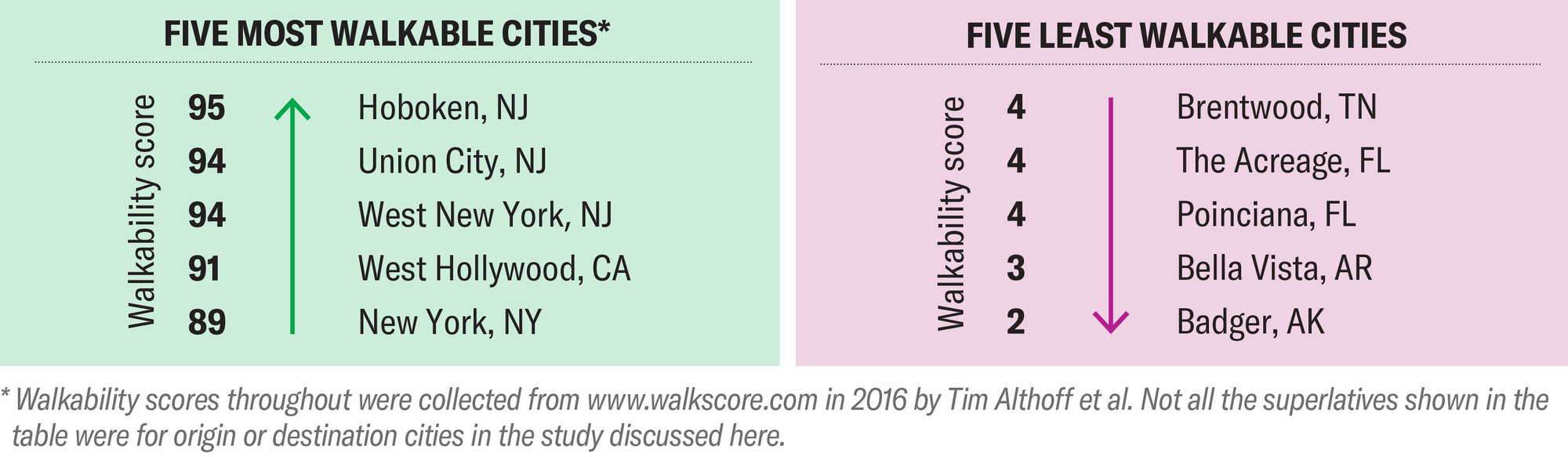
MORE WALKABLE, MORE STEPS
Each square represents a relocation pair of cities. One axis shows the change in city walkability, and the other axis shows the change in daily steps. Those who moved to more walkable cities added about 1,100 steps a day, and relocating to less walkable places cut activity by a similar amount.
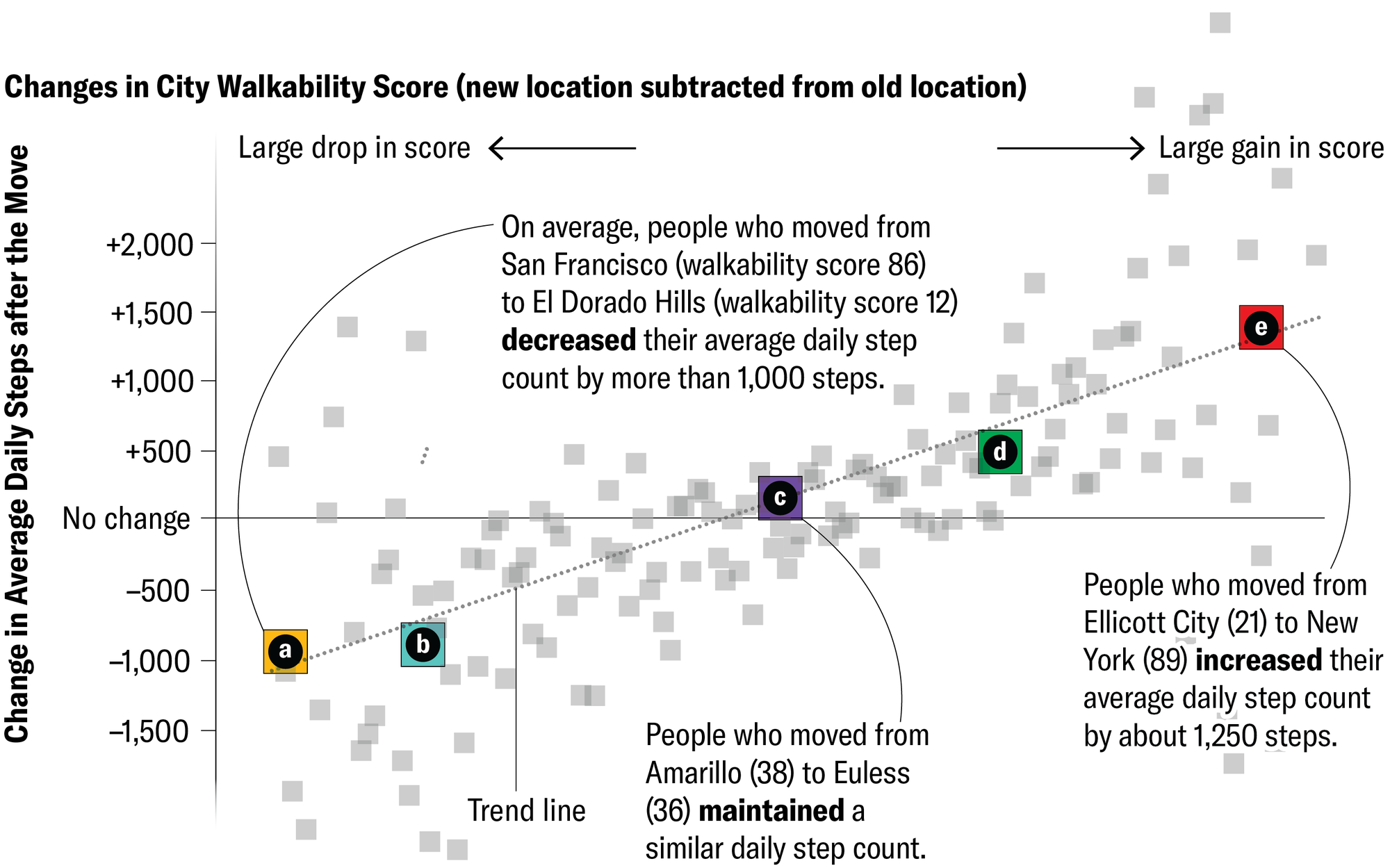
WHAT IF EVERY U.S. CITY WALKED LIKE NEW YORK CITY AND CHICAGO?
If all U.S. cities had Chicago’s walkability score of 78, the average person would walk 443 more steps a day and gain an extra 24 minutes of weekly moderate to vigorous physical activity: enough for 11.2 percent of people, or 36 million more Americans, to meet targets in aerobic-activity guidelines. And if everyone walked like New Yorkers, an even larger share—14.5 percent, or about 47 million people—would meet those targets.

It’s Time to Stand Up for Science
If you enjoyed this article, I’d like to ask for your support. Scientific American has served as an advocate for science and industry for 180 years, and right now may be the most critical moment in that two-century history.
I’ve been a Scientific American subscriber since I was 12 years old, and it helped shape the way I look at the world. SciAm always educates and delights me, and inspires a sense of awe for our vast, beautiful universe. I hope it does that for you, too.
If you subscribe to Scientific American, you help ensure that our coverage is centered on meaningful research and discovery; that we have the resources to report on the decisions that threaten labs across the U.S.; and that we support both budding and working scientists at a time when the value of science itself too often goes unrecognized.
In return, you get essential news, captivating podcasts, brilliant infographics, can’t-miss newsletters, must-watch videos, challenging games, and the science world’s best writing and reporting. You can even gift someone a subscription.
There has never been a more important time for us to stand up and show why science matters. I hope you’ll support us in that mission.