
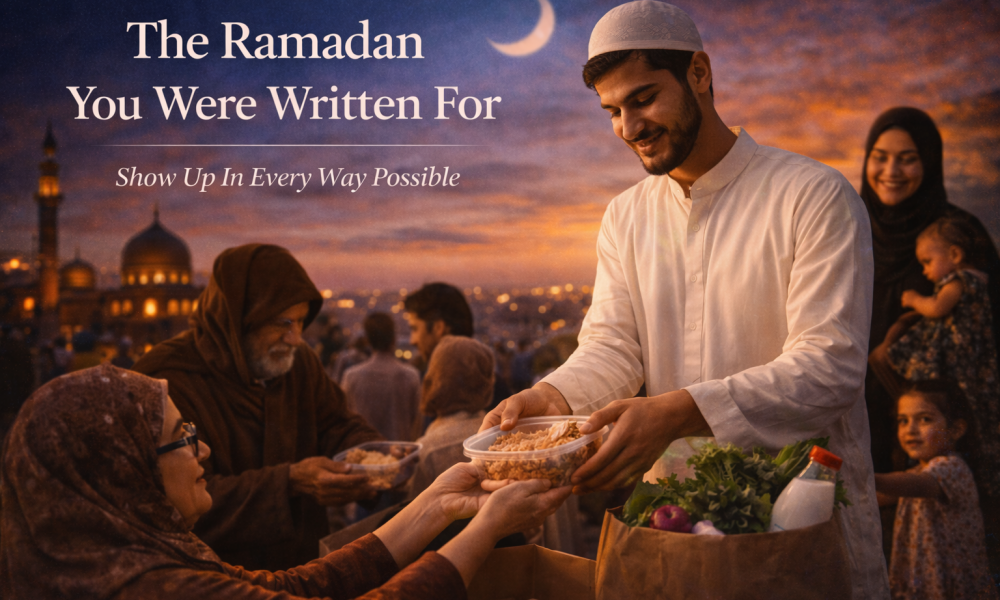
You could die before it arrives.
This is not morbid. This is the mathematics of existence that every Muslim knows but rarely speaks aloud. Last Ramadan, people prayed beside you who are now beneath the earth. They had grocery lists for this year. They had plans. They assumed, as you are assuming now, that another Ramadan was guaranteed.
It was not.
Keep supporting MuslimMatters for the sake of Allah
Alhamdulillah, we’re at over 850 supporters. Help us get to 900 supporters this month. All it takes is a small gift from a reader like you to keep us going, for just $2 / month.
The Prophet (SAW) has taught us the best of deeds are those that done consistently, even if they are small.
Click here to support MuslimMatters with a monthly donation of $2 per month. Set it and collect blessings from Allah (swt) for the khayr you’re supporting without thinking about it.
And so, before we discuss iftars and taraweeh schedules and Quran khatm goals, before we debate moon sightings and prayer times and which masjid has the best qari, we must begin with the only truth that matters: you are not promised this Ramadan. If you reach it, you reach it because Allah  extended your breath that far. Every fast you complete is a gift you did not earn. Every prayer you stand for is borrowed time being spent on its only worthy purchase.
This is not meant to frighten you. It is meant to wake you up.
Because here is what follows from this truth: Allah has already written your Ramadan. The rizq you will receive, the worship you will be granted the ability to perform, the sins you will be protected from or fall into, the tears you will cry, and the prayers that will be answered. All of it inscribed by a Hand far wiser than yours. Your task is not to engineer a perfect Ramadan. Your task is to show up for the one you were written for.
The Great Surfacing
Ramadan has a way of drawing Muslims out from everywhere. It is perhaps the only month where the ummah becomes geographically visible to itself.
Parking lots at masajid overflow. Shoes pile up at entrances in quantities that would alarm a fire marshal. The younger sisters appear in abayas and dresses that spark whispered debates among the elders. The younger brothers walk in wearing crisp thobs, smelling of oud and cologne, looking halfway between piety and a fashion shoot. People who haven’t prayed in congregation for eleven months suddenly materialize in the front rows.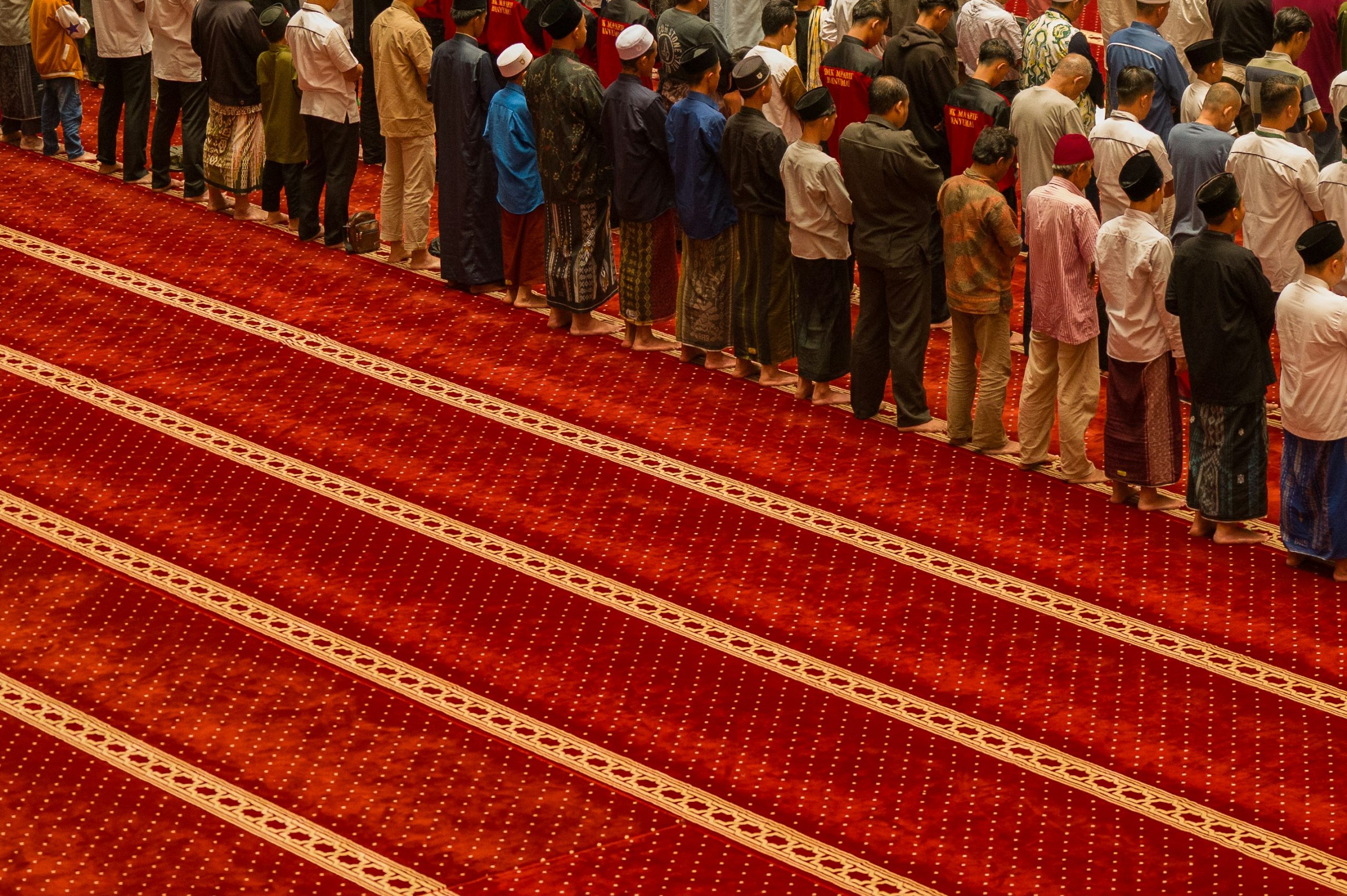
And before you let judgment creep into your heart, before you think “Ramadan Muslims,” remember: Allah
This surfacing is one of Ramadan’s quiet miracles. The ummah, scattered and fragmented for most of the year, suddenly remembers it is one body. For thirty days, we eat together, fast together, pray together, and break together. The isolation of modern Muslim life temporarily lifts.
The Interior Architecture
There is something outsiders cannot see: the interior architecture of a fasting day.
There is the body shock of the first few days. The headaches. The fog that descends around 2pm and refuses to lift. Your body, accustomed to its constant inputs, protests. And then, for most, adaptation. The hunger becomes background noise. You discover reserves you forgot you had. You realize how much of your eating was never really about need.
Suhoor is not simply a meal. What you consume before dawn will either carry you or collapse under you. This is not unspiritual. The Prophet ﷺ told us there is blessing in suhoor. He ﷺ did not romanticize unnecessary suffering.
The Two Ledgers
Here is where we must be honest with ourselves.
Ramadan amplifies. Whatever you were doing before, you will likely do more of it now. If you were someone who prayed, read Quran, and gave charity, Ramadan will pour fuel on that fire. If you were someone who gossiped, slandered, and wasted time, Ramadan does not automatically interrupt those patterns.
The same ummah that comes together for taraweeh also comes together to discuss who is marrying whom, whose children are failing, whose faith seems performative. The post-iftar gathering can be a garden of remembrance or a swamp of backbiting. Often, tragically, it is both.
The fasting of the stomach is the easy part. The fasting of the tongue, the eyes, the ears: this is where most of us fail. I include myself in that “us.” I am not writing from above the struggle. I am writing from within it. And yet the Prophet ﷺ told us clearly:
“Whoever does not give up false speech and acting upon it, Allah has no need of his giving up food and drink.”1
Your Ramadan is not measured in calories avoided. It is measured in what you choose to consume and produce in other ways.
Where Do You Stand?
Ramadan, if you let it, will show you exactly where you are. Not where you think you are. Not where you tell others you are. Where you actually are.
When you stand in the masjid for taraweeh, what is your experience? Some people pray all twenty rakats and feel their souls lifted. Others leave after four, or eight, and carry guilt about it.
But let us be careful here. Some people get overwhelmed easily in crowded spaces. Some have ADHD and find it nearly impossible to stay still for extended periods, their bodies screaming to move while their hearts want to remain. Some are hunted by intrusive thoughts that ambush them the moment they try to focus, turning every rakat into a battle they did not choose. Some listen to the Quran being recited and feel nothing, no connection, no khushu, just words washing over them while they wonder what is wrong with them.
These struggles are real. They are not excuses. They are the specific tests Allah has written for specific people. The person who stays for four rakats while fighting their own mind may be exerting more effort than the one who breezes through twenty. Only Allah knows what each prayer costs the one praying it.
And Ramadan does not pause the dunya. Exams still happen. Work deadlines still loom. The Western calendar does not bend for the Islamic one. This is hard. Do not let anyone tell you it is not hard. And yet this too was written for you. What is asked of you is not perfection. What is asked is presence.
So the question is: are you honest with yourself about where you are? Are you showing up with whatever capacity you have, even when that capacity feels pathetically small? There is no condemnation in these questions. There is only clarity. And clarity, however uncomfortable, is a mercy.
The Loneliness No One Mentions
We must talk about this.
Ramadan, for all its communal beauty, can be devastatingly lonely.

Not everyone experiences the communal beauty that comes with Ramadan.
If you have a spouse, children, a household that fasts together and prays together and breaks bread together, Ramadan feels like coming home. The table is full. Suhoor is someone gently waking you. Iftar is noise and laughter and small hands reaching for samosas before the adhan finishes.
But not everyone has this.
There are students far from home, breaking fast alone in dorms and studio apartments, the adhan playing from their phones because there is no one to say “Allahu Akbar” with. There are singles who watch families pour into the masjid while they sit alone on the edges, wondering if anyone sees them. There are converts whose biological families do not understand, who hide their fasting at work because explaining feels exhausting.
There are the poor. And we must speak of the poor specifically.
There are people who come to the masjid iftar not for community, but because it is the most reliable meal they will have. And some of them take extra food to go. They fill containers. They wrap things in napkins. And they feel eyes on them. They sense the judgment of those who have never known what it is to be uncertain about tomorrow’s food.
Let this be very clear: if someone takes extra food from a community iftar, that is between them and Allah . Your job is to make sure there is enough to take. Your job is to make taking it feel dignified, not shameful. The Prophet ﷺ fed people. He did not audit them.
If you are not one of these people, you have been given something. Do not mistake comfort for virtue.
The Assignment
Whatever else you plan for this Ramadan, the Quran khatm, the taraweeh attendance, the dua lists, the charity goals, add one thing that requires nothing but intention:
Help at least one person.
Not an organization. Not a cause. A person. A specific human being whose Ramadan becomes easier because you existed in it.
Maybe it is the brother who always sits alone. You sit with him. Maybe it is the single mother struggling to manage children during taraweeh. You watch them for one night. Maybe it is the student who cannot afford iftar groceries. You fill their fridge quietly, without announcement, without expecting thanks. Maybe it is someone at your own table who is drowning, and you never noticed.
The Prophet ﷺ said:
“Whoever provides iftar for a fasting person will have a reward like his, without anything being diminished from the reward of the fasting person.”2
But I think the deeper wisdom is this: Ramadan is not a solo endeavor. It was never meant to be. We are an ummah. We fast together, not merely at the same time but for one another.
The Ramadan You Were Written For
You do not know what this Ramadan holds. You do not know if you will reach its end. You do not know which night will be Laylat al-Qadr, which dua will be answered, which prostration will change everything.
You do not know. And this is the point.
So, enter this month not as an architect but as a guest. Accept what is given. Show up for what is asked. Forgive yourself when you fall short. Return, again and again, to the One who invited you here.
I will be trying to do the same. I do not know where I stand. I fluctuate. I falter. But I want good for you the way I want it for myself, and I ask Allah to help us both.
May Allah make it your best Ramadan yet. Not by your definition of best, but by His.
Ameen
Related:
– Expect Trials This Ramadan…As There Should Be I Ust. Justin Parrott
– The Architecture of Withholding: When Charity Becomes Control