
At any given moment, 89,000 terawatts of solar power hits the Earth’s surface. While significant advancements have been made in harvesting this power, existing technologies do not capture the full potential of the entire solar spectrum. This limitation primarily lies in these technologies’ incomplete absorption of the sun’s ultraviolet, visible, and infrared radiation.
A team of researchers at KU-KIST Graduate School of Converging Science and Technology, Seoul, has now reported a way of absorbing nearly the full usable solar spectrum in thermal-based devices, using self-assembling gold nanospheres called plasmonic colloidal supraballs.
Solar radiation spans ultraviolet (50-55%), visible (40-45%), and infrared (3-5%) wavelengths. Photovoltaic (PV) cells primarily convert visible light and part of the near-infrared spectrum into electricity, leaving much of the remaining energy untapped. Concentrated solar systems collect broader wavelengths using mirrors, but require large-scale infrastructure and still depend on receiver materials that are not perfectly absorbing. Solar-thermal collectors absorb visible and infrared light relatively well, yet their efficiency is constrained by surface coatings that rarely achieve near-total absorption.
This is where the plasmonic supraballs come in.
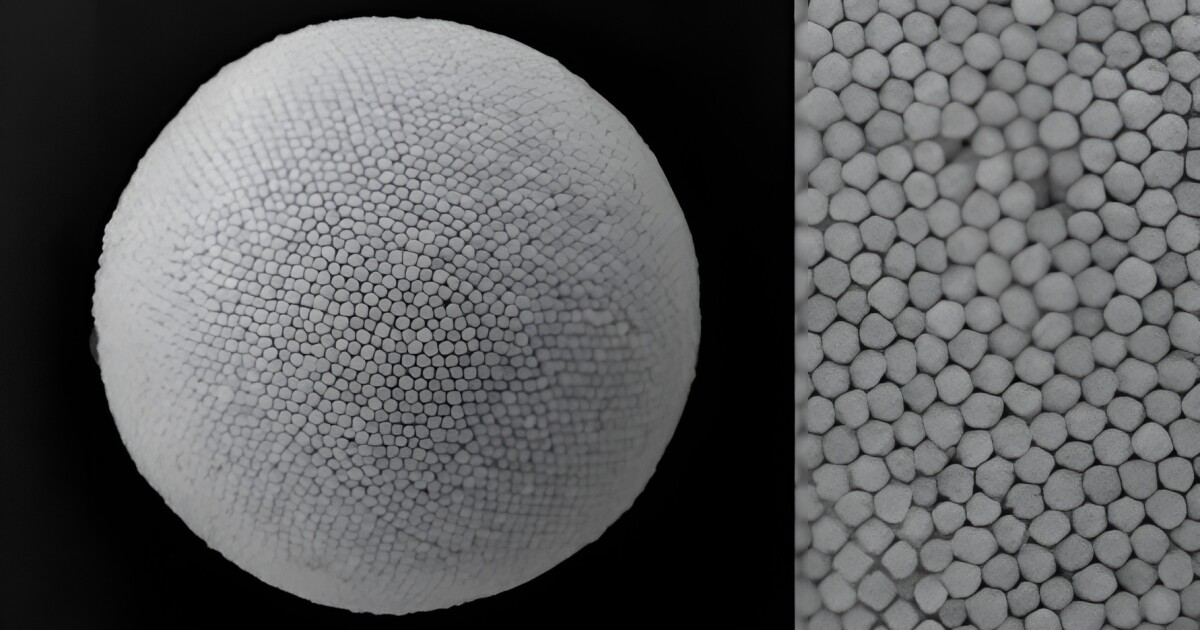
The new technology starts as a colloidal suspension of gold nanoparticles, which self-assemble into micrometer-scale spheres in solution. Thousands of nanoparticles cluster together to form “supraballs” and the liquid is then drop-cast onto the ceramic surface of a thermoelectric generator, forming a dense, textured film that efficiently captures sunlight.
Conventional gold nanoparticle films and dielectric absorber coatings do already exist that can increase light absorption in specific wavelength ranges and reduce heat re-radiation. However, the often suffer from limited infrared absorption, angular sensitivity, high manufacturing costs, and thermal degradation over long-term thermal exposure.
Plasmonic supraballs work differently. Localized surface plasmon resonances (LSPR) at the nanoparticle surfaces, combined with Mie-type resonances within the spheres, trap photons across UV, visible, and near-infrared wavelengths, converting much of this energy into heat. This results in ~90% absorption across the solar spectrum, significantly improving thermal energy capture and creating a stronger temperature gradient that ultimately generates nearly 2.4 times the power output of conventional nanoparticle coatings.
The team, comprising Jaewon Lee, Seungwoo Lee, and Kyung Hun Rho, published their research in the journal ACS Applied Materials & Interfaces.
It is important to note that the plasmonic supraball technology is primarily designed for thermal-based solar systems, such as thermoelectric solar generators (TEG systems), solar-thermal collectors, and thermal management and passive heating systems. They could also play a role in hybrid PV-thermal (PVT) systems where visible light is converted to electricity by PV cells, and remaining wavelengths are harvested as heat.
“Our plasmonic supraballs offer a simple route to harvesting the full solar spectrum,” says Seungwoo Lee. “Ultimately, this coating technology could significantly lower the barrier for high-efficiency solar-thermal and photothermal systems in real-world energy applications.”
Beyond performance, another major appeal of the technology is its practicality. The supraballs require low-complexity fabrication and application via solution processing. Furthermore, the technology is compatible with existing, commercially available devices.
Source: American Chemical Society