
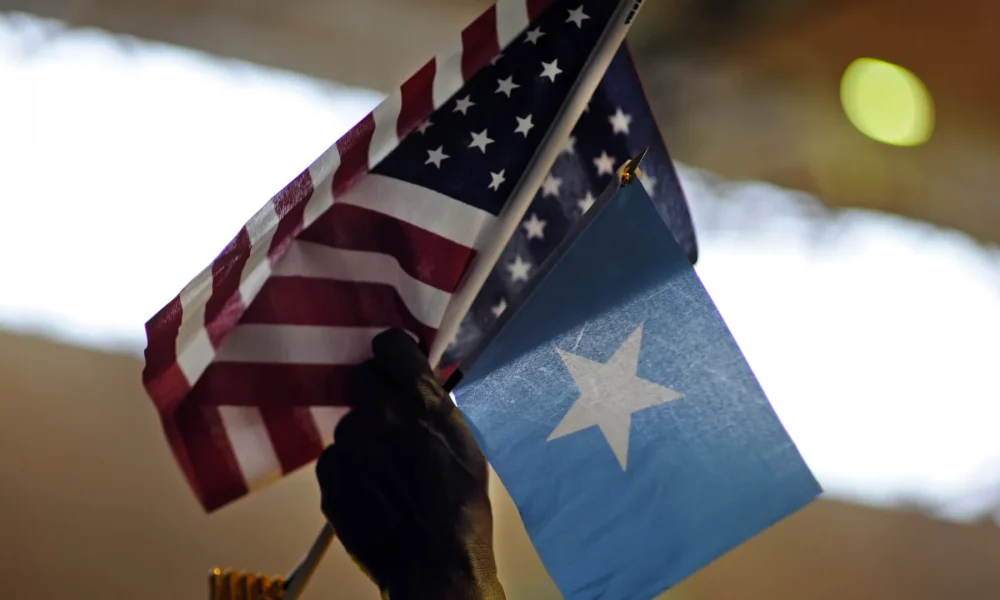
Ranked among the many issues for which the winter of 2025-26 might be remembered in the United States – ranging from explosive exposes of abusive tycoons linked to a country whose genocide of Palestine Washington has long supported, to a regime-change raid in Venezuela, to sabre-rattling over Greenland – is the conduct and controversy of its immigration enforcement agency, commonly known as ICE, particularly in Minnesota. And central to the Minnesota operation has been a long-running smear campaign against Somalis by the American right wing.
Somalis as an Easy Target
Although their narratives have been bubbling for several years among the far-right, misinformation and hate-mongering toward Somalis in the United States came to international attention in December 2025 when the immigration enforcement militia descended on Minnesota and promptly began to arrest thousands of people, supposedly on suspicion of illegal immigration. Somalis have in particular been targeted by Donald Trump’s regime, whose officials have recklessly flung around accusations of scams against Somalis at large.
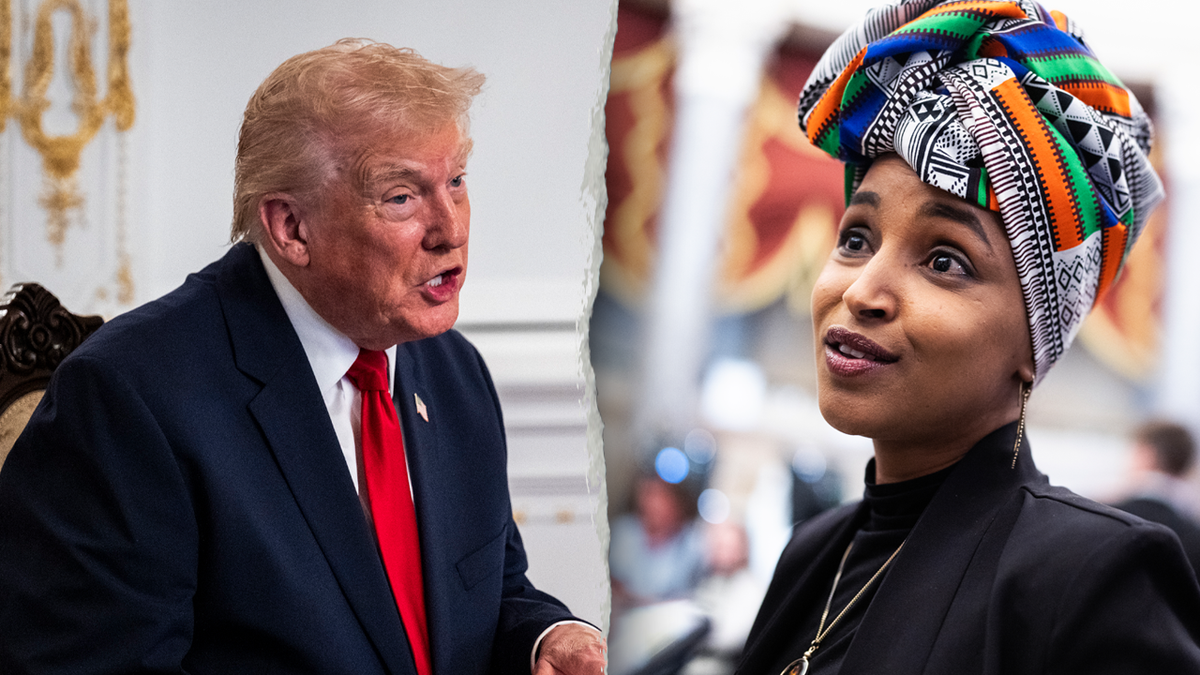
The American far-right has a history of targeting one minority after another – Mexicans, infamously, were an early target of choice during Trump’s first electoral campaign a decade ago – and the needle has swung to Somalis. But their status as a visible and distinctive minority is not the only reason that Somali-Americans have been targeted with special venom. Somalis simultaneously tick several boxes for the far-right and the various networks, influencers, and rabble-rousers who incite them. For one thing, Somalis are overwhelmingly Muslims; for another, they are quite distinctly black Africans. Thirdly, the Minnesotan politician Ilhan Omar, from the liberal opposition, has been a favourite target of the right-wing since she was elected in 2019. Fourthly, Minnesota’s governor, Timothy Walz, was the opposition’s vice-presidential nominee in the last election, and the government has made a point of attacking him: to claim that Minnesota is drowning in Somali fraud implicates Walz as well.
Keep supporting MuslimMatters for the sake of Allah
Alhamdulillah, we’re at over 850 supporters. Help us get to 900 supporters this month. All it takes is a small gift from a reader like you to keep us going, for just $2 / month.
The Prophet (SAW) has taught us the best of deeds are those that done consistently, even if they are small.
Click here to support MuslimMatters with a monthly donation of $2 per month. Set it and collect blessings from Allah (swt) for the khayr you’re supporting without thinking about it.
“Minnesotan politician Ilhan Omar, from the liberal opposition, has been a favourite target of the right-wing since she was elected in 2019.”
The Somalia War and the United States
Beyond internecine American politics, however, there are also broader geopolitical and institutional issues. Somalia carries popular connotations of state failure and militia anarchy owing to the civil war of the 1990s. More recently, the United States has been heavily involved in Somalia’s war, mainly but not exclusively through regular airstrikes that peaked under Trump’s first tenure. The American role in this war is rarely mentioned or debated at home, and this makes it easy for the far-right to target Somali diasporas as opportunistic “aliens”.
Somalia was famously labelled the world’s first “failed state” in the 1990s, after a longstanding military dictatorship armed to the teeth by Washington was ousted. Supposedly in order to relieve a famine – which, in fact, had largely passed by the time they deployed – American soldiers were sent at the helm of a United Nations mission to Somalia, where they proved entirely incapable of appreciating, let alone navigating, the war’s fractious politics, which they only exacerbated with their imperious and frequently gung-ho attitude.
The United Nations secretary-general Boutros Boutros-Ghali – a pro-American former foreign minister of Egypt – was unsatisfied with famine relief and intended to make the mission an example of United Nations jurisdiction backed up by American power. In fact, the leaders of the original famine relief mission, Algerian diplomat Mohamed Sahnoun and Pakistani commander Imtiaz Shaheen, resigned in disgust, Shaheen describing the attitude toward Somalia as that of an opportunistic scientist trying to test a vaccine on an animal. Boutros-Ghali’s dismissive arrogance toward the region, especially toward Somalia’s most powerful militia commander, Farah Aidid, was shared by the American admiral in charge of the mission, Jonathan Howe.
Pithily nicknamed “Animal Howe” rather than “Admiral Howe” by Somali detractors, Howe’s incompetence only exacerbated Somali polarization, while both American and other United Nations soldiers were frequently guilty of abuses and gratuitous brutality, with the Habirgidir clan in Mogadishu a particular target. Though by the conservative guess of its own military, American bombardment killed some three thousand Somalis over the course of the year, the abiding memory of the campaign was the killing of eighteen American soldiers, several of whose corpses were dragged through the streets, by Somali militants in the October 1993 Battle of Mogadishu. With no attention to the wider context or the much greater human cost borne by the Somalis, Somalia was myopically recalled in the United States as a case of barbaric ingratitude for a relief mission.
However, the 1993 campaign was only the first chapter in a long American military involvement in Somalia. During the 2000s, the United States funded a number of predatory militias to hunt down Islamists as part of its “war on terror”, and in 2006, this backfired when the Islamists captured Mogadishu. Thereafter, the United States not only ousted the Islamists with a military invasion, largely conducted through airstrikes and commandos, but did so in league with Somalia’s “Auld Enemy” Ethiopia – an aspiring regional hegemon whose rivalry with Somalia is akin to that between India and Pakistan, between China and Taiwan, or between the two Koreas.
During the late 2000s, many Somalis from the diaspora fought in the subsequent insurgency against the invasion. The most prominent insurgent faction, Shabaab, actively urged foreign and diaspora Muslims to join its campaign: in turn, American “counterterrorism” agencies increasingly focused on Somali-Americans during this period. The United States is therefore closely intertwined with the Somali war: American airpower and diplomacy have been key ingredients in a twenty-year occupation, while Shabaab appeals have prompted increased institutional scrutiny on Somali-Americans long before Trump came to power.
None of this history is countenanced, let alone appreciated, by America’s far-right: instead, Somalis, like other minorities, are treated in racist logic as “Third Worlders” genetically predisposed to make a mess of whatever country they visit. This has been amplified by the attempts of pro-Israel influencers, who have whipped up smear campaigns against many Muslim populations in North America and the United States: in the United States, Somalis have become a favoured target for far-right networks both linked to Israel and not, including those to which Trump is keenest to pander.
Theatrics and Diversions in Minnesota’s Winter of Discontent
Trump, and the American right wing at large, have long set deportations of alleged “illegals” as an unabashed aim. Mass deportations of illegal immigrants are hardly a novelty in American politics; Trump’s gleefully menacing “Border Czar” Tom Homan cut his teeth under the Democratic regime of Barack Obama. What is newer is the blatant politicization, undisguised ethnic profiling, and unrestrained glee, often crossing the line into sadism, that is involved in crackdowns. Over seventy thousand people across the United States have been arrested, frequently in galling conditions, on evidence that is usually thin where it exists at all: over four thousand of these have fallen prey to the grandly announced Minnesota crackdown, where masked “ICE” agents were joined by border patrollers with a similarly cavalier attitude toward such inconveniences as trigger discipline or proof of guilt.
This attitude was on show when masked agents shot dead, on camera, two civilians without provocation and were blamed by officials as senior as Trump’s blustery deputy James Vance for their own murders. It was also on display when Somali-American driver Ahmed bin-Hassan was accosted in his car at work by over a dozen agents who demanded his documentation. With a cool and cheeky, almost mocking humour, remarkable given that a civilian had already recently been killed by federal agents, bin-Hassan challenged the agents.
“‘Can I see your identity?’” he asked, echoing an agent’s question. “Why the hell would I show random people my ID? You want to steal my identity? Where’s your ID? Let me check if you’re a US citizen, how about that? Hey, you guys better move on, man.” Noticing their Border Patrol insignia, he added, “Dude, listen. I’m here working, you’re working too, right? So go, it says ‘U.S. Border Patrol’, this is not the border. Go to the Canada border or the Mexico border. I’m working, dude.”
Bewildered by this uncommon commonsense defiance, the agents pointed out his Somali accent, as if different accents in a multiethnic country were an indication of guilt. “Oh, so you going by accents now? Is that what it is? Is that an accent? Have you heard the Israeli accent? Have you heard the European accent? It’s garbage.”
As the faltering agents continued to hover, bin-Hassan held firm. “I’m not gonna show you, I don’t have to show you anything. If a police officer comes here, I’ll comply with it, but you, as Border Patrol, I don’t even know if you’re a real police officer. Where’s your ID? Where’s your ID?” Referring to the nameless labels that the officers wore, he added, “And I’m not gonna go by C20. That’s a, that’s a periodic chemical, that’s a periodic element. C20? What are you, Cobalt 20?”
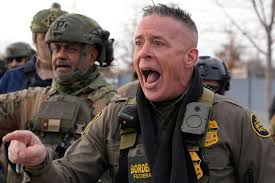
Border police commander Greg Bovino
Matters reached such a stage that the bewildered agents were forced to call in a man without a mask, their commander Gregory Bovino – who, with his longcoat and crewcut, has swaggered at the centre of the crackdown controversy- was called in, but the Somali-American driver held his ground.
Bovino’s attempts at intimidation have often backfired, but his officers have presented a real threat: he has been known to protect and encourage even officers with blood on their hands. His theatrics eventually earned such ire that he was sidelined in favour of Homan himself.
But none of this suggests respite for Minnesota or for Somali-Americans. Under pressure for links with notorious pedophile and child-trafficker Jeffrey Epstein, a key node in pro-Israel and anti-Muslim networks, and his regime’s refusal to release Epstein’s files without redaction, Trump has continued to lash out at both Somalia and Somali-Americans, and reached for a favourite target in Omar. The Somali government, with the exception of outspoken defence minister Ahmed Fiqi, has been subdued; Omar, though, finally snapped back, “The leader of the Pedophile Protection Party is trying to deflect attention from his name being all over the Epstein files.”
The deeper Trump sinks in the mire, the more he can be expected to attack Somalis as red meat for his supporters. Even more, however, there is no indication that Somali Americans will back down.
Related:
– Op-Ed: Bitterness Prolonged – A Short History Of The Somaliland Dispute
– Op-Ed: Understanding The Somaliland Recognition Decision – A Counterargument To The Prevailing Muslim Consensus