


Horses whinny by making sounds in a unique way that is not seen in other animals
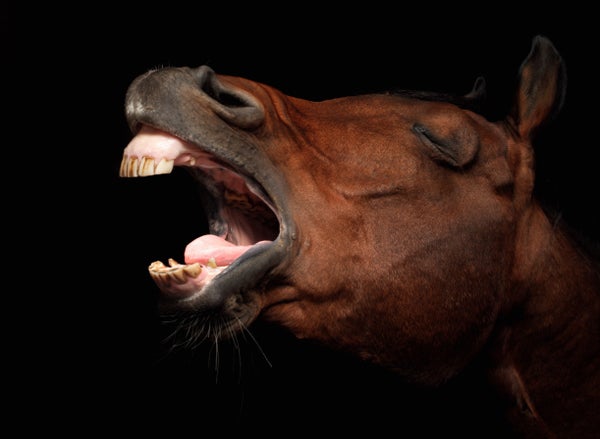
The distinctive sound horses produce when they whinny is created by combining low and high pitch sounds together, like grunting and whistling at the same time
martin gallagher/Getty Images
How horses whinny has long been a mystery. The sound is quite distinct from any other in the animal kingdom. And now scientists think they’ve discovered why: horses whinny by producing sounds at two frequencies at the same time—much like singing and whistling simultaneously.
The findings, which were published on Monday in Current Biology, suggest horses produce sounds at two frequencies in two distinct ways in their larynx, or voice box. A low-frequency sound of about 200 hertz is produced by vibrating the vocal cords, just as we do while singing. And a high-frequency sound of more than 1,000 hertz is produced by whistling within the larynx.
“We now finally know how the two fundamental frequencies that make up a whinny are produced by horses,” said Élodie Briefer, an associate professor in the department of ecology and evolution at the University of Copenhagen and a co-author of the paper, in a statement.
On supporting science journalism
If you’re enjoying this article, consider supporting our award-winning journalism by subscribing. By purchasing a subscription you are helping to ensure the future of impactful stories about the discoveries and ideas shaping our world today.
In general, the larger an animal—and its larynx—is, the lower the frequency of sound it produces. Meanwhile smaller critters, such as mice, produce high-frequency whistles. But this study suggests that horses are unique in their ability to whistle and vibrate their vocal cords at the same time, the authors write.
“This is going to be a landmark paper in terms of stimulating research into vocalizations in equids,” said Sue McDonnell, an adjunct professor of reproduction and behavior at the University of Pennsylvania, who was not involved in the research, to the New York Times.
The results support a theory that horses may have evolved to communicate multiple messages in a single vocalization, the study authors write.
“In the past, we found that these two frequencies are important for horses, as they convey different messages about the horses’ own emotions,” Briefer said in the same statement. “We now have compelling evidence that they are also produced through distinct mechanisms.”
It’s Time to Stand Up for Science
If you enjoyed this article, I’d like to ask for your support. Scientific American has served as an advocate for science and industry for 180 years, and right now may be the most critical moment in that two-century history.
I’ve been a Scientific American subscriber since I was 12 years old, and it helped shape the way I look at the world. SciAm always educates and delights me, and inspires a sense of awe for our vast, beautiful universe. I hope it does that for you, too.
If you subscribe to Scientific American, you help ensure that our coverage is centered on meaningful research and discovery; that we have the resources to report on the decisions that threaten labs across the U.S.; and that we support both budding and working scientists at a time when the value of science itself too often goes unrecognized.
In return, you get essential news, captivating podcasts, brilliant infographics, can’t-miss newsletters, must-watch videos, challenging games, and the science world’s best writing and reporting. You can even gift someone a subscription.
There has never been a more important time for us to stand up and show why science matters. I hope you’ll support us in that mission.