
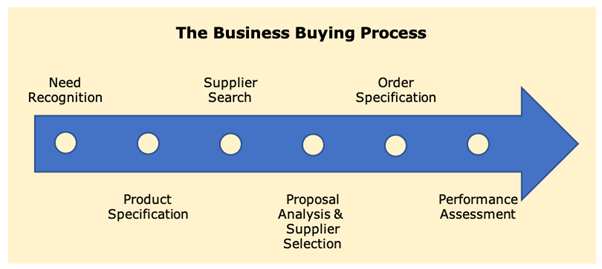
Imagine this: you’re building a scheduling tool.
If you’re selling to companies, your first real customer is a 40-person agency. You start realizing that a small UI tweak can affect three roles within the same account. Roadmap decisions begin to revolve around stability, depth, and making sure nothing feels half-built.
Now imagine the same core product, but it’s aimed at individual creators managing their own work. Nobody is asking about billing exports. Instead, you notice that most users create one board and then stop. You interview customers and realize you may have to simplify templates, add guided setup, and surface examples.
Product management in a startup rarely feels neat. It’s part pattern-spotting, part gut instinct, part damage control.
At its core, you’re trying to answer a simple question: what should we build next, and why? But that question lands differently depending on who you’re building for.
B2B pulls you toward depth, integration, and reliability, while B2C pushes you toward speed and clarity.
In both worlds, you’re trying to understand what actually moves the needle instead of chasing noise. You’re deciding what to ignore.
Whether you’re building for enterprise buyers or individual users, understanding these structural differences helps you make cleaner decisions and avoid borrowing the wrong playbook.
#mc_embed_signup{background:#fff; false;clear:left; font:14px Helvetica,Arial,sans-serif; width: 600px;}
/* Add your own Mailchimp form style overrides in your site stylesheet or in this style block.
We recommend moving this block and the preceding CSS link to the HEAD of your HTML file. */
Sign Up for The Start Newsletter
(function($) {window.fnames = new Array(); window.ftypes = new Array();fnames[0]=’EMAIL’;ftypes[0]=’email’;fnames[1]=’FNAME’;ftypes[1]=’text’;fnames[2]=’LNAME’;ftypes[2]=’text’;fnames[3]=’ADDRESS’;ftypes[3]=’address’;fnames[4]=’PHONE’;ftypes[4]=’phone’;fnames[5]=’MMERGE5′;ftypes[5]=’text’;}(jQuery));var $mcj = jQuery.noConflict(true);
// SMS Phone Multi-Country Functionality
if(!window.MC) {
window.MC = {};
}
window.MC.smsPhoneData = {
defaultCountryCode: ‘US’,
programs: [],
smsProgramDataCountryNames: []
};
function getCountryUnicodeFlag(countryCode) {
return countryCode.toUpperCase().replace(/./g, (char) => String.fromCodePoint(char.charCodeAt(0) + 127397))
};
// HTML sanitization function to prevent XSS
function sanitizeHtml(str) {
if (typeof str !== ‘string’) return ”;
return str
.replace(/&/g, ‘&’)
.replace(//g, ‘>’)
.replace(/”/g, ‘"’)
.replace(/’/g, ‘'’)
.replace(/\//g, ‘/’);
}
// URL sanitization function to prevent javascript: and data: URLs
function sanitizeUrl(url) {
if (typeof url !== ‘string’) return ”;
const trimmedUrl = url.trim().toLowerCase();
if (trimmedUrl.startsWith(‘javascript:’) || trimmedUrl.startsWith(‘data:’) || trimmedUrl.startsWith(‘vbscript:’)) {
return ‘#’;
}
return url;
}
const getBrowserLanguage = () => {
if (!window?.navigator?.language?.split(‘-‘)[1]) {
return window?.navigator?.language?.toUpperCase();
}
return window?.navigator?.language?.split(‘-‘)[1];
};
function getDefaultCountryProgram(defaultCountryCode, smsProgramData) {
if (!smsProgramData || smsProgramData.length === 0) {
return null;
}
const browserLanguage = getBrowserLanguage();
if (browserLanguage) {
const foundProgram = smsProgramData.find(
(program) => program?.countryCode === browserLanguage,
);
if (foundProgram) {
return foundProgram;
}
}
if (defaultCountryCode) {
const foundProgram = smsProgramData.find(
(program) => program?.countryCode === defaultCountryCode,
);
if (foundProgram) {
return foundProgram;
}
}
return smsProgramData[0];
}
function updateSmsLegalText(countryCode, fieldName) {
if (!countryCode || !fieldName) {
return;
}
const programs = window?.MC?.smsPhoneData?.programs;
if (!programs || !Array.isArray(programs)) {
return;
}
const program = programs.find(program => program?.countryCode === countryCode);
if (!program || !program.requiredTemplate) {
return;
}
const legalTextElement = document.querySelector(‘#legal-text-‘ + fieldName);
if (!legalTextElement) {
return;
}
// Remove HTML tags and clean up the text
const divRegex = new RegExp(‘]*>’, ‘gi’);
const fullAnchorRegex = new RegExp(‘<a.*?', 'g');
const anchorRegex = new RegExp('(.*?)‘);
const template = program.requiredTemplate.replace(divRegex, ”);
legalTextElement.textContent=””;
const parts = template.split(/(.*?)/g);
parts.forEach(function(part) {
if (!part) {
return;
}
const anchorMatch = part.match(/(.*?)/);
if (anchorMatch) {
const linkElement = document.createElement(‘a’);
linkElement.href = sanitizeUrl(anchorMatch[1]);
linkElement.target = sanitizeHtml(anchorMatch[2]);
linkElement.textContent = sanitizeHtml(anchorMatch[3]);
legalTextElement.appendChild(linkElement);
} else {
legalTextElement.appendChild(document.createTextNode(part));
}
});
}
function generateDropdownOptions(smsProgramData) {
if (!smsProgramData || smsProgramData.length === 0) {
return ”;
}
return smsProgramData.map(program => {
const flag = getCountryUnicodeFlag(program.countryCode);
const countryName = getCountryName(program.countryCode);
const callingCode = program.countryCallingCode || ”;
// Sanitize all values to prevent XSS
const sanitizedCountryCode = sanitizeHtml(program.countryCode || ”);
const sanitizedCountryName = sanitizeHtml(countryName || ”);
const sanitizedCallingCode = sanitizeHtml(callingCode || ”);
return ” + sanitizedCountryName + ‘ ‘ + sanitizedCallingCode + ”;
}).join(”);
}
function getCountryName(countryCode) {
if (window.MC?.smsPhoneData?.smsProgramDataCountryNames && Array.isArray(window.MC.smsPhoneData.smsProgramDataCountryNames)) {
for (let i = 0; i < window.MC.smsPhoneData.smsProgramDataCountryNames.length; i++) {
if (window.MC.smsPhoneData.smsProgramDataCountryNames[i].code === countryCode) {
return window.MC.smsPhoneData.smsProgramDataCountryNames[i].name;
}
}
}
return countryCode;
}
function getDefaultPlaceholder(countryCode) {
if (!countryCode || typeof countryCode !== 'string') {
return '+1 000 000 0000'; // Default US placeholder
}
var mockPlaceholders = [
{
countryCode: 'US',
placeholder: '+1 000 000 0000',
helpText: 'Include the US country code +1 before the phone number',
},
{
countryCode: 'GB',
placeholder: '+44 0000 000000',
helpText: 'Include the GB country code +44 before the phone number',
},
{
countryCode: 'CA',
placeholder: '+1 000 000 0000',
helpText: 'Include the CA country code +1 before the phone number',
},
{
countryCode: 'AU',
placeholder: '+61 000 000 000',
helpText: 'Include the AU country code +61 before the phone number',
},
{
countryCode: 'DE',
placeholder: '+49 000 0000000',
helpText: 'Fügen Sie vor der Telefonnummer die DE-Ländervorwahl +49 ein',
},
{
countryCode: 'FR',
placeholder: '+33 0 00 00 00 00',
helpText: 'Incluez le code pays FR +33 avant le numéro de téléphone',
},
{
countryCode: 'ES',
placeholder: '+34 000 000 000',
helpText: 'Incluya el código de país ES +34 antes del número de teléfono',
},
{
countryCode: 'NL',
placeholder: '+31 0 00000000',
helpText: 'Voeg de NL-landcode +31 toe vóór het telefoonnummer',
},
{
countryCode: 'BE',
placeholder: '+32 000 00 00 00',
helpText: 'Incluez le code pays BE +32 avant le numéro de téléphone',
},
{
countryCode: 'CH',
placeholder: '+41 00 000 00 00',
helpText: 'Fügen Sie vor der Telefonnummer die CH-Ländervorwahl +41 ein',
},
{
countryCode: 'AT',
placeholder: '+43 000 000 0000',
helpText: 'Fügen Sie vor der Telefonnummer die AT-Ländervorwahl +43 ein',
},
{
countryCode: 'IE',
placeholder: '+353 00 000 0000',
helpText: 'Include the IE country code +353 before the phone number',
},
{
countryCode: 'IT',
placeholder: '+39 000 000 0000',
helpText: 'Includere il prefisso internazionale IT +39 prima del numero di telefono',
},
];
const selectedPlaceholder = mockPlaceholders.find(function(item) {
return item && item.countryCode === countryCode;
});
return selectedPlaceholder ? selectedPlaceholder.placeholder : mockPlaceholders[0].placeholder;
}
function updatePlaceholder(countryCode, fieldName) {
if (!countryCode || !fieldName) {
return;
}
const phoneInput = document.querySelector('#mce-' + fieldName);
if (!phoneInput) {
return;
}
const placeholder = getDefaultPlaceholder(countryCode);
if (placeholder) {
phoneInput.placeholder = placeholder;
}
}
function updateCountryCodeInstruction(countryCode, fieldName) {
updatePlaceholder(countryCode, fieldName);
}
function getDefaultHelpText(countryCode) {
var mockPlaceholders = [
{
countryCode: 'US',
placeholder: '+1 000 000 0000',
helpText: 'Include the US country code +1 before the phone number',
},
{
countryCode: 'GB',
placeholder: '+44 0000 000000',
helpText: 'Include the GB country code +44 before the phone number',
},
{
countryCode: 'CA',
placeholder: '+1 000 000 0000',
helpText: 'Include the CA country code +1 before the phone number',
},
{
countryCode: 'AU',
placeholder: '+61 000 000 000',
helpText: 'Include the AU country code +61 before the phone number',
},
{
countryCode: 'DE',
placeholder: '+49 000 0000000',
helpText: 'Fügen Sie vor der Telefonnummer die DE-Ländervorwahl +49 ein',
},
{
countryCode: 'FR',
placeholder: '+33 0 00 00 00 00',
helpText: 'Incluez le code pays FR +33 avant le numéro de téléphone',
},
{
countryCode: 'ES',
placeholder: '+34 000 000 000',
helpText: 'Incluya el código de país ES +34 antes del número de teléfono',
},
{
countryCode: 'NL',
placeholder: '+31 0 00000000',
helpText: 'Voeg de NL-landcode +31 toe vóór het telefoonnummer',
},
{
countryCode: 'BE',
placeholder: '+32 000 00 00 00',
helpText: 'Incluez le code pays BE +32 avant le numéro de téléphone',
},
{
countryCode: 'CH',
placeholder: '+41 00 000 00 00',
helpText: 'Fügen Sie vor der Telefonnummer die CH-Ländervorwahl +41 ein',
},
{
countryCode: 'AT',
placeholder: '+43 000 000 0000',
helpText: 'Fügen Sie vor der Telefonnummer die AT-Ländervorwahl +43 ein',
},
{
countryCode: 'IE',
placeholder: '+353 00 000 0000',
helpText: 'Include the IE country code +353 before the phone number',
},
{
countryCode: 'IT',
placeholder: '+39 000 000 0000',
helpText: 'Includere il prefisso internazionale IT +39 prima del numero di telefono',
},
];
if (!countryCode || typeof countryCode !== 'string') {
return mockPlaceholders[0].helpText;
}
const selectedHelpText = mockPlaceholders.find(function(item) {
return item && item.countryCode === countryCode;
});
return selectedHelpText ? selectedHelpText.helpText : mockPlaceholders[0].helpText;
}
function setDefaultHelpText(countryCode) {
const helpTextSpan = document.querySelector('#help-text');
if (!helpTextSpan) {
return;
}
}
function updateHelpTextCountryCode(countryCode, fieldName) {
if (!countryCode || !fieldName) {
return;
}
setDefaultHelpText(countryCode);
}
function initializeSmsPhoneDropdown(fieldName) {
if (!fieldName || typeof fieldName !== 'string') {
return;
}
const dropdown = document.querySelector('#country-select-' + fieldName);
const displayFlag = document.querySelector('#flag-display-' + fieldName);
if (!dropdown || !displayFlag) {
return;
}
const smsPhoneData = window.MC?.smsPhoneData;
if (smsPhoneData && smsPhoneData.programs && Array.isArray(smsPhoneData.programs)) {
dropdown.innerHTML = generateDropdownOptions(smsPhoneData.programs);
}
const defaultProgram = getDefaultCountryProgram(smsPhoneData?.defaultCountryCode, smsPhoneData?.programs);
if (defaultProgram && defaultProgram.countryCode) {
dropdown.value = defaultProgram.countryCode;
const flagSpan = displayFlag?.querySelector('#flag-emoji-' + fieldName);
if (flagSpan) {
flagSpan.textContent = getCountryUnicodeFlag(defaultProgram.countryCode);
flagSpan.setAttribute('aria-label', sanitizeHtml(defaultProgram.countryCode) + ' flag');
}
updateSmsLegalText(defaultProgram.countryCode, fieldName);
updatePlaceholder(defaultProgram.countryCode, fieldName);
updateCountryCodeInstruction(defaultProgram.countryCode, fieldName);
}
var smsNotRequiredRemoveCountryCodeEnabled = true;
var smsField = Object.values({"EMAIL":{"name":"EMAIL","label":"Email Address","helper_text":"","type":"email","required":true,"audience_field_name":"Email Address","merge_id":0,"help_text_enabled":false,"enabled":true,"order":0,"field_type":"merge"},"FNAME":{"name":"FNAME","label":"First Name","helper_text":"","type":"text","required":false,"audience_field_name":"First Name","enabled":false,"order":null,"field_type":"merge","merge_id":1},"LNAME":{"name":"LNAME","label":"Last Name","helper_text":"","type":"text","required":false,"audience_field_name":"Last Name","enabled":false,"order":null,"field_type":"merge","merge_id":2},"ADDRESS":{"name":"ADDRESS","label":"Address","helper_text":"","type":"address","required":false,"audience_field_name":"Address","enabled":false,"order":null,"field_type":"merge","merge_id":3,"countries":{"2":"Albania","3":"Algeria","4":"Andorra","5":"Angola","6":"Argentina","7":"Armenia","8":"Australia","9":"Austria","10":"Azerbaijan","11":"Bahamas","12":"Bahrain","13":"Bangladesh","14":"Barbados","15":"Belarus","16":"Belgium","17":"Belize","18":"Benin","19":"Bermuda","20":"Bhutan","21":"Bolivia","22":"Bosnia and Herzegovina","23":"Botswana","24":"Brazil","25":"Bulgaria","26":"Burkina Faso","27":"Burundi","28":"Cambodia","29":"Cameroon","30":"Canada","31":"Cape Verde","32":"Cayman Islands","33":"Central African Republic","34":"Chad","35":"Chile","36":"China","37":"Colombia","38":"Congo","40":"Croatia","41":"Cyprus","42":"Czech Republic","43":"Denmark","44":"Djibouti","45":"Ecuador","46":"Egypt","47":"El Salvador","48":"Equatorial Guinea","49":"Eritrea","50":"Estonia","51":"Ethiopia","52":"Fiji","53":"Finland","54":"France","56":"Gabon","57":"Gambia","58":"Georgia","59":"Germany","60":"Ghana","61":"Greece","62":"Guam","63":"Guinea","64":"Guinea-Bissau","65":"Guyana","66":"Honduras","67":"Hong Kong","68":"Hungary","69":"Iceland","70":"India","71":"Indonesia","74":"Ireland","75":"Israel","76":"Italy","78":"Japan","79":"Jordan","80":"Kazakhstan","81":"Kenya","82":"Kuwait","83":"Kyrgyzstan","84":"Lao People's Democratic Republic","85":"Latvia","86":"Lebanon","87":"Lesotho","88":"Liberia","90":"Liechtenstein","91":"Lithuania","92":"Luxembourg","93":"Macedonia","94":"Madagascar","95":"Malawi","96":"Malaysia","97":"Maldives","98":"Mali","99":"Malta","100":"Mauritania","101":"Mexico","102":"Moldova","103":"Monaco","104":"Mongolia","105":"Morocco","106":"Mozambique","107":"Namibia","108":"Nepal","109":"Netherlands","110":"Netherlands Antilles","111":"New Zealand","112":"Nicaragua","113":"Niger","114":"Nigeria","116":"Norway","117":"Oman","118":"Pakistan","119":"Panama","120":"Paraguay","121":"Peru","122":"Philippines","123":"Poland","124":"Portugal","126":"Qatar","127":"Reunion","128":"Romania","129":"Russia","130":"Rwanda","132":"Samoa (Independent)","133":"Saudi Arabia","134":"Senegal","135":"Seychelles","136":"Sierra Leone","137":"Singapore","138":"Slovakia","139":"Slovenia","140":"Somalia","141":"South Africa","142":"South Korea","143":"Spain","144":"Sri Lanka","146":"Suriname","147":"Swaziland","148":"Sweden","149":"Switzerland","152":"Taiwan","153":"Tanzania","154":"Thailand","155":"Togo","156":"Tunisia","157":"Turkiye","158":"Turkmenistan","159":"Uganda","161":"Ukraine","162":"United Arab Emirates","163":"Uruguay","164":"USA","165":"Uzbekistan","166":"Vatican City State (Holy See)","167":"Venezuela","168":"Vietnam","169":"Virgin Islands (British)","170":"Yemen","173":"Zambia","174":"Zimbabwe","175":"Antigua And Barbuda","176":"Anguilla","178":"American Samoa","179":"Aruba","180":"Brunei Darussalam","181":"Bouvet Island","183":"Cook Islands","185":"Christmas Island","187":"Dominican Republic","188":"Western Sahara","189":"Falkland Islands","191":"Faroe Islands","192":"Grenada","193":"French Guiana","194":"Gibraltar","195":"Greenland","196":"Guadeloupe","198":"Guatemala","200":"Haiti","202":"Jamaica","203":"Kiribati","204":"Comoros","205":"Saint Kitts and Nevis","206":"Saint Lucia","207":"Marshall Islands","208":"Macau","210":"Martinique","212":"Mauritius","213":"New Caledonia","214":"Norfolk Island","215":"Nauru","217":"Niue","219":"Papua New Guinea","221":"Pitcairn","222":"Palau","223":"Solomon Islands","225":"Svalbard and Jan Mayen Islands","227":"San Marino","232":"Tonga","233":"Timor-Leste","234":"Trinidad and Tobago","235":"Tuvalu","237":"Saint Vincent and the Grenadines","238":"Virgin Islands (U.S.)","239":"Vanuatu","241":"Mayotte","242":"Myanmar","255":"Sao Tome and Principe","257":"South Georgia and the South Sandwich Islands","260":"Tajikistan","262":"United Kingdom","268":"Costa Rica","270":"Guernsey","272":"North Korea","274":"Afghanistan","275":"Cote D'Ivoire","276":"Cuba","277":"French Polynesia","278":"Iran","279":"Iraq","281":"Libya","282":"Palestine","285":"Syria","286":"Aaland Islands","287":"Turks & Caicos Islands","288":"Jersey (Channel Islands)","289":"Dominica","290":"Montenegro","293":"Sudan","294":"Montserrat","298":"Curacao","302":"Sint Maarten","311":"South Sudan","315":"Republic of Kosovo","318":"Congo, Democratic Republic of the","323":"Isle of Man","324":"Saint Martin","325":"Bonaire, Saint Eustatius and Saba","326":"Serbia"},"defaultcountry":164},"PHONE":{"name":"PHONE","label":"Phone Number","helper_text":"","type":"phone","required":false,"audience_field_name":"Phone Number","phoneformat":"","enabled":false,"order":null,"field_type":"merge","merge_id":4},"MMERGE5":{"name":"MMERGE5","label":"Contributor Pitch","helper_text":"","type":"text","required":false,"audience_field_name":"Contributor Pitch","enabled":false,"order":null,"field_type":"merge","merge_id":5}}).find(function(f) { return f.name === fieldName && f.type === 'smsphone'; });
var isRequired = smsField ? smsField.required : false;
var shouldAppendCountryCode = smsNotRequiredRemoveCountryCodeEnabled ? isRequired : true;
var phoneInput = document.querySelector('#mce-' + fieldName);
if (phoneInput && defaultProgram.countryCallingCode && shouldAppendCountryCode) {
phoneInput.value = defaultProgram.countryCallingCode;
}
displayFlag?.addEventListener('click', function(e) {
dropdown.focus();
});
dropdown?.addEventListener('change', function() {
const selectedCountry = this.value;
if (!selectedCountry || typeof selectedCountry !== 'string') {
return;
}
const flagSpan = displayFlag?.querySelector('#flag-emoji-' + fieldName);
if (flagSpan) {
flagSpan.textContent = getCountryUnicodeFlag(selectedCountry);
flagSpan.setAttribute('aria-label', sanitizeHtml(selectedCountry) + ' flag');
}
const selectedProgram = window.MC?.smsPhoneData?.programs.find(function(program) {
return program && program.countryCode === selectedCountry;
});
var smsNotRequiredRemoveCountryCodeEnabled = true;
var smsField = Object.values({"EMAIL":{"name":"EMAIL","label":"Email Address","helper_text":"","type":"email","required":true,"audience_field_name":"Email Address","merge_id":0,"help_text_enabled":false,"enabled":true,"order":0,"field_type":"merge"},"FNAME":{"name":"FNAME","label":"First Name","helper_text":"","type":"text","required":false,"audience_field_name":"First Name","enabled":false,"order":null,"field_type":"merge","merge_id":1},"LNAME":{"name":"LNAME","label":"Last Name","helper_text":"","type":"text","required":false,"audience_field_name":"Last Name","enabled":false,"order":null,"field_type":"merge","merge_id":2},"ADDRESS":{"name":"ADDRESS","label":"Address","helper_text":"","type":"address","required":false,"audience_field_name":"Address","enabled":false,"order":null,"field_type":"merge","merge_id":3,"countries":{"2":"Albania","3":"Algeria","4":"Andorra","5":"Angola","6":"Argentina","7":"Armenia","8":"Australia","9":"Austria","10":"Azerbaijan","11":"Bahamas","12":"Bahrain","13":"Bangladesh","14":"Barbados","15":"Belarus","16":"Belgium","17":"Belize","18":"Benin","19":"Bermuda","20":"Bhutan","21":"Bolivia","22":"Bosnia and Herzegovina","23":"Botswana","24":"Brazil","25":"Bulgaria","26":"Burkina Faso","27":"Burundi","28":"Cambodia","29":"Cameroon","30":"Canada","31":"Cape Verde","32":"Cayman Islands","33":"Central African Republic","34":"Chad","35":"Chile","36":"China","37":"Colombia","38":"Congo","40":"Croatia","41":"Cyprus","42":"Czech Republic","43":"Denmark","44":"Djibouti","45":"Ecuador","46":"Egypt","47":"El Salvador","48":"Equatorial Guinea","49":"Eritrea","50":"Estonia","51":"Ethiopia","52":"Fiji","53":"Finland","54":"France","56":"Gabon","57":"Gambia","58":"Georgia","59":"Germany","60":"Ghana","61":"Greece","62":"Guam","63":"Guinea","64":"Guinea-Bissau","65":"Guyana","66":"Honduras","67":"Hong Kong","68":"Hungary","69":"Iceland","70":"India","71":"Indonesia","74":"Ireland","75":"Israel","76":"Italy","78":"Japan","79":"Jordan","80":"Kazakhstan","81":"Kenya","82":"Kuwait","83":"Kyrgyzstan","84":"Lao People's Democratic Republic","85":"Latvia","86":"Lebanon","87":"Lesotho","88":"Liberia","90":"Liechtenstein","91":"Lithuania","92":"Luxembourg","93":"Macedonia","94":"Madagascar","95":"Malawi","96":"Malaysia","97":"Maldives","98":"Mali","99":"Malta","100":"Mauritania","101":"Mexico","102":"Moldova","103":"Monaco","104":"Mongolia","105":"Morocco","106":"Mozambique","107":"Namibia","108":"Nepal","109":"Netherlands","110":"Netherlands Antilles","111":"New Zealand","112":"Nicaragua","113":"Niger","114":"Nigeria","116":"Norway","117":"Oman","118":"Pakistan","119":"Panama","120":"Paraguay","121":"Peru","122":"Philippines","123":"Poland","124":"Portugal","126":"Qatar","127":"Reunion","128":"Romania","129":"Russia","130":"Rwanda","132":"Samoa (Independent)","133":"Saudi Arabia","134":"Senegal","135":"Seychelles","136":"Sierra Leone","137":"Singapore","138":"Slovakia","139":"Slovenia","140":"Somalia","141":"South Africa","142":"South Korea","143":"Spain","144":"Sri Lanka","146":"Suriname","147":"Swaziland","148":"Sweden","149":"Switzerland","152":"Taiwan","153":"Tanzania","154":"Thailand","155":"Togo","156":"Tunisia","157":"Turkiye","158":"Turkmenistan","159":"Uganda","161":"Ukraine","162":"United Arab Emirates","163":"Uruguay","164":"USA","165":"Uzbekistan","166":"Vatican City State (Holy See)","167":"Venezuela","168":"Vietnam","169":"Virgin Islands (British)","170":"Yemen","173":"Zambia","174":"Zimbabwe","175":"Antigua And Barbuda","176":"Anguilla","178":"American Samoa","179":"Aruba","180":"Brunei Darussalam","181":"Bouvet Island","183":"Cook Islands","185":"Christmas Island","187":"Dominican Republic","188":"Western Sahara","189":"Falkland Islands","191":"Faroe Islands","192":"Grenada","193":"French Guiana","194":"Gibraltar","195":"Greenland","196":"Guadeloupe","198":"Guatemala","200":"Haiti","202":"Jamaica","203":"Kiribati","204":"Comoros","205":"Saint Kitts and Nevis","206":"Saint Lucia","207":"Marshall Islands","208":"Macau","210":"Martinique","212":"Mauritius","213":"New Caledonia","214":"Norfolk Island","215":"Nauru","217":"Niue","219":"Papua New Guinea","221":"Pitcairn","222":"Palau","223":"Solomon Islands","225":"Svalbard and Jan Mayen Islands","227":"San Marino","232":"Tonga","233":"Timor-Leste","234":"Trinidad and Tobago","235":"Tuvalu","237":"Saint Vincent and the Grenadines","238":"Virgin Islands (U.S.)","239":"Vanuatu","241":"Mayotte","242":"Myanmar","255":"Sao Tome and Principe","257":"South Georgia and the South Sandwich Islands","260":"Tajikistan","262":"United Kingdom","268":"Costa Rica","270":"Guernsey","272":"North Korea","274":"Afghanistan","275":"Cote D'Ivoire","276":"Cuba","277":"French Polynesia","278":"Iran","279":"Iraq","281":"Libya","282":"Palestine","285":"Syria","286":"Aaland Islands","287":"Turks & Caicos Islands","288":"Jersey (Channel Islands)","289":"Dominica","290":"Montenegro","293":"Sudan","294":"Montserrat","298":"Curacao","302":"Sint Maarten","311":"South Sudan","315":"Republic of Kosovo","318":"Congo, Democratic Republic of the","323":"Isle of Man","324":"Saint Martin","325":"Bonaire, Saint Eustatius and Saba","326":"Serbia"},"defaultcountry":164},"PHONE":{"name":"PHONE","label":"Phone Number","helper_text":"","type":"phone","required":false,"audience_field_name":"Phone Number","phoneformat":"","enabled":false,"order":null,"field_type":"merge","merge_id":4},"MMERGE5":{"name":"MMERGE5","label":"Contributor Pitch","helper_text":"","type":"text","required":false,"audience_field_name":"Contributor Pitch","enabled":false,"order":null,"field_type":"merge","merge_id":5}}).find(function(f) { return f.name === fieldName && f.type === 'smsphone'; });
var isRequired = smsField ? smsField.required : false;
var shouldAppendCountryCode = smsNotRequiredRemoveCountryCodeEnabled ? isRequired : true;
var phoneInput = document.querySelector('#mce-' + fieldName);
if (phoneInput && selectedProgram.countryCallingCode && shouldAppendCountryCode) {
phoneInput.value = selectedProgram.countryCallingCode;
}
updateSmsLegalText(selectedCountry, fieldName);
updatePlaceholder(selectedCountry, fieldName);
updateCountryCodeInstruction(selectedCountry, fieldName);
});
}
document.addEventListener('DOMContentLoaded', function() {
const smsPhoneFields = document.querySelectorAll('[id^="country-select-"]');
smsPhoneFields.forEach(function(dropdown) {
const fieldName = dropdown?.id.replace('country-select-', '');
initializeSmsPhoneDropdown(fieldName);
});
});
Understanding the basics: B2B vs B2C
Before getting into roadmaps and rituals, it helps to step back and look at the structural differences. A lot of product confusion happens because teams borrow tactics from the wrong model. What works beautifully in a consumer app can quietly break an enterprise motion, and vice versa.
Defining B2B and B2C
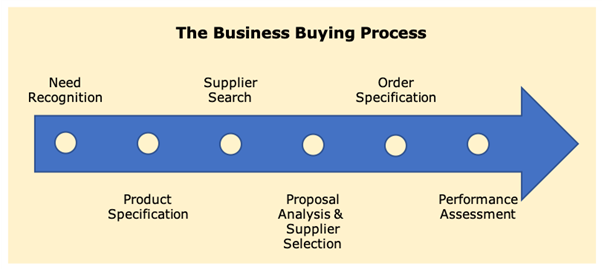
B2B startups sell to other companies. That might mean workflow software, developer tools, data platforms, finance systems, or logistics infrastructure. The important detail is that the person using the product is often not the person paying for it.
A project manager might use the tool every day, but a department head approves the budget and procurement signs the contract. You’re building for one set of hands while persuading another set of eyes, as you can see below.
Andrew Bates, COO of Bates Electric, operates in a world where the people judging success aren’t always the people doing the day-to-day work and he sees how that changes what “good” looks like.
“In B2B, you can’t design only for the person using the tool or service,” Bates said. “The supervisor cares about reliability and scheduling, finance cares about predictability, and leadership cares about risk.
If you make something that’s great for the field but doesn’t report cleanly, or you make reporting perfect but the workflow is painful, you’ll feel it later in churn, delays, or friction at renewal. The product has to work across roles, because adoption is rarely a single-person decision.”
B2C startups sell directly to individuals. Think mobile apps, marketplaces, streaming platforms, or subscription services. In most cases, the user and the buyer are the same person.
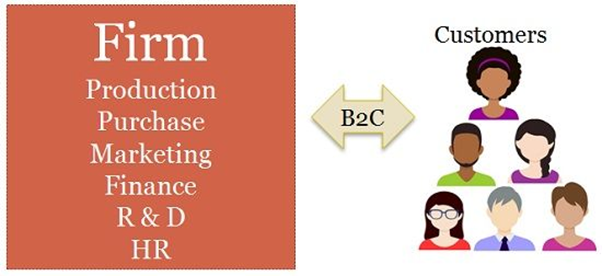
The decision happens quickly, often emotionally, and usually without a committee. If someone likes it, they tap “subscribe.” If they don’t, they delete it.
That difference alone reshapes how product decisions ripple through the company.
Product development strategies
This is where the difference between B2B and B2C starts affecting your calendar. The kind of conversations you’re in, the length of your build cycles, even how nervous you feel before shipping — all of that shifts depending on who’s on the other side.
B2B product development
In B2B, you don’t really get to build in isolation. Even if you try, the product will pull you back into the real world pretty quickly.
Most serious B2B work starts with understanding how a company already operates. You sit in on calls. You watch someone switch between five tabs because your product doesn’t quite handle one edge case. You realize the “minor” export feature you deprioritized is the only way finance reconciles their numbers at month-end.
That’s why the discovery phase in B2B often feels heavier. You’re mapping processes, roles, and handoffs. The user might love your product, but if it doesn’t fit into the larger system, such as security, reporting, and integrations, it won’t survive procurement or renewal.
Methodology tends to follow reality. Many teams use Agile for ongoing development because steady releases and feedback are necessary. But when you’re rebuilding a core system or operating in a regulated industry, you’ll see more structured planning. There are specs, sign-offs, and timelines that matter. You don’t get to “just ship and see.”
The real tension shows up with customization. One large customer asks for something very specific. It makes sense for them. It even makes sense commercially. But if you build it in a narrow way, your product slowly becomes a patchwork of exceptions. Over time, strong B2B teams learn to protect the core. They solve through configuration, permissions, APIs, with ways to stay flexible without forking the product for every account.
B2B product work is less about speed and more about durability. A feature isn’t just about engagement; it’s about whether it will still make sense six months into a contract.
B2C product development
B2C feels lighter in some ways and harsher in others.
You don’t have procurement. You don’t have multi-month sales cycles. What you do have is indifference. Someone downloads your app, pokes around for three minutes, and leaves. No exit interview. No warning.
Ryan Beattie, Director of Business Development at UK SARMs, works on a consumer business where the product can be strong and still lose people if trust and clarity aren’t nailed early.
“In B2C, you don’t get much time to explain yourself. If a first-time buyer hesitates for even a minute, it’s because they don’t feel confident about what they’re buying, what happens next, or whether support will be there if something goes wrong,” Beattie said. “We’ve learned that tiny things like clearer shipping expectations, simpler product comparisons, and fewer decisions on the first screen do more than a long list of benefits. The job is to remove doubt before you try to add depth.”
That’s why B2C teams tend to build in shorter loops. You launch something small, watch what people actually do, and adjust quickly. If a new onboarding flow reduces drop-off, you know within days. If it doesn’t, you revert and try again. The feedback is behavioral and immediate.
In B2C, friction isn’t debated in meetings, it shows up as churn. Research from groups like Nielsen Norman consistently points out how quickly users judge consumer experiences. That reality forces clarity and simplicity in ways B2B products sometimes get away without.
In both models, you’re still trying to solve real problems. But in B2B, you’re building something that has to withstand scrutiny inside an organization. In B2C, you’re building something that has to earn attention repeatedly in a noisy environment.
Customer engagement and market strategies
The engagement motion in B2B and B2C differs in philosophy. In one, you’re deepening a relationship inside an organization. In the other, you’re trying to stay present in someone’s daily life.
B2B customer engagement
Winning a B2B account is the start of the real work. Ongoing value delivery earns renewals, expansions, and references. This may need some work, as there’s a struggle in the industry when it comes to consistent buyer satisfaction.
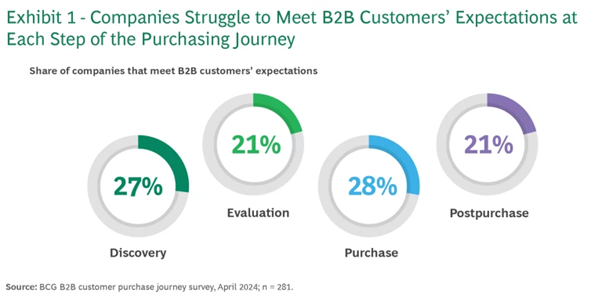
Your first sale to an enterprise customer is just the beginning of the relationship. The real revenue comes from expansion within that account over the years.
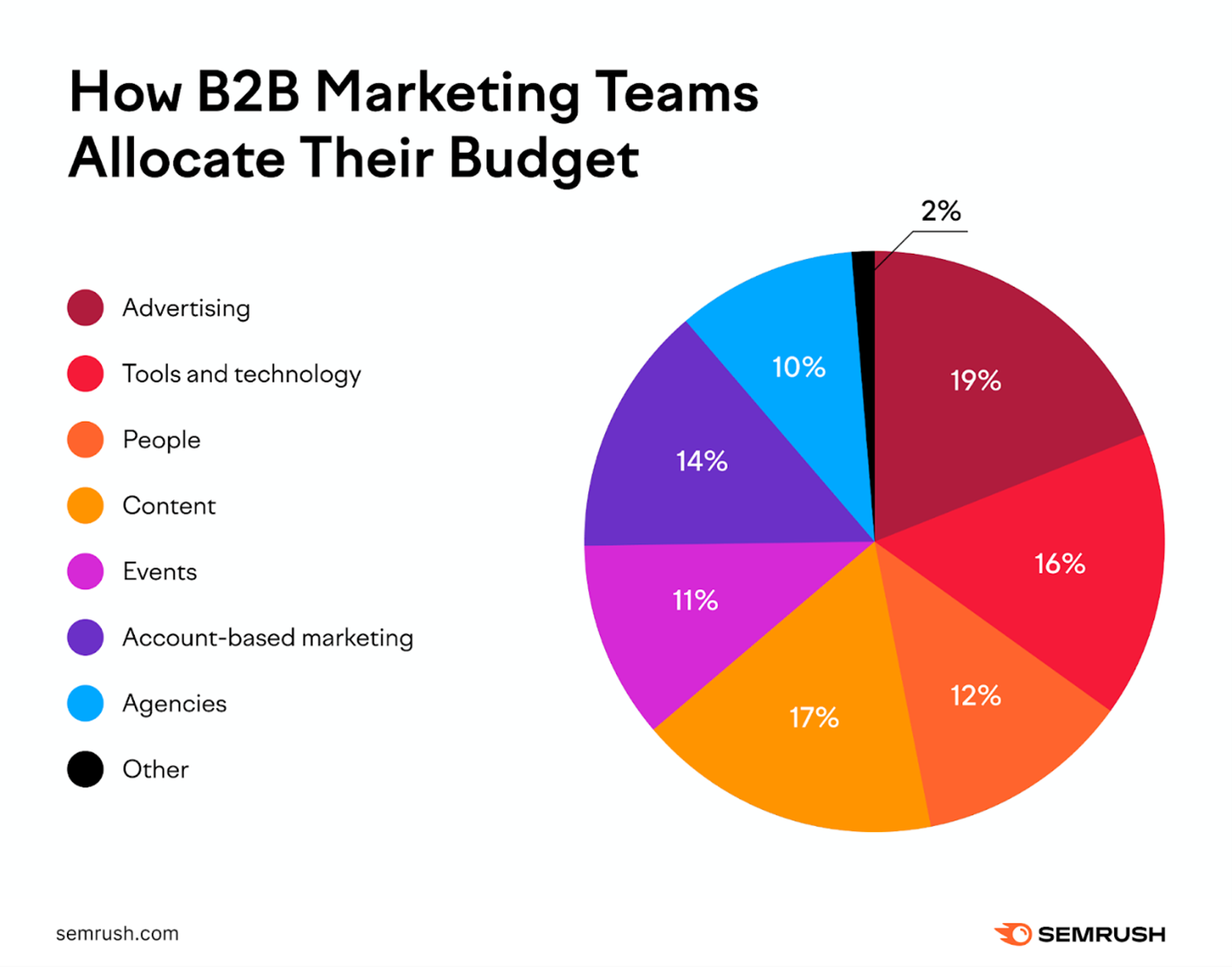
Partnerships matter, too. Integrations with adjacent platforms reduce switching costs and meet customers where they already work. When you make your customer the hero inside their company, your product sticks. 11 percent of the budget is allocated to account-based marketing in B2B, as you can see below.
Strong onboarding and implementation that maps the product to real processes matter. So do executive QBRs tied to measurable outcomes, not vanity metrics. Champion enablement helps your advocates sell internally. A product roadmap that translates customer insight into scalable, configurable features keeps you grounded.
B2C marketing tactics
On the consumer side, you’re casting a wider net, then working hard to keep people around. Social proof, community, and habit formation matter as much as feature depth.
Adrian Iorga, Founder and President of Stairhopper Movers, runs a consumer business where customers make decisions under stress, and he sees how that pressure changes what people respond to.
“A consumer is trying to reduce anxiety fast,” Iorga said. “They want to know: do you show up, do you break things, and will this turn into a headache? The product experience, whether it’s an app or a service flow, has to answer those questions quickly with proof people trust, like clear pricing, clear steps, and signals that you’re reliable. If you make them work too hard to understand what happens next, they’ll pick the option that feels simpler, even if it’s not technically better.”
Modern consumers want to belong to something bigger than a transaction. When users form friendships through your product, they become your most powerful marketers.
Sustainable growth usually comes from strong retention, useful onboarding, clear value moments, and lightweight rituals that customers repeat daily or weekly. The win is often a sharper first-run experience or one well-timed nudge rather than a brand-new feature set.
Sales and revenue models
If product development shapes what you build, your sales and revenue model shape how the business survives. The way money comes in affects prioritization, hiring, forecasting, and even how patient you can afford to be. A B2B company and a B2C company might ship similar features, but the mechanics of revenue underneath them create very different pressures.
B2B sales strategies
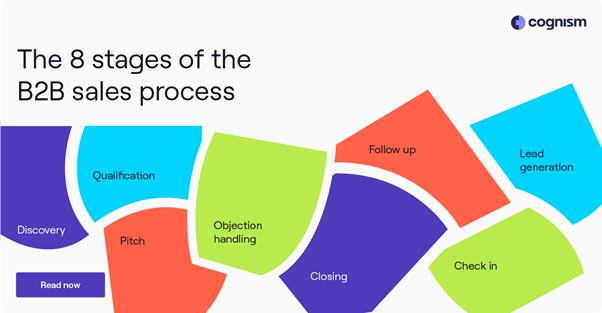
B2B revenue rides on a disciplined, multi-threaded sales process, as you can see below.
Net dollar retention becomes the north star for healthy SaaS revenue because it captures expansion as well as churn.
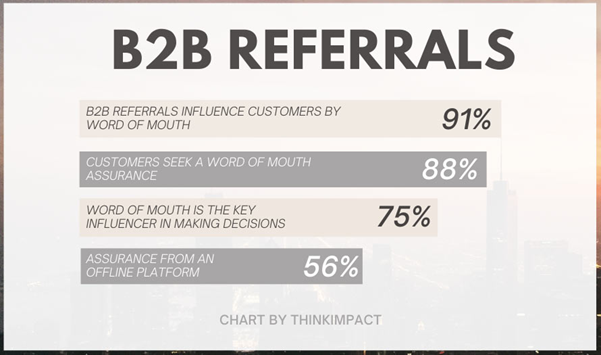
When targeting gets trickier, retention and referrals matter even more.
Security and compliance often sit on the critical path. Early investment in SOC 2, data governance, and privacy pays for itself by reducing friction during procurement. It’s not the most exciting line item in your backlog, but it opens doors.
B2C revenue models
B2C revenue is usually volume-based: many customers pay a small amount each or convert from free tiers. Subscriptions, in-app purchases, ads, and hybrid models are common.
The freemium model can work well when your free experience is truly valuable, and your premium upgrade is obvious at the right moment.
Harvard Business Review outlines the importance of designing the right paywall, limiting free scope thoughtfully, and nudging at natural value thresholds.
CAC and LTV are the dials you’ll watch most closely. As privacy rules evolve, GDPR, Apple’s App Tracking Transparency, and other changes, you’ll want a resilient mix of channels and stronger first-party data practices.
Verizon Small Business Digital Ready
Find free courses, mentorship, networking and grants created just for small businesses.

Join for Free
We earn a commission if you make a purchase, at no additional cost to you.
Verizon Small Business Digital Ready
Find free courses, mentorship, networking and grants created just for small businesses.
Challenges unique to B2B and B2C product management
B2B’s hard parts start early: breaking into an industry without references, clearing security reviews, and navigating complex buying dynamics.
Even after you win, implementations can stall without clear ownership or change management. Scaling responsibly means balancing enterprise asks with a clean core product and choosing standards that speed future deals.
B2C brands face different challenges. Algorithm changes shock your growth curve. Retention demands relentless iteration to keep people engaged. You might see download spikes that don’t translate to durable usage. That’s normal. Keep your metrics simple, your experiments small, and your insights grounded in real user behavior.
Ryan Walton, Program Ambassador of The Anonymous Project, works with people navigating shifting routines and competing demands, and he sees a similar pattern in why products lose momentum over time.
“Most people don’t leave because something is broken,” Walton said. “ If there isn’t a clear reason to return, the product slowly slips down the priority list. You can keep adding features, but unless there’s a simple, repeatable moment that feels worth coming back to, usage fades. Retention is less about constant novelty and more about giving people one dependable reason to show up again.”
Pick one model, master its unique dynamics, and build deep expertise. You can always expand later from a position of strength rather than struggling to be adequate at both.
Case studies and real-world examples
It’s easier to see these differences when you look at companies that leaned fully into their model instead of trying to blur it.
Slack didn’t begin by marching through enterprise procurement. Teams adopted it because it felt lighter and more intuitive than what they were using. One team would start, then invite another.
It felt closer to a consumer app in its usability, but it solved a serious coordination problem. Onboarding was tight. Integrations made it useful quickly. Expansion was pulled by usage.
Atlassian took a slightly different path. Templates and an app marketplace made it possible for teams to get started without a salesperson guiding every step. Over time, as larger customers demanded more controls and support, enterprise features were layered in. Look at the very first version of their product. It’s much simpler than what you will see now.
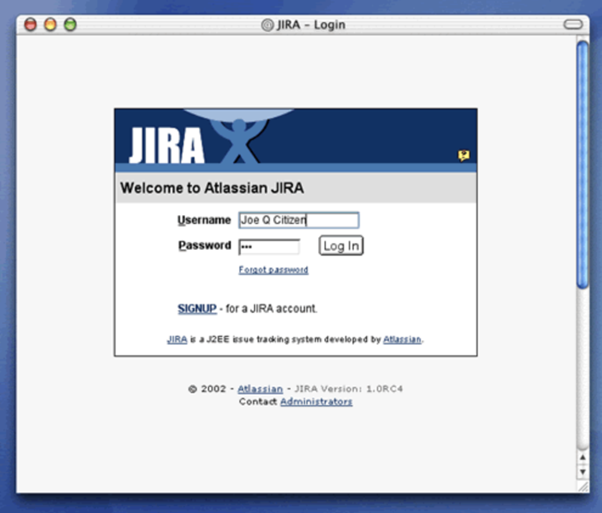
The early self-serve foundation didn’t disappear; it became a funnel into bigger deployments. The product was designed to scale with the customer rather than restart when they grew.
On the consumer side, the pattern shifts.
Duolingo has been open about treating its product like an ongoing experiment. Rather than betting everything on large feature launches, the team tests small changes constantly, how a lesson is structured, when a reminder is sent, and how progress is displayed. Those adjustments may look minor in isolation, but together they shape motivation and daily engagement. In consumer markets, sustained growth often comes from compounding refinements rather than headline releases.
Calm found its footing by embedding itself into routines people already had, like winding down before sleep and focusing during work. The brand felt reassuring rather than urgent. A free tier lowered the barrier to trying it, and the paid experience built on habits that were already forming. Instead of chasing novelty, it leaned into repetition and consistency.
Across all of these examples, the throughline is alignment. The companies that last tend to respect the mechanics of their model instead of fighting them.
What you can do now
B2B and B2C share the same product-management backbone, like clear problems, measured outcomes, and tight feedback, but the muscles they use are different.
Focus on one model until you truly understand its rhythms. In B2B, sit with users, instrument value, and invest in customer success from day one. In B2C, ship small, test fast, and design for habit. Community can lower your acquisition costs more than you think.
If you’re choosing between B2B and B2C, start with your strengths and where you can build unfair insight. Then commit. The rest will come into focus once you know exactly who you’re building for and why they’ll care.
If you’re navigating the early trade-offs between B2B and B2C, or figuring out how to shape your product strategy around the market you’re serving, it helps to see how other founders are thinking through similar decisions.
Image by rawpixel.com on Freepik
The post How Product Management Differs in B2B and B2C Startups appeared first on StartupNation.