
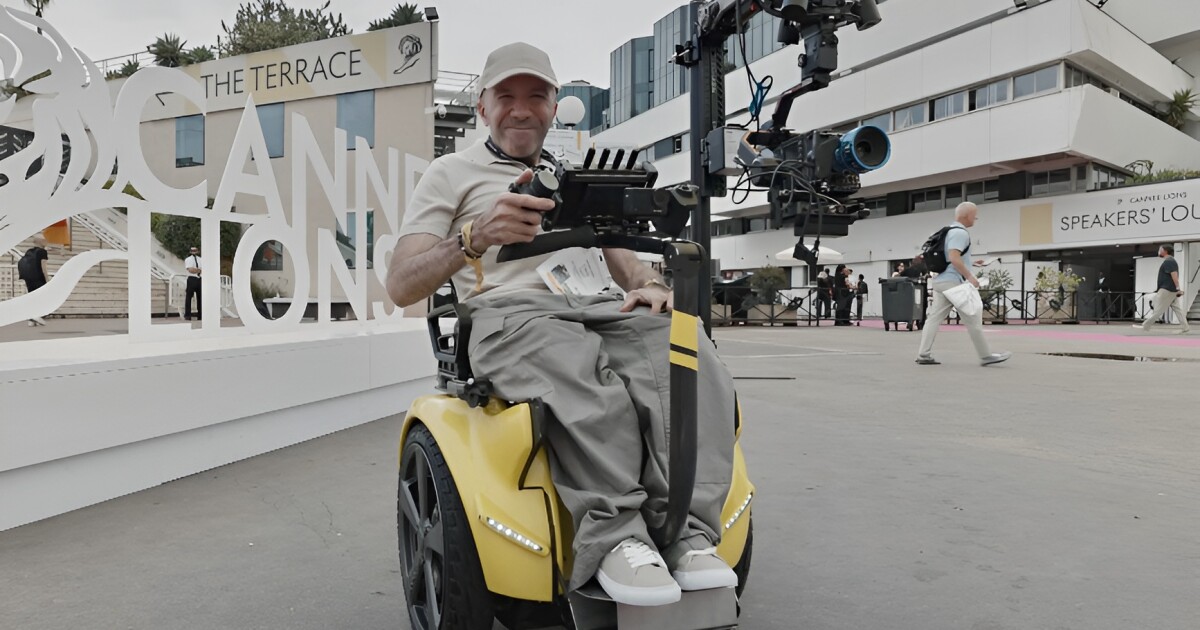
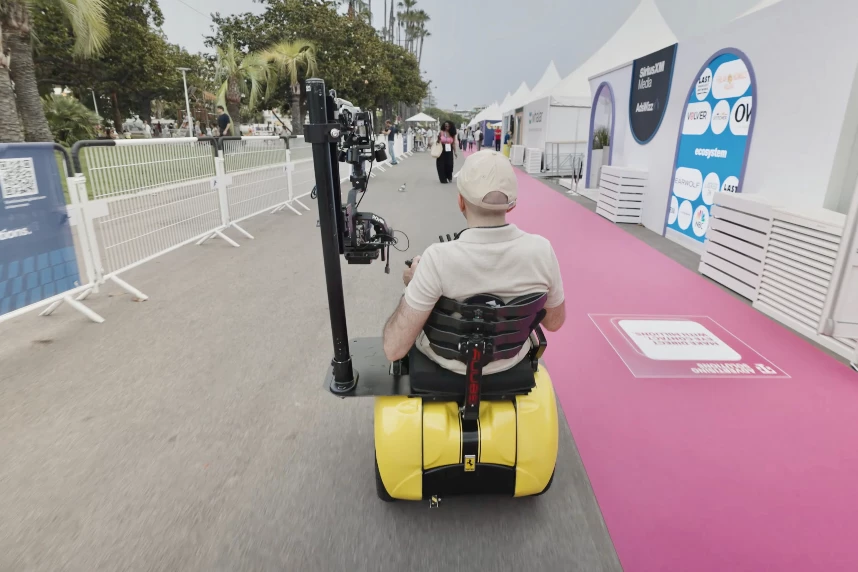
If Caerus, the son of Zeus and the Greek god of opportunity zips by, one is supposed to seize the single lock of hair on his head to capture the golden fortune it symbolizes. That can be declared of Christopher Lynch, an awarding-winning Irish filmmaker based in London, who was born with osteogenesis imperfecta. Founder of Caerus Technology, Lynch has developed what is claimed to be the world’s first wheelchair-mounted Steadicam system.
Osteogenesis imperfecta (brittle bone disease) is an inherited genetic condition that causes soft bone deformations and other mild to severe issues leading to fractures or bone breakages from not being able to support one’s own body weight. By his own estimate, Lynch says he has broken over 100 bones in his lifetime. “I can’t put weight on my legs and have even broken my back doing pull ups,” he says.
Diverse Made Media
In the early part of his 20-plus-year filmmaking career, Lynch soon realized he could not effectively manage the role of DOP (Director of Photography). His disability limited him in being able to achieve the types of shots that required being able to maneuver very quickly, especially in tight spaces.
“I’ve always wanted to be a camera operator. The industry is already tough enough without a disability,” says Lych. “It’s physically demanding. It’s highly competitive, and it’s really expensive.”
Steadicam operation can be already be physically taxing, due to the weight distribution from the vest that is worn on the body. This results in operator fatigue that can incur costly disruptions due to industry mandates of regular camera operator breaks every 20 to 30 minutes to relieve the strain.
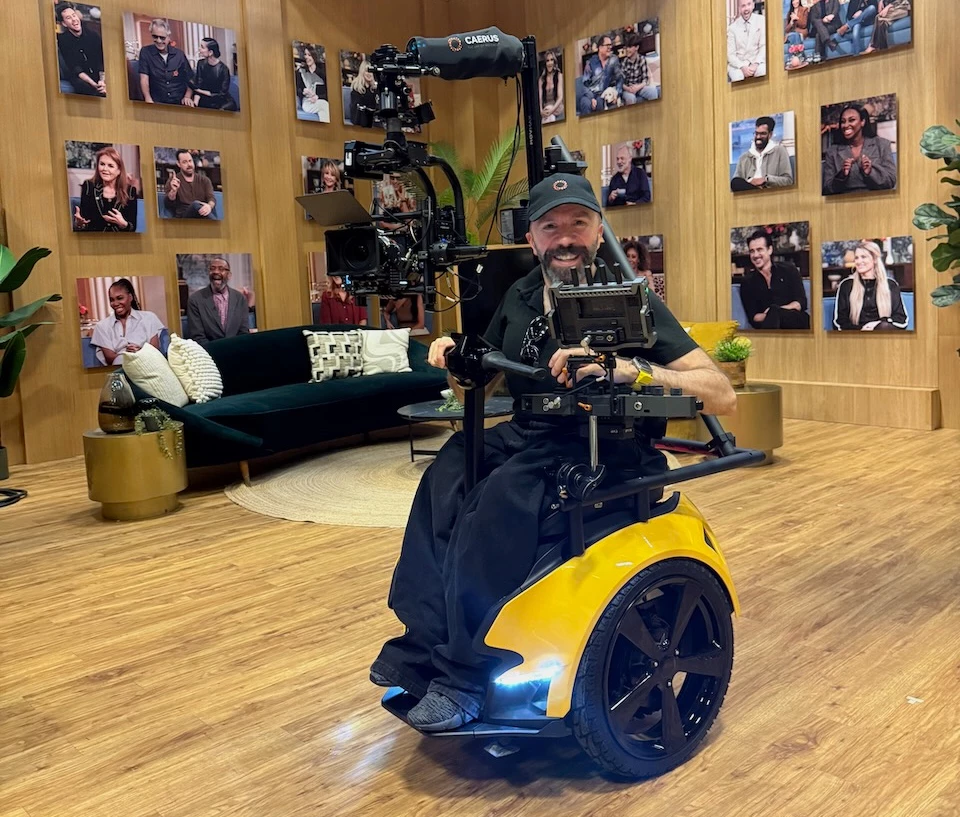
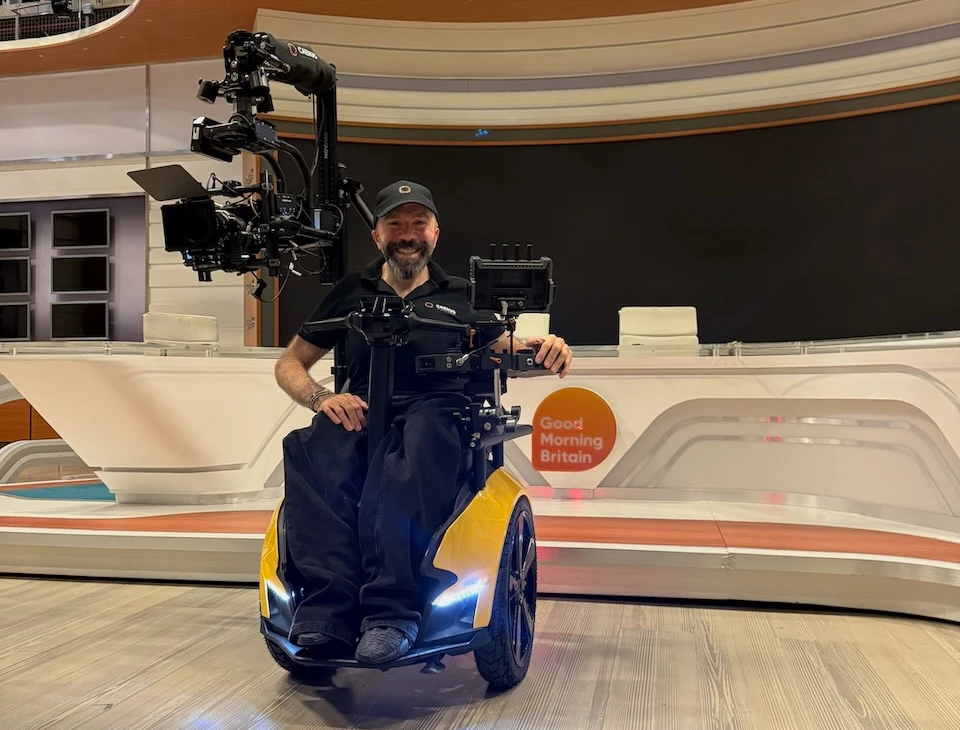
Lynch – with support from global TV and film brands such as Ronford Baker, RED, CVP and DJI – co-created the Caerus Steadicam, a wheelchair-attached camera mount that fits onto the Genny Zero, a state-of-the-art Italian-designed, Swiss-made self-balancing wheelchair.
Diverse Made Media
The sleek, sporty-looking Genny Zero has two rugged wheels enabling it to pivot smoothly into smaller spaces than most standard electric wheelchairs, plus it is able to deliver dolly and orbiting shots without the need of laying tracks. It has a top speed of 12 mph (20 km/h) and a range of 15.5 mi (25 km) – with a swappable battery – enabling a smooth transition from indoor to outdoor tracking of subjects, running shots, or the following of cars at a slow speed from a first-person perspective.
Five years in the making, the Caerus Steadicam was initially designed for wheelchair users to work in the film industry, but there are advantages also for the able-bodied since the weight distribution is spread out on the wheelchair, thus alleviating the need to carry heavy loads.
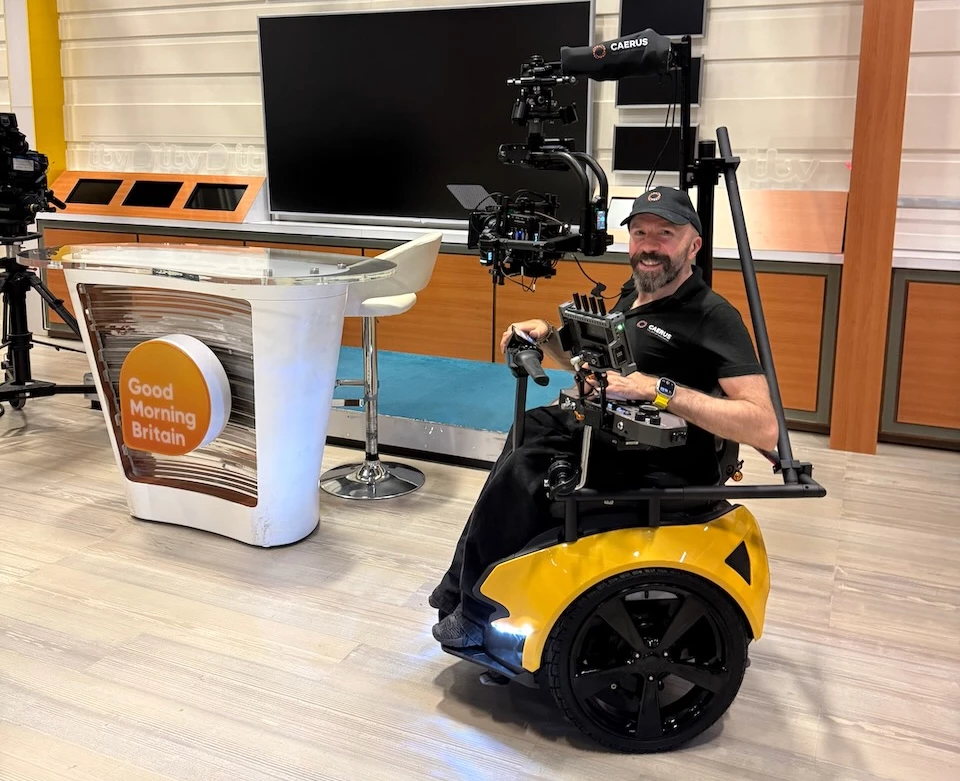
The Caerus mount can be detached for remote single-operator use by other AC’s (Assistant Camera Operators) if the chair user cannot operate both the camera and wheelchair concurrently. Otherwise, the user can operate the Steadicam by way of a control panel placed at chest level, solving one of the problems faced by film-making wheelchair users.
Lynch says, “As a wheelchair user, I always say you need four arms, you need two arms to push yourself and two arms to hold the camera. No matter how much I train, I’m never going to be able to pickup an 88-lb [40-kg] camera package.”
Diverse Made Media
Industry-wide, the response has been hugely positive in anticipation of what this new system can contribute – not just with the inclusion of people who previously were left out, but with the creative possibilities that are now afforded by the Caerus system. Lynch also founded Diverse Made Media, a disability-led company supported by an advisory board of established leaders from the TV and film sector based on “capability, not categories.” The Diverse Made Media team includes a roster of about 500+ members within their network from every department and community.
He says, “We don’t have ‘disability targets’. We have production requirements and we find the best people to meet them. Sometimes that person uses a wheelchair. Sometimes they don’t. The work determines the hire, not the optics. And create a role for disabled film makers that hasn’t been possible before.”
Diverse Made Media
A Caerus purchase for new customers includes mandatory in-person two-day training with support on setup, installation, rigging/de-rigging, operating fundamentals, plus health and safety support as well lifetime access to training materials.
Currently, there is a wait list for the Caerus Vista, an all-round indoor and outdoor model, capable of handling most production types. It’s priced at £65,000 (about US$88,000).
Some of the projects Diverse Made Media has worked on with the Caerus Steadicam so far include:
Allianz x IPC (International Paralympic Committee), June 2025
Euro Para Youth Games Istanbul, July 2025
The Rosie Jones Foundation, August 2025
Caerus Global Launch, September 2025
BBC In the Driving Seat co-production, October 2025
Finally, what is Lynch’s lofty dream now that he can operate a camera rig comfortably and nimbly? “Getting on to a big Hollywood blockbuster with a legendary director is definitely a bucket list. I’ve no doubt it will happen. Maybe the next Bond movie?”
This is Caerus – The World’s First Wheelchair-based Camera System
Source: Diverse Made Media