
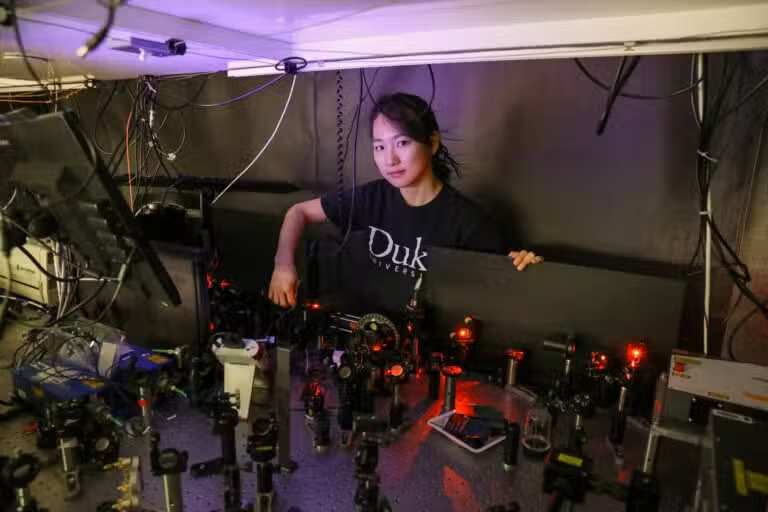
As metasurfaces trap and localize optical energy, thermal photodetection begins operating at response times measured in picoseconds rather than conventional slow thermal scales.
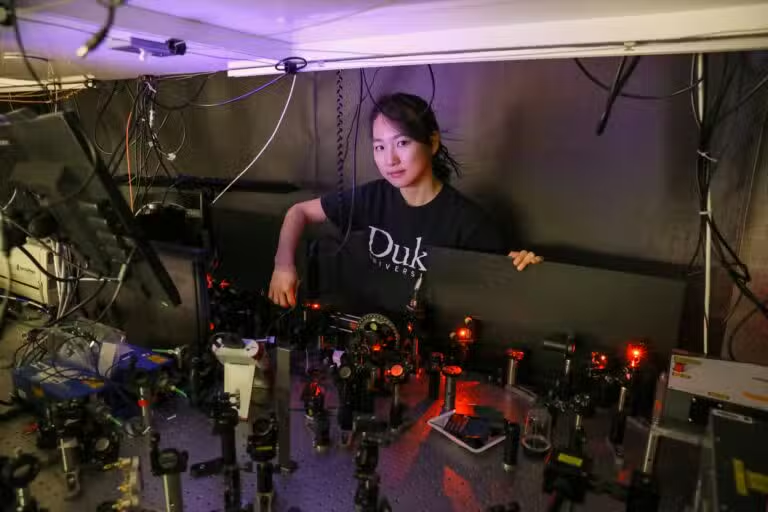
Electrical engineers at Duke University have demonstrated a pyroelectric photodetector operating at speeds far beyond those typically associated with thermal detection technologies. The ultrathin device detects light by responding to heat generated when incoming radiation is absorbed, enabling it to capture signals across a wide portion of the electromagnetic spectrum.

Photodetectors form the sensing foundation of modern imaging systems. Conventional semiconductor detectors generate electrical currents when struck by visible light, allowing computers to convert optical signals into digital images. However, semiconductor materials function effectively only within a limited range of wavelengths, restricting their ability to capture information beyond the visible spectrum.
Thermal photodetectors provide an alternative approach. Instead of relying on semiconductor bandgaps, these devices generate electrical signals when absorbed light produces heat within the sensing layer. This mechanism allows them to respond to a broader set of frequencies, but traditional designs have often been slower and bulkier because producing measurable heat typically requires thicker absorbers or intense light sources.
The device developed at the university addresses this limitation through a metasurface structure designed to trap and concentrate incoming light. Precisely engineered silver nanocubes are positioned on a transparent layer roughly 10 nanometers above a thin gold film. When light strikes the nanocubes, electrons within the silver respond through plasmonic interactions that confine and absorb optical energy at frequencies determined by the nanocubes’ geometry and spacing.
Because the metasurface captures light efficiently, only an ultrathin pyroelectric layer beneath it is required to convert absorbed heat into an electrical signal. Researchers also redesigned the metasurface geometry into a circular configuration to increase exposure while reducing signal travel distance.
Measurements showed the detector operating at speeds of up to 2.8 gigahertz, corresponding to a response time of approximately 125 picoseconds.
“Commercial pyroelectric detectors aren’t very responsive, so they need a very bright light or very thick absorbers to work,” says Maiken Mikkelsen, Professor of Electrical and Computer Engineering, “Our approach integrates near perfect absorbers and super thin pyroelectrics to achieve a response time of 125 picoseconds.”