

NASA changed an asteroid’s orbital path around the sun, a first for humankind
Smashing a spacecraft into a binary asteroid system has managed to alter its path around the sun, a new analysis reveals
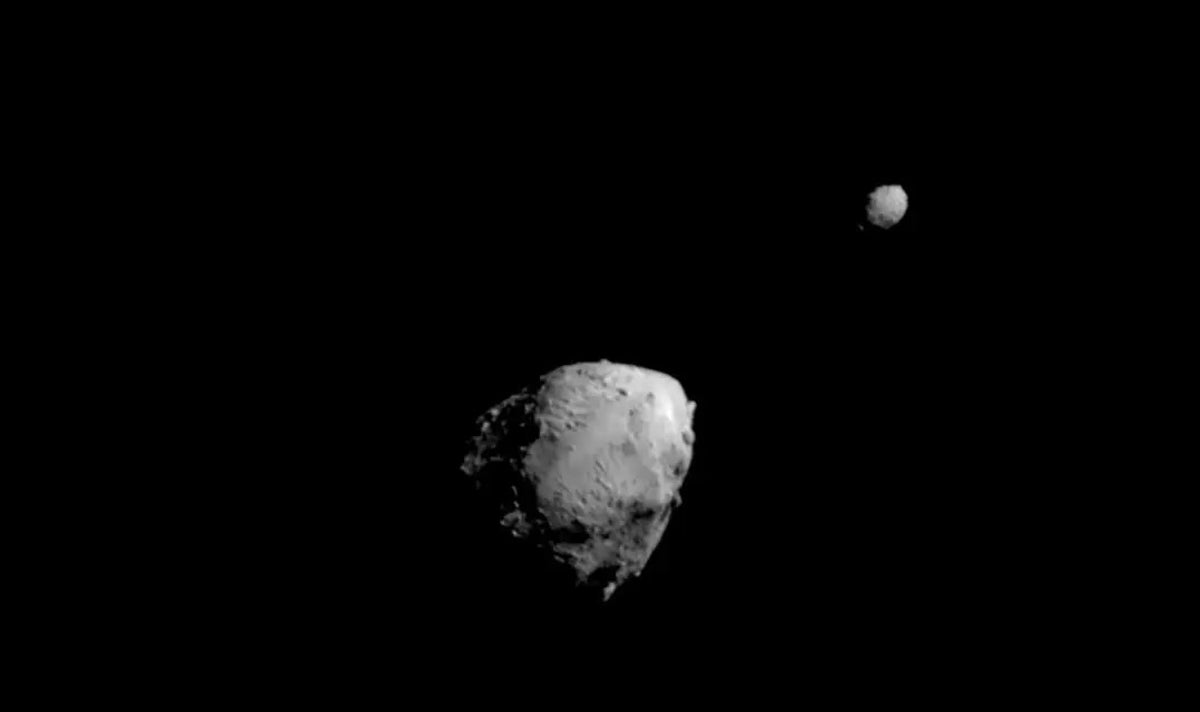
The asteroid binary, Didymos and Dimorphos.
In September 2022 NASA smashed a spacecraft into an asteroid. Called Dimorphos, the rock is the smaller asteroid in a binary pair; it orbits a larger one called Didymos. Slamming into Dimorphos told scientists numerous things: the collision managed to jolt the asteroid slightly off course, slowing its orbit around its bigger companion by around 30 minutes and suggesting that a similar method might help defend Earth from encroaching asteroids.
But now the mission has revealed something even more profound: by slowing Dimorphos’s orbit, NASA has managed to alter the entire binary system’s orbit around the sun. The act of changing a natural object’s orbit around our home star marks a first for humanity.
In a study published on Friday in the journal Science Advances, researchers explain how the original collision with Dimorphos slowed the entire binary’s solar orbit by around 12 microns per second. The new data could help NASA better prepare to deflect asteroids that may one day threaten the planet, the researchers say.
On supporting science journalism
If you’re enjoying this article, consider supporting our award-winning journalism by subscribing. By purchasing a subscription you are helping to ensure the future of impactful stories about the discoveries and ideas shaping our world today.
“If [an asteroid] is ever on its way to hitting the Earth, we can more confidently now say that we have the ability to push them around and away from the Earth,” says the study’s lead author Rahil Makadia, who was a planetary defense scientist at the University of Illinois Urbana-Champaign when it was conducted.
Dimorphos and Didymos don’t pose a danger to Earth. But they were chosen as the targets for the Double Asteroid Redirection Test (DART) to assess our planetary defense capabilities, Makadia explains. DART involved ramming a 570-kilogram spacecraft moving at some 22,530 kilometers an hour into Dimorphos in a bid to slow its journey around Didymos. Still, scientists believed that the test just might be able to change the pair’s heliocentric orbit, too.
“This was also something we had thought about even before the DART impact,” Makadia says. “But what we didn’t know was the extent to which this would happen and whether or not we would be able to measure it at all.”
Makadia and his team combined radar measurements and observations of the binary system as it passed in front of the sun in order to compare the asteroids’ pre-DART orbit with their postimpact path. The system’s approximately two-year journey around the sun slowed by around 11.7 microns per second, or around 370 meters per year, the analysis found.
The finding is “very cool,” says Jay McMahon, an associate professor of aerospace engineering sciences at the University of Colorado Boulder. McMahon has worked with the DART team in the past but was not involved with the new study. “Like any experiment, you can make a prediction about what will happen, but then you have to take the measurements to prove it,” he says. “And so, this proves it.”
Makadia and his colleagues also calculated the collision’s “momentum enhancement factor,” which essentially measured how much the loss of rocks, dust and other material during impact contributed to the change in orbit. “It basically doubled the push from the spacecraft alone,” Makadia says. The team also estimated the mass of each asteroid separately for the first time.
The findings may have broader implications beyond planetary defense, notes Masatoshi Hirabayashi, another DART scientist who was not directly involved with the new study and an associate professor in aerospace engineering at the Georgia Institute of Technology. Knowing the asteroids’ respective mass and densities could help scientists better understand their structure, “a key piece of information of how this binary asteroid formed,” he says.
More data are coming soon: later this year the European Space Agency’s Hera mission is set to take a closer look at DART’s effect on Dimorphos and Didymos, including the impact crater left by the collision.
“Once we get the measurements from [Hera], we can then come at these numbers from a completely independent way and confirm them and maybe build on them as well,” Makadia says.
It’s Time to Stand Up for Science
If you enjoyed this article, I’d like to ask for your support. Scientific American has served as an advocate for science and industry for 180 years, and right now may be the most critical moment in that two-century history.
I’ve been a Scientific American subscriber since I was 12 years old, and it helped shape the way I look at the world. SciAm always educates and delights me, and inspires a sense of awe for our vast, beautiful universe. I hope it does that for you, too.
If you subscribe to Scientific American, you help ensure that our coverage is centered on meaningful research and discovery; that we have the resources to report on the decisions that threaten labs across the U.S.; and that we support both budding and working scientists at a time when the value of science itself too often goes unrecognized.
In return, you get essential news, captivating podcasts, brilliant infographics, can’t-miss newsletters, must-watch videos, challenging games, and the science world’s best writing and reporting. You can even gift someone a subscription.
There has never been a more important time for us to stand up and show why science matters. I hope you’ll support us in that mission.