
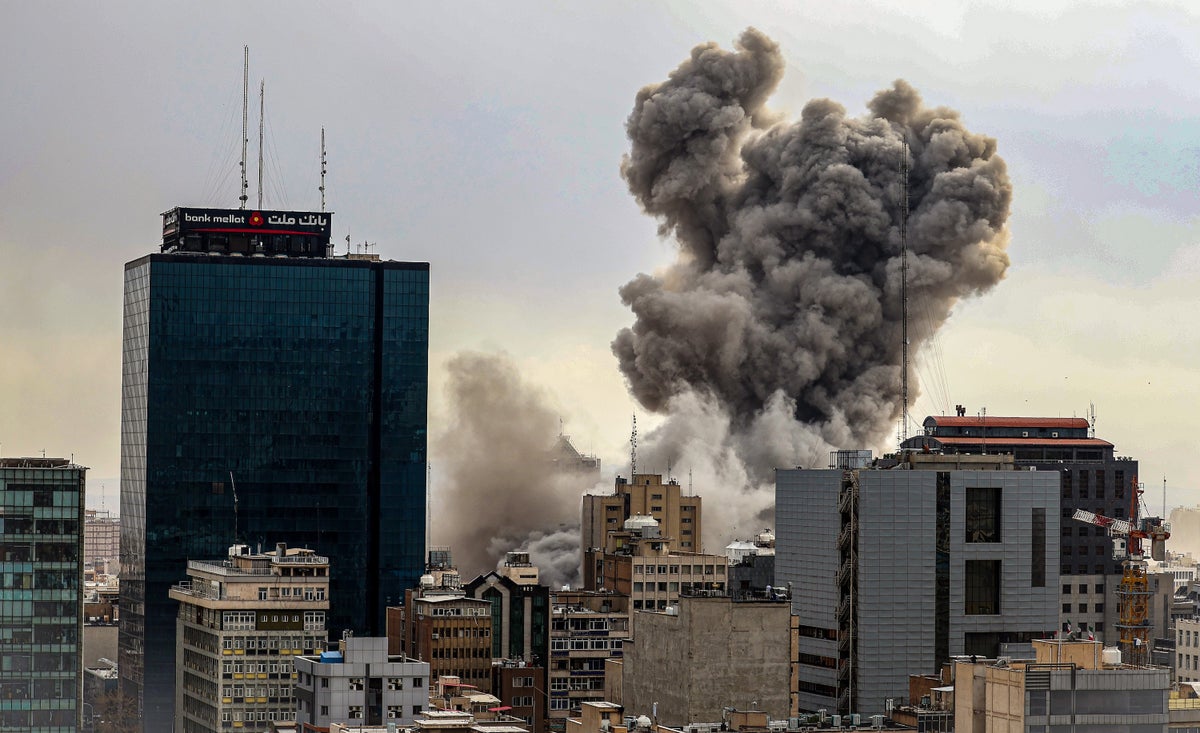
Confusion on whether Iran truly needed only “two weeks to four weeks” to make a nuclear weapon, as President Donald Trump suggested on Monday, hangs over the ongoing U.S. and Israeli war on the Persian Gulf nation. Nuclear experts call this claim unlikely—but the confusion may stem from some basics of atomic chemistry.
“There was no evidence that Iran was close to a nuclear weapon,” says Jeffrey Lewis of the James Martin Center for Nonproliferation Studies at the Middlebury Institute of International Studies. His comment echoed those of other experts after the war’s start, as well as statements from International Atomic Energy Agency (IAEA) chief Rafael Grossi at that time and in 2025 and last year’s “threat assessment” report by U.S. intelligence agencies.
According to an IAEA estimate, as of June 2025, Iran possessed 441 kilograms of 60 percent enriched uranium, where the percentage refers to the share of the isotope uranium 235 (U 235) found in the material. That would be enough for 10 nuclear weapons if the material could be enriched further to full 90 percent weapons-grade concentrations, according to the IAEA. That further enrichment would take a matter of weeks in a fully functioning Iranian nuclear complex, perhaps explaining the time line within Trump’s declaration.
On supporting science journalism
If you’re enjoying this article, consider supporting our award-winning journalism by subscribing. By purchasing a subscription you are helping to ensure the future of impactful stories about the discoveries and ideas shaping our world today.
That step alone doesn’t equal a bomb, however. And Iran’s main enrichment capabilities were “completely and totally obliterated,” according to Trump himself in June, after the U.S. bombed three underground Iranian facilities. The administration’s special envoy to the Middle East Steve Witkoff nonetheless claimed on March 3, after the start of the current war, that Iran had the capability to make 11 nuclear bombs. Trump administration officials reportedly failed to include nuclear technical experts in their negotiation teams with Iran prior to the war, adding to the uncertainty. If Iran really had rebuilt these facilities, that might have led—over months and not weeks—to the nation resuming its uranium enrichment, Lewis says. “But this is all ‘if,’ ‘maybe’ and ‘later,’” he adds.
Enrichment
For starters, enriching uranium isn’t simple, says former Los Alamos National Laboratory chemist Cheryl Rofer. It begins with mining uranium ore, which is then filtered and dried to make “yellowcake” uranium oxide concentrate. Yellowcake is only about 0.7 percent U 235, where a standard atomic bomb typically requires uranium metal that is 90 percent enriched. To get there, technicians must chemically convert the yellowcake into uranium hexafluoride gas (a molecule containing one uranium atom and six fluorides) and feed it into centrifuges. Spun at 50,000 to 100,000 revolutions per minute, molecules containing the slightly lighter U 235 separate from those with the heavier, and much more common, uranium isotope U 238. The U 235 stream then travels through cascades of more centrifuges whirling to further concentrate the stream, first to 20 percent enrichment (so-called highly-enriched uranium) and then to 60 percent concentration. “It takes many stages to separate the two isotopes,” Rofer says.
Since the first Trump administration withdrew from the international agreement with Iran to halt enrichment in 2018, Iran had stopped at the intermediate step of 60 percent enrichment in its production of uranium and had not proceeding to the 90 percent required for bombs. “Iran’s decision was intended to send a political message: ‘We have gone as far as we can go in response to provocations without producing weapons-grade uranium,’” noted Robert E. Kelley of the Stockholm International Peace Research Institute in 2021. Iran had buried entrances to tunnels at its Isfahan nuclear complex in February, leaving observers to conclude that the uranium remains stored, likely in canisters of uranium hexafluoride gas, or in disarray there after the June 2025 bombing of the site.
To be as close as Trump claimed to having a conventional nuclear weapon, Iran would have needed to secure and enrich that gas to 90 percent in centrifuges, extract and chemically separate it back to solid uranium, shape it into spheres of uranium metal (a task that is “not simple,” Rofer says) and then construct explosive devices around them. A handful of smaller bombs might be crafted from the material in its present 60 percent concentration, according to physicist Edwin Lyman of the Union of Concerned Scientists.
“It is not impossible to imagine that Iran had maneuvered itself into a ‘breakout’ situation,” matching Trump’s claims of an imminent weapon, says nuclear historian Alex Wellerstein of the Stevens Institute of Technology. “But it is also quite possible that they have not done so. Big claims require big evidence, especially when lives are at stake.”
Retrieval
Lawmakers such as Democratic senator Chris Coons of Delaware, as well as news reports, have raised the possibility that the U.S. or Israel could somehow retrieve Iran’s enriched uranium stores in a commando operation. Secretary of State Marco Rubio reportedly discussed the option at a closed congressional briefing on Tuesday, according to Axios. “We haven’t gone after it. We wouldn’t do it now. Maybe we will do it later,” Trump said last week.
Safely retrieving these uranium canisters—which likely take the form of dozens of 25- to 50-pound containers filled with uranium hexafluoride gas under pressure—would be highly challenging under wartime conditions. To start, we’d need military control to bring in bulldozers, ground and air transportation for the cannisters, as well as the capability to handle any challenges in locating and moving the material from inside places like the mountain in Isfahan to outside, says nuclear proliferation expert Miles Pomper of the James Martin Center for Nonproliferation Studies. Another difficulty would be determining whether the team had truly retrieved all the uranium, he says, given that the lack of safeguards in the past few months means “the chain of custody” has essentially been broken.
Leaving aside the military challenges, a commando team would also have to worry about damaged canisters flying around spewing corrosive, radioactive gas and about their improper storage leading to a nuclear “criticality event”—an uncontrolled nuclear fission chain reaction, Rofer says. That would not lead to an explosion “but a blue flash and a lot of released neutrons,” lethal to everyone nearby, she adds. “You can’t just send a bunch of guys with a truck to throw the stuff in the back and drive off.”
In 1994 U.S. forces removed 600 kilograms of highly-enriched uranium from Kazakhstan left over from the Soviet Union in “Project Sapphire.” With Kazakhstan’s cooperation, the material traveled on three C-5 cargo aircraft, an effort that took a team of specialists almost a month of 12-hour days from October to November, 1994, to complete. “The Soviets did not keep good records, and it was everywhere,” Rofer says.
The best outcome now would be the resumption of peaceful IAEA monitoring of Iran’s enrichment capabilities, Pomper says. If the war in Iran leads to concern about the uranium falling into “dangerous hands,” however, the possibility of a retrieval mission could become more urgent, he says. Israeli news reports claim the Mossad intelligence service has some knowledge of the uranium’s security, which might ensure alarms over its movement.
Nevertheless, most experts regard a retrieval raid to Iran as “rather fantastical,” Wellerstein says. “Certainly, it would require more forethought and planning than the Iranian war has exhibited so far.”
Editor’s Note (3/11/26): This story is in development and may be updated.