

The gut microbiome may influence brain aging, mouse study suggests
A communication pathway between the brain and the gut may be integral to how well the brain holds on to memories

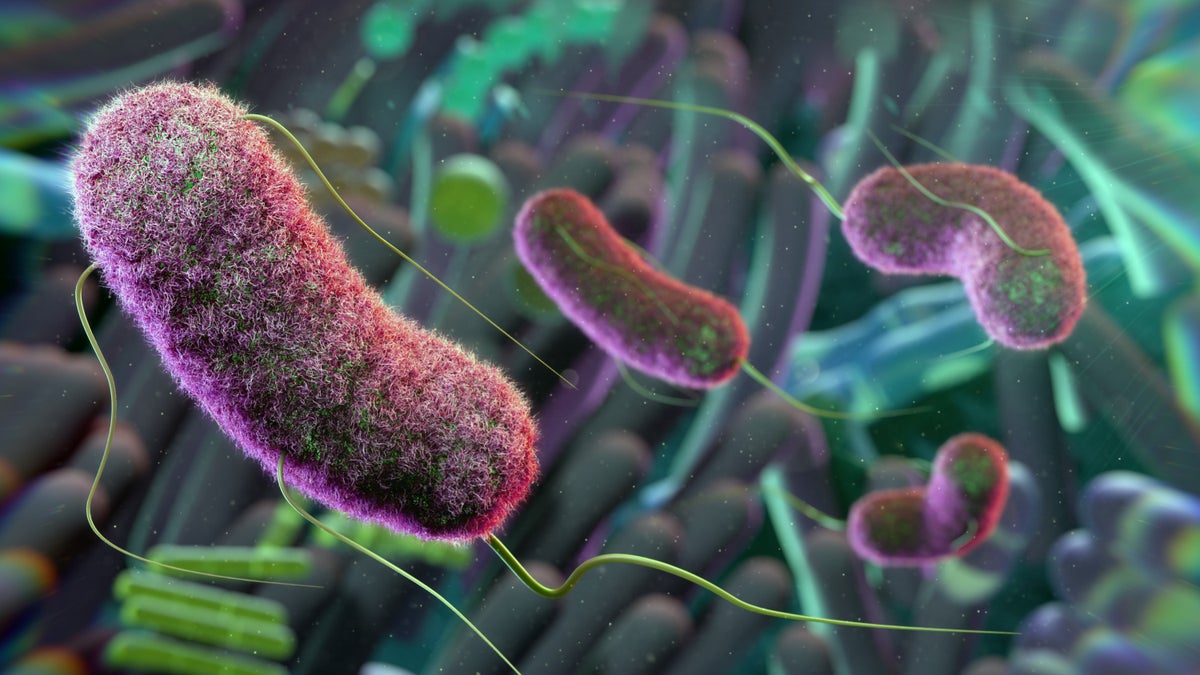
A conceptual illustration of the gut microbiome.
THOM LEACH/SCIENCE PHOTO LIBRARY/Getty Images
Age changes the brain, but why some people remain mentally sharp well into their dotage while others don’t is a bit of a mystery. Part of the answer may have to do with genetics, but now a new study in mice suggests it could also have something to do with our gut.
In a series of experiments, researchers found that a communication pathway between the brain and the gut may be integral to how well the brain holds on to memories.
The genesis for the study came from a chance observation: young, two-month-old lab mice housed with older, 18-month-old mice showed “really impaired cognition,” says Timothy Cox, the study’s lead author and a graduate student at the University of Pennsylvania. He and his colleagues suspected gut bacteria might be involved.
On supporting science journalism
If you’re enjoying this article, consider supporting our award-winning journalism by subscribing. By purchasing a subscription you are helping to ensure the future of impactful stories about the discoveries and ideas shaping our world today.
In the study, researchers exposed young mice raised in a sterile, microbe-free environment to gut bacteria from old mice, causing the younger animals to perform worse on cognitive tests, as if they had prematurely aged, just like the cohoused mice. When young mice that were housed with older mice were given antibiotics, however, the effect was erased. And older, microbe-free mice still had good memory skills. Taken together, the results suggest that bacteria in the older mice’s gut made young mice perform like they had an old brain.
By sequencing the bacteria found in older mice’s feces, the researchers identified a culprit—a species of bacteria called Parabacteroides goldsteinii.
When the researchers exposed young mice that were raised in a sterile environment or treated with antibiotics to P. goldsteinii, the mice again performed worse in cognitive tests. P. goldsteinii, Cox explains, can trigger inflammation in mice, which could hinder the vagus nerve—the communication highway that conveys signals between the gut and the brain. Stimulating the vagus nerve also improved the mice’s cognitive performance. The findings were published on Wednesday in the journal Nature.
The findings build on previous research showing that the microbiomes of younger mice can “rejuvenate” the brain in older mice, says John Cryan, a professor of anatomy at University College Cork in Ireland, who was not involved in the new study. Multiple studies over the past decade have shown that “the microbiota-gut-brain axis” can influence brain function. “What this study adds is a much clearer mechanistic pathway,” he says.
Importantly, the study was conducted in mice, and its findings are not easily applicable to humans. The researchers emphasize that the results don’t indicate that young people who live with older adult humans might experience cognitive issues. For one, the human gut microbiome is complex in its own way. And for another, mice eat each one another’s feces. “I suspect that most people are not doing that,” Cox says.
But the results could one day lead to future therapies for memory issues and cognitive decline in people. P. goldsteinii is “certainly a member of the human microbiome,” says Christoph Thaiss, an assistant professor of pathology at Stanford University and co-senior author of the paper. But whether it affects cognitive decline in humans is unclear.
Vagus nerve stimulation, meanwhile, is an already approved procedure for various brain conditions, including stroke and epilepsy.
“It’s definitely not impossible to imagine a future where people stimulate their vagus nerve to counteract cognitive decline,” Thaiss says. “But we would need larger studies and clinical trials in order to figure this out.”
It’s Time to Stand Up for Science
If you enjoyed this article, I’d like to ask for your support. Scientific American has served as an advocate for science and industry for 180 years, and right now may be the most critical moment in that two-century history.
I’ve been a Scientific American subscriber since I was 12 years old, and it helped shape the way I look at the world. SciAm always educates and delights me, and inspires a sense of awe for our vast, beautiful universe. I hope it does that for you, too.
If you subscribe to Scientific American, you help ensure that our coverage is centered on meaningful research and discovery; that we have the resources to report on the decisions that threaten labs across the U.S.; and that we support both budding and working scientists at a time when the value of science itself too often goes unrecognized.
In return, you get essential news, captivating podcasts, brilliant infographics, can’t-miss newsletters, must-watch videos, challenging games, and the science world’s best writing and reporting. You can even gift someone a subscription.
There has never been a more important time for us to stand up and show why science matters. I hope you’ll support us in that mission.