
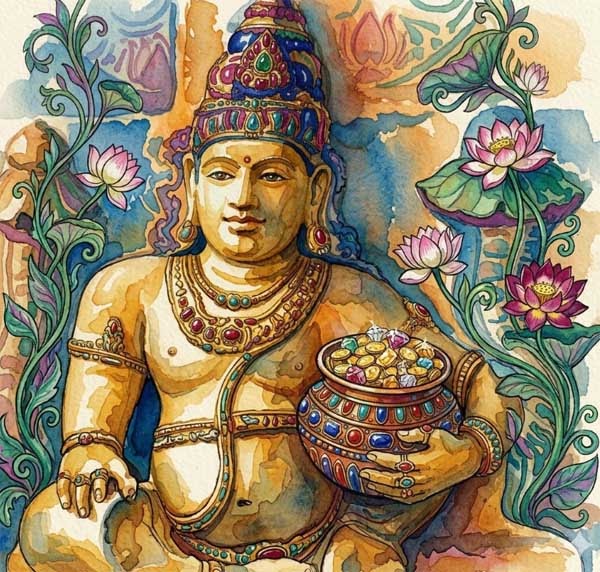
Padma Nidhi Form Of Kubera — The Divine Guardian of Abundance at the Temple Gates
In the sacred landscape of South Indian temple architecture,
few figures carry as much spiritual weight and visual grace as the Padma Nidhi.
Standing sentinel at the entrances of great temples, particularly in Tamil
Nadu, these divine forms are among the most auspicious presences in Hindu
sacred art. They are not mere decorative sculptures but living embodiments of
cosmic wealth, divine grace, and the boundless generosity of Kubera, the Lord
of Treasures.
Who Is Kubera?
Kubera, also known as Dhanada (giver of wealth), Vitteshvara
(lord of riches), and Yaksharaja (king of the Yakshas), holds a unique and
exalted position in the Hindu tradition. He is the regent of the North, one of
the Ashtadikpalas or the eight guardians of the eight directions, and is
regarded as the treasurer of the gods. The Vishnu Purana, the Mahabharata, and
the Ramayana all speak of Kubera as an immensely powerful and righteous lord
who governs the material prosperity of the cosmos.
The Rig Veda makes early references to Kubera under the name
Vaisravana, born of the sage Vishrava. Over time, his association with
treasure, abundance, and the guardianship of sacred spaces deepened, and his
presence became inseparable from the iconographic programs of Hindu temples.
“Dhanada tvam samriddhyartham yakshanam adhipo
bhava” — “You, the giver of wealth, shall become the lord of the
Yakshas for the prosperity of all.” (Vishnu Purana)

The Nidhis — Kubera’s Nine Divine Treasures
One of the most theologically rich aspects of Kubera’s
worship is his association with the Nava Nidhis — the nine divine treasures.
These are not ordinary riches but personified cosmic powers, each representing
a different form of abundance. The nine Nidhis are: Padma, Mahapadma, Shankha,
Makara, Kachchhapa, Mukunda, Nanda, Nila, and Kharva. Together they represent
the fullness of divine prosperity that Kubera holds in trust for the world.
Among these nine, Padma Nidhi holds the foremost place. The
very name Padma — the lotus — signals purity, spiritual perfection, and
material abundance born of righteousness. The lotus, rooted in mud yet blooming
in pristine beauty, is one of the most potent symbols in Hindu thought,
appearing in the hands of Lakshmi herself as a sign of sriman, the auspicious
fullness of being.
Iconographic Description of Padma Nidhi Form Of Kubera
The sculptural form of Padma Nidhi as found in Tamil Nadu
temples follows a carefully prescribed iconographic canon. He is depicted as a
benevolent, two-armed figure seated in ardha padmasana, a half-lotus posture
that combines earthly accessibility with spiritual elevation. His right hand is
raised in abhaya mudra, the gesture of fearlessness and reassurance, conveying
to the devotee that all fear is removed upon entering the sacred precinct. His
left hand holds a pot overflowing with gold coins and precious gems, the visual
declaration of his inexhaustible wealth.
Flanking the figure on both sides are two graceful stalks or
elaborately decorated creepers, each crowned with a full-blown lotus blossom at
the top. These lotuses are not incidental adornments. They reinforce the
identity of this figure as Padma Nidhi specifically, as opposed to the other
Nidhis. The creepers themselves, winding upward in organic beauty, evoke the
idea of prosperity growing naturally from a pure foundation — wealth that is
neither forced nor stolen but organically arising from virtue and devotion.
The overall impression of the sculpture is one of serene
munificence. There is no ferocity, no martial energy. This is the Kubera aspect
at its most welcoming — wealth offered freely, protection given
unconditionally, and the devotee invited to enter the temple under divine
patronage.
Placement at the Temple Entrance — Sacred Symbolism
The placement of Padma Nidhi sculptures flanking the
entrances of temples is deeply deliberate and scripturally grounded. In the
Agama Shastra tradition, which governs the construction and iconographic
programs of South Indian temples, threshold spaces are considered liminal zones
of extraordinary spiritual power. The dvara or doorway is not merely a physical
passage but a cosmic gateway between the profane world and the sacred interior.
By placing Padma Nidhi at this threshold, the temple
architects and priests communicated a profound theological message: that one
who crosses this threshold enters under the protection and blessing of divine
abundance. The devotee is not merely entering a building but stepping into the
domain of Kubera’s generosity, guaranteed safety, and showered with the grace
of the Nidhi.
The Manasara, an ancient Sanskrit treatise on architecture
and iconography, emphasizes that the placement of auspicious guardian figures
at temple entrances is essential for the sanctity and completeness of the
sacred structure. Dvarapalas, Nidhis, and other threshold deities together
constitute the protective and auspicious framework within which divine worship
can unfold without obstruction.
“Dvari sthapayitavyau tu nidhi dvitayam uttamam” —
“At the doorway, the two foremost Nidhis are to be established.”
(Manasara Silpa Shastra)
The Lotus as a Symbol of Pure Abundance
The centrality of the lotus in the Padma Nidhi form deserves
particular attention. In the Bhagavata Purana and the Devi Bhagavata Purana,
the lotus is described as the abode of Lakshmi, the goddess of wealth and
fortune. The sacred text declares:
“Padme sthita Padmavarna, Padmakshi Padmasambhava”
— “She who abides in the lotus, who has the color of the lotus, whose eyes
are like the lotus, who is born of the lotus.” (Devi Bhagavata Purana)
When Padma Nidhi stands flanked by lotuses on creepers, the
sculptor encodes a visual theology: this form of Kubera is aligned with
Lakshmi’s grace, drawing from the same spiritual source of pure, dharmic
abundance. The wealth dispensed by Padma Nidhi is Lakshmi-blessed wealth,
untainted by adharma.
Kubera and the Concept of Dharmic Wealth
A vital aspect of Kubera’s spiritual significance, often
overlooked in popular understanding, is that his wealth is always tied to
dharma — righteous conduct. He is not merely a god of material riches but the
guardian of wealth in its spiritually sanctioned form. The Mahabharata
repeatedly emphasizes that Kubera’s treasures flow only toward those who earn
through right action.
In the Yaksha Prashna episode of the Mahabharata, the themes
of dharma and prosperity are intimately interwoven, reflecting the ancient
understanding that true wealth is inseparable from moral integrity. The
presence of Padma Nidhi at temple thresholds thus also serves as a subtle
reminder to the devotee: enter with a dharmic heart, and this abundance is
yours.
Regional Significance in Tamil Nadu Temples
The prevalence of Padma Nidhi sculptures in Tamil Nadu
temples reflects the deep integration of Agamic tradition into Dravidian temple
architecture. Temples of the Chola, Pallava, Pandya, and Vijayanagara periods
all feature these forms with remarkable consistency, suggesting that their
presence was not merely aesthetic but a canonical requirement.
In great temple complexes such as those of Thanjavur,
Madurai, Kumbakonam, and Chidambaram, Padma Nidhi and his companion Shankha
Nidhi are typically found as a pair on either side of the main entrance or the
sanctum doorway. Together they form a complete statement of divine welcome: one
offering abundance, the other offering the sanctifying grace of the cosmic
conch. Devotees performing pradakshina — circumambulation of the temple —
encounter these forms at key junctures, reinforcing the prayer for prosperity
and protection at every sacred turn.
The Living Presence of Divine Abundance
Padma Nidhi is far more than a sculptural convention. He is
a theologically precise and spiritually potent embodiment of the Kubera
principle — that the divine cosmos is a place of boundless generosity, that
sacred space is protected by gracious and abundant powers, and that the devotee
who approaches with faith is embraced by wealth, fearlessness, and the eternal
benediction of the lotus.
In every temple where he stands, arms raised in reassurance
and hand full of golden gifts, Padma Nidhi silently proclaims the ancient Hindu
vision of a universe governed not by scarcity but by divine plenitude — a
universe where the treasures of the spirit and the gifts of the earth both flow
from the same inexhaustible sacred source.