
Cars are moving to 48V power systems. A new design shows how power can flow easily, use less wiring, and still run old 12V parts.
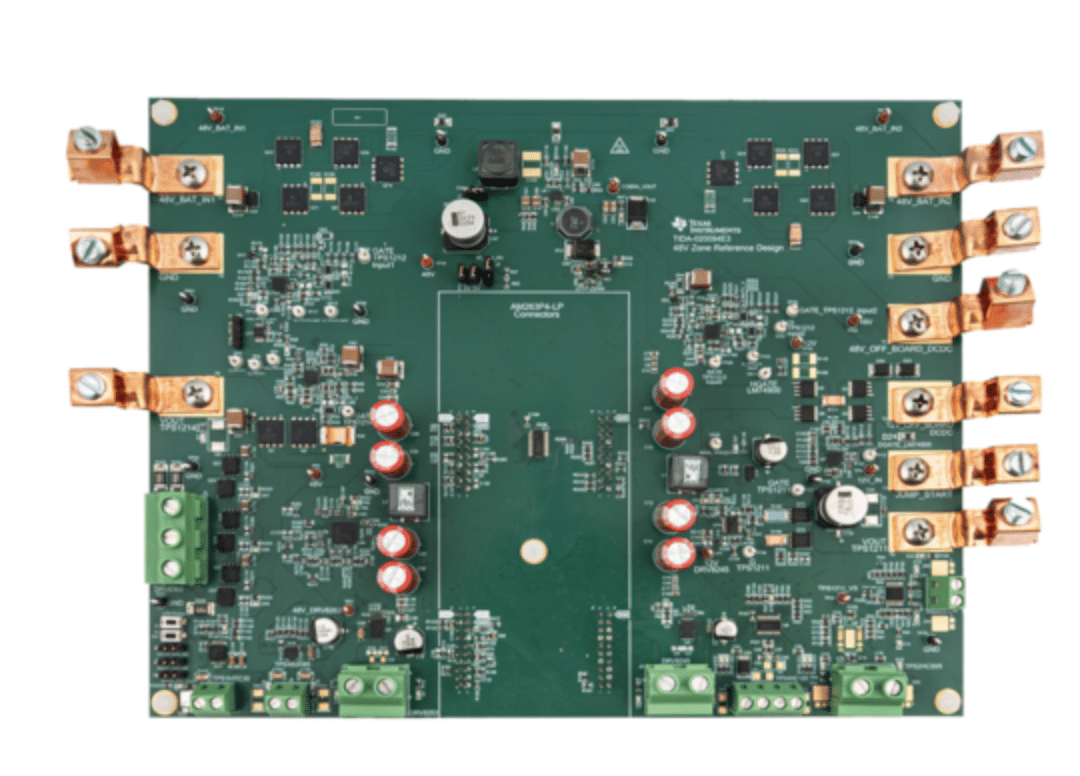
A 48V zonal power architecture is emerging as automakers redesign vehicle electrical systems. The TIDA-020094 reference design from Texas Instruments shows how this transition may be implemented at the system level. The platform demonstrates a 48V backbone power distribution structure, 48V-to-12V conversion options, and the types of load drivers required to support mixed-voltage automotive electronics.
The design focuses on how power moves across a zonal vehicle architecture. Instead of relying on centralized power distribution boxes, the approach distributes power through a 48V backbone that links multiple zone control modules (ZCMs). Each module connects in series along this backbone. The structure allows power to move in both directions between zones, enabling the system to continue operating even when power sources shift between modules.

This backbone approach reflects a broader change in automotive electrical design. Traditional vehicles use large power distribution boxes that route high currents across long wiring harnesses. When the supply voltage increases to 48V, the current required to deliver the same power decreases. Lower current reduces wiring size and losses, which makes centralized power distribution boxes less necessary. In a zonal system, the zone control module instead takes responsibility for both primary and secondary power distribution within its area of the vehicle.
The reference design evaluates how such a backbone behaves at the system level. Dual high-side switch controllers form the core of the backbone interface. Multiple zone modules can be connected in series so engineers can observe how power flows through the chain of zones. The platform also allows testing of fault conditions that occur when different supply voltages interact, such as short circuits between 48V and 12V load drivers.
A separate connector on the board allows engineers to evaluate different 48V-to-12V conversion approaches. Although the main vehicle supply may shift to 48V, the 12V rail remains necessary because many existing vehicle components still operate at that voltage. Lighting systems, body electronics, infotainment modules, and other legacy loads continue to require a 12V supply.
These legacy loads create significant power demand inside each zone. In many cases, the power requirement ranges between about 500 W and 1 kW. This demand makes the 48V-to-12V conversion stage an important design decision. Engineers must select a topology that meets efficiency, cost, and integration requirements while also fitting into the zonal architecture.
Several power conversion options are under evaluation. Switched capacitor converters and switched tank converters are two approaches designed to handle higher power levels with compact designs. Other possibilities include LLC converters, buck-boost converters, and conventional buck converters. Each topology has different characteristics in terms of size, efficiency, complexity, and bidirectional power capability.
As automakers move toward zonal architectures, the combination of a 48V backbone and distributed zone modules may simplify vehicle electrical systems. Fewer centralized distribution components, shorter wiring paths, and integrated power management within each zone could reshape how future vehicle power networks are designed.
TI has tested this reference design. It comes with a bill of materials (BOM), schematics, assembly drawing, printed circuit board (PCB) layout, and more. The company’s website has additional data about the reference design. To read more about this reference design, click here.