
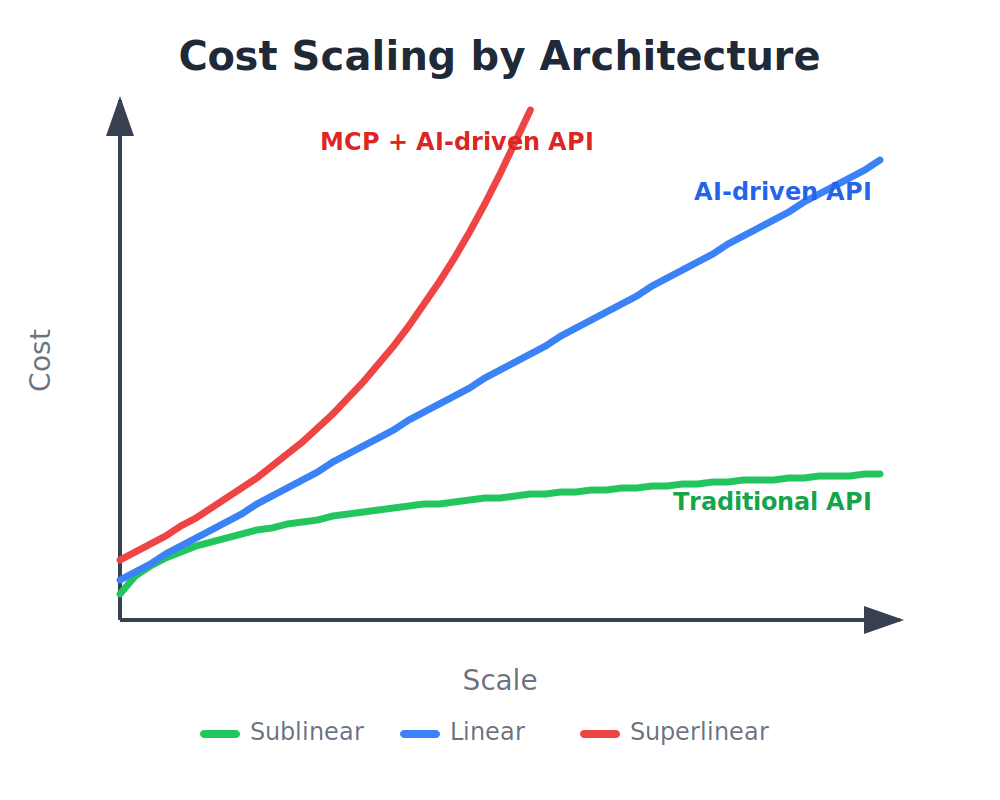
An enterprise builds an AI-powered contract review API that costs $1.58 per document to process: loading the contract, running five extraction passes through an LLM, flagging risks, and generating a summary. The unit economics are reasonable, and the API works well when called by internal applications. Then the team exposes this API via MCP for agentic consumption, making it an agentic API.
On Friday evening, an agent hits a timeout and begins retrying. By Monday morning, that single document had been processed a thousand times. Multiply that across a batch of a thousand contracts, and the weekend bill reaches $1.6 million. Traditional APIs had powerful economics due to sublinear cost curves. Cost curves for AI-driven APIs are steeper and more linear due to token economics, but manageable. Once an AI API is exposed via MCP for agentic consumption, costs can spiral out of control when agents behave unpredictably.
Through the lens of a standard API gateway, every single request passed validation. The token was valid, the rate limits were respected, and the scope was authorized. The gateway approved each one because it evaluated requests in isolation, with no way to recognize that request #847 was similar to request #846 that preceded it. This exposes a fundamental problem: stateless API gateways are not equipped for agentic consumption. The architectural assumptions that served the API management industry for decades break down when non-deterministic agents become API consumers.
The Blind Proxy Problem in Agentic APIs
An AI gateway cannot see the LLM’s intent or reasoning. It can only observe the token usage, the tool being called, and the parameters being passed. It cannot tell whether the current request is the 500th retry of a failed operation, or whether an agent is drifting from document search to admin database exports. Each individual request appears valid, but the pattern remains invisible, which is why the gateway functions as a blind proxy.
Enterprise customers are starting to explore whether gateways can track conversational context as they encounter the limits of stateless architecture in production. Most MCP gateway implementations today focus on securing MCP and per-request observability. They use Mcp-Session-Id for routing such as to ensure requests hit the same backend, but not for behavioral governance like loop detection or cumulative spend tracking. The session identifier exists, but the session-aware intelligence does not.
Human-consumed APIs never had this problem. These API consumers are accountable (through API keys), their behavior is predictable (following similar code paths), and they give up quickly (such as after a few retries). While inputs may differ, the code is not rewritten on the fly. Agentic consumption exhibits none of these characteristics. They create identity gaps, blurring the line between user responsibility and agent autonomy. They execute non-deterministically and hallucinate parameters, meaning the same prompt can trigger dramatically different tool calls. Agents retry execution relentlessly until an outcome is achieved.
For traditional APIs, fixing both intentional and unintentional API abuse has always been a game of whack-a-mole. However, fixing MCP abuse is like playing whack-a-mole at a thousand rounds a minute. The agent is changing its behavior faster than you can close gaps.
“Fixing API abuse is playing Whack-a-Mole…Fixing MCP abuse is playing Whack-a-Mole at a thousand rounds a minute.”
Three Pillars of Agentic API Governance
Governing agentic APIs requires a framework built on three pillars: economic, behavioral, and identity. Each operates across the request, session, and organization levels. Session-level governance is where the most significant challenges emerge, as most API gateways minimize statefulness for scalability and performance.
Economic governance is typically where teams first feel pain. Recently, AI gateways introduced token-level rate limiting as AI API requests can have dramatically different LLM cost profiles. However, token-level limiting falls short once agentic consumption is introduced. A token rate limit measures throughput, not waste; a slow retry loop passes every rate limit while burning money for hours. Thus, static limits will evolve into session-based tracking keyed to an Mcp-Session-Id: accumulated costs, spend velocity monitoring that flags abnormal burn rates, loop detection, and hard caps that trigger a kill switch when thresholds are exceeded. When an agent has submitted 127 identical requests and consumed $200 at $3.21 per minute, that pattern is actionable intelligence to avoid the $1.6 million problem shared at the beginning.
Behavioral governance addresses what agents are allowed to do and catches mistakes humans would not make as agents do not respect boundaries. When an agent with read: data scope attempts to call DELETE /users/all, the gateway must recognize that scope does not equal action and block the request. While best practice was a fine-grained API scope, this is now critical for agentic consumption.
Subtler problems require session context to detect. An agent that begins with document search, progresses to HR records, and then requests a database export may be submitting individually valid calls with correct scopes, but the sequence reveals privilege escalation. Detecting scope drift, applying risk scoring, and triggering human-in-the-loop approval all require tracking behavior across sessions.
Identity governance presents the most difficult retrofit challenge. What happens when an agent needs to consume an API it has just discovered? Traditional OAuth was not designed for autonomous agents as it assumes a human registers applications through a developer portal to get credentials. Agents need to move at machine speed. The MCP specification in 2025 addressed this through Client ID Metadata Documents (CIMD), which allow agents to host their own identity, enabling agents to self-register securely without human provisioning workflows. By adopting CIMD, agents can register in milliseconds, moving at the speed of the LLM rather than the speed of the developer portal.
Accountability is equally important. If a user spawns 1,000 agents, with each spawning even more agents, you need to know both who the user is and which agent is acting so that audit logs can identify which agent deleted records at 3 AM. Tokens must capture and validate both user and agent identity so that audit trails and compliance reporting can attribute actions accurately.
The AI Gateway Becomes Session-Aware
Implementing this framework requires a hybrid architecture. Identity validation should remain stateless, handling JWT signatures, claim extraction, and CIMD validation to enable horizontal scaling. Governance, however, evolves to be stateful, tracking spend, accumulated counts, and behavioral patterns in a cache indexed by Mcp-Session-Id. This session state transforms a blind proxy into an intelligent governor for your agentic APIs, one that can detect loops, scope drift, and escalation patterns that per-request validation will never catch. A short-lived cache (like Redis or Memcached) allows for session-aware tracking with sub-millisecond overhead. This will require a rethink of enterprise architecture and middleware. For the last 20 years, enterprise architecture settled on stateless RESTful APIs, with statefulness often seen as an enemy of scale. Agentic consumption is now undoing those trends.
Gartner predicts that over 40% of agentic AI projects will be canceled by 2027, primarily due to escalating costs and inadequate risk controls. Companies today face competing mandates: they must ship MCP capabilities quickly to remain competitive while also governing agentic consumption before it causes enterprise-wide damage. Most organizations are prioritizing speed and assuming they can retrofit governance later.
That approach introduces tremendous risks. The $1.6 million weekend is not an edge case to address in future iterations; it is the predictable outcome of applying stateless governance to fundamentally stateful problems. Teams that recognize this early will build a strong governance infrastructure from the beginning, designed for agentic consumption. Those who do not will learn the same lesson at far greater cost.