
[CLIP: Theme music]
Kendra Pierre-Louis: For Scientific American’s Science Quickly, I’m Kendra Pierre-Louis, in for Rachel Feltman.
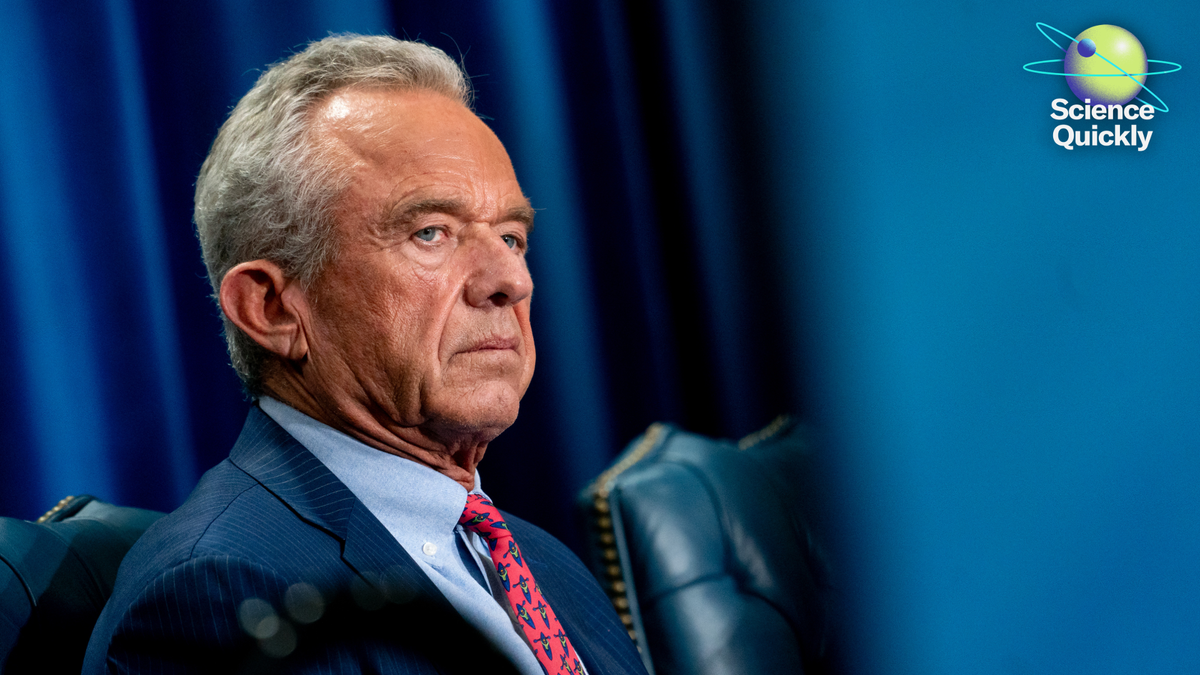
Last February, Robert F. Kennedy, Jr., was sworn in as the U.S. secretary of health and human services. The HHS, which oversees the Centers for Disease Control and Prevention and the U.S. Food and Drug Administration, is effectively the nation’s public health department. It’s responsible for protecting the health of the American people.
On supporting science journalism
If you’re enjoying this article, consider supporting our award-winning journalism by subscribing. By purchasing a subscription you are helping to ensure the future of impactful stories about the discoveries and ideas shaping our world today.
And yet, since assuming the role, Secretary Kennedy has often taken actions that have contradicted best practices in public health. The CDC no longer recommends hepatitis B vaccine for all newborns, and last August the HHS cut funding for 22 mRNA vaccine development projects. The secretary has proffered up unproven treatments for measles and muddied the waters on the effectiveness of the measles vaccine amid one of the largest measles outbreaks in recent memory.
When the health secretary hasn’t been undermining vaccines, he has been propping up fringe health theories, such as that seed oils are uniquely unhealthy.
[CLIP: RFK, Jr., speaks in an August 24, 2024, interview on Fox & Friends Weekend: “Seed oils … they are associated with all kinds of very, very serious illnesses, including body-wide inflammation.”]
Pierre-Louis: And the false conspiracy theory that the U.S. military bioengineered Lyme disease.
[CLIP: RFK, Jr., speaks on a January 19, 2024, episode of the RFK Jr Podcast: “Hey everybody, today we’re gonna talk about Plum Island, the military laboratory 257 and the origins of Lyme disease.”]
Pierre-Louis: Undergirding his actions is a belief system that many public health experts say is not only at odds with almost everything we know about public health but is indicative of what some are calling, quote, “soft eugenics.”
While eugenics of the 20th century focused on forced sterilization, the idea is that soft eugenics takes a different tactic. It focuses on enacting policies to take away lifesaving health care, like vaccines, from the most vulnerable. The presumed goal is for nature to take its course, leaving a wake of dead bodies and allowing only the so-called genetically superior to survive.
When asked about this characterization, an HHS spokesperson wrote in an e-mail to SciAm that it was, quote, “absurd” and that the secretary, quote, “continues to focus on ensuring that vaccines … meet the highest standards of safety.” So today we take a deep dive into what we know the health secretary believes, how that ties into eugenics and the effects of his policies that are already being felt. We begin with Dan Vergano, a senior editor at Scientific American, who, in February, wrote a story about how Kennedy has already altered public health.
Pierre-Louis: Thanks for taking the time to chat with us today.
Dan Vergano: Great to be here.
Pierre-Louis: The first thing that struck me was something that you wrote in the piece, which is that during his confirmation hearings, he pledged not to fire anyone who was doing their job, but almost as soon as he was confirmed there were massive layoffs of staff. Can you talk about those layoffs, especially in concert with some of the appointments and hirings that he has made?
Vergano: Despite his pledge, there were huge layoffs at HHS, and that’s serious blows to agencies like FDA, CDC and [the National Institutes of Health]. We’re talking about thousands of people at each place leaving: NIH directorships, which are very experienced people, gone. CDC senior leadership, people who are very experienced at responding to outbreaks of all kinds, have left, and they’ve left over, you know, sheer disagreement with RFK, Jr., including his own handpicked CDC director. So it’s a major whack to the scientific establishment in the U.S.
The most famous, probably, staffing changes made was on the vaccine committee at, at CDC, which became famous in the pandemic as the place where, you know, vaccines were sort of evaluated. And he removed very accomplished people, very good vaccine experts, and replaced them with people who have an antipathy to vaccines in their background. And the outcome of all this has been a great deal of lost public trust in …
Pierre-Louis: Mm-hmm.
Vergano: The agencies who are evaluating vaccines.
Pierre-Louis: I wanna talk a little bit about the health secretary’s approach to infectious disease specifically: his guidance on bird flu, for example; how he’s been handling the measles outbreaks that have been sort of popping up kind of continuously since—during his tenure; and his broader attitudes towards vaccines and, quote, unquote, “natural immunity.”
Vergano: Right, what we’re seeing in his response to the measles [outbreaks], to vaccines in general, this idea of fostering natural immunity and even his advice to the farmers about bird flu is a sort of import from the wellness industry, at least the side of it that disdains sort of established medicine, of which vaccines are part of it. And, and their nostrum, which is, you know, a century old or more, is that, you know, healthy people don’t get sick, and furthermore, diseases and so forth like, weed out the weak, and we should just let that happen.
This idea that the chickens should just be allowed to have bird flu ravage them and then the ones that survive will be the ones that are resistant and we’ll breed up the chickens again from them—like, superior genes somehow guaranteeing, like, perfect health all the time that’s, in fact, wrong and, you know, is an, an idea that, you know, owes more to the “survival of the fittest” notions from 150 years ago rather than any actual science today. And then likewise, the idea that vaccines only help people who are sick and somehow not deserving to live, which is—we saw this kind of rhetoric in the pandemic.
And, you know, for measles itself …
Pierre-Louis: Mm-hmm.
Vergano: He said it’s very hard for a healthy child to die of measles, which is wrong. [CLIP: RFK, Jr., appears on Fox on March 4, 2025: “It’s very, very difficult for measles to kill a healthy person.”]
Vergano: One of the children who died in Texas, the—people remarked, was just a healthy-as-could-be kid.
So all you’re gonna do is make a bunch of kids sick; injure their immune systems, actually, the ones who live …
Pierre-Louis: Mm-hmm.
Vergano: And cause a lot of unnecessary misery.
I mean, he did come back, though, and later say, like, “Get the measles shot,” when it became a political liability. But we still got outbreaks because it’s a very infectious disease, and if you’re not vaccinated, you’re probably gonna get it.
Pierre-Louis: How does all of this tie into his “Make America Healthy Again,” or MAHA, campaign?
Vergano: So MAHA owes a lot to the wellness industry, which is, you know, an outgrowth of 100 years of these sort of notions of being “well” is sufficient against diseases, and then medicines, actually, are things to be avoided. Simply, you know, eating the right food, doing the right exercise, living a healthy life is enough to sort of be healthy, and this other stuff is suspicious, medicines and so forth.
And a lot of the wellness ideas are ones that nobody could argue with. The critique of it is that it’s feel-good stuff for people who are already well-off. It’s a lot easier for, you know, a wealthy mom who has a nanny taking care of the kids to make sure she gets to the gym four times a week and eats organic vegetables rather than a working mother, you know?
And so the wellness-movement rhetoric, it just sort of permeates a lot of his talk, and it’s sort of what’s brought him adulation in the antivaccine movement and before he launched his presidential campaign.
Pierre-Louis: There’s also this element with, like, his new inverted food pyramid and the way that he discusses what he eats, for example, cooking everything in beef tallow and, like, the fear of seed oils were even in there. The rhetoric that he’s espousing about eating healthy doesn’t seem to be in line with the science.
Vergano: Right, this, this is a strain in the, the wellness movement that people have noted. It’s a kind of nostalgia for an America that never was, where we had a steak and eggs for breakfast and …
Pierre-Louis: Mm-hmm.
Vergano: A pile of flapjacks, it was sunny every day, and we felt great—not coincidentally, when we were young. That also is tied into this notion that real food is real, gosh darn it, and, like, nothing’s more real than a steak.
Pierre-Louis: Mm-hmm. Or raw milk.
Vergano: Or raw milk.
And so that’s this sort of nostalgic, wishful thinking that’s, you know, a shame in some ways because, actually, eating, you know, fruits and vegetables is—a banana is, is, again, better than a Milky Way bar for you.
Pierre-Louis: What would you say, looking at RFK, Jr.’s efforts over the past year, would you say are kind of the biggest takeaways of his tenure so far?
Vergano: The big takeaway is that, underneath it all, he’s still just a politician. When push comes to shove, he endorses the measles vaccine. When push comes to shove, he doesn’t critique pesticides and ultraprocessed food because that’s inconvenient for the administration.
He’s doing a lot of things that, you know, he wants to do in terms of harming trust in vaccines. You can point to him as an antivaccine activist, and that’s okay, but you do have to keep in mind that this is a guy who wanted to be president and that when, you know, push comes to shove, that’s who he really is.
Pierre-Louis: COVID kind of caught us flat-footed in 2020. Where do you think we are now in relation to 2020?
Vergano: We’re undoubtedly worse off, not because we know less or we won’t know what to do, but because the things we did that were good have been discredited, the non-pharmaceutical interventions—the social distancing, things like that.
So it looks like everything is poised for a mess, that even the things we know now work won’t be employed because they’ve become politically unpalatable to the people in charge. There’s this sort of let-it-rip idea to deal with an outbreak, which is gonna be disastrous if there’s a disease that’s as deadly as COVID was initially and to which we have no natural immunity.
[CLIP: Music]
Pierre-Louis: When COVID first started spreading, there was no vaccine. In contrast, we’ve had safe and effective vaccines for measles since the 1960s. And yet, amid the 2025 measles outbreaks in states like Texas and South Carolina, critics say federal health messaging about vaccination was delayed.
During much of that time, Secretary Kennedy was suggesting ineffective treatments for measles while working to unwind the childhood vaccine schedule. In January, while discussing South Carolina’s measles outbreak, the CDC’s then-number two Ralph Abraham said of communities choosing to forgo vaccination, quote, “That’s their personal freedom,” and that the U.S. potentially losing its measles elimination status was, quote, “the cost of doing business.” All of this raises one question: Why are we doing this?
To get a sense of the ideology that guides the health secretary, we spoke with Beth Mole, a senior health reporter with Ars Technica. She wrote an article last year explaining that Secretary Kennedy doesn’t believe in a foundational concept of public health.
Pierre-Louis: Hi, Beth. Thank you so much for joining us today.
Beth Mole: Thank you for having me.
Pierre-Louis: There’s been a lot of attention about Health Secretary Robert F. Kennedy, Jr., what he says and what he does, but you wrote a really fascinating article about what he believes. Why did you decide to do that?
Mole: I had been following RFK, Jr.’s career before he became health secretary, so I was very familiar with the rhetoric that he uses in terms of his antivaccine advocacy. Hearing his thoughts about vaccination and infectious diseases and then sort of drawing on his more environmental legal background—hearing his thoughts on, you know, natural living and, you know, pollution and, and toxins in the environment, things like that—and I think if you, like, drill down and get a, a broader perspective of where he’s coming from in his long advocacy against vaccines, you see a more complete picture. And I think it really comes down to his rejection of germ theory.
So germ theory is this pretty basic idea that germs are in the environment—bacteria, viruses, fungi—and they can cause diseases. And we take precautions to prevent them from causing diseases, including vaccines, but also antibiotics and sanitation.
My understanding of his idea is that he understands that germs are real [Laughs], which is an important caveat to include because there are people who don’t accept that germs are real. He’s been in the news for saying that he is not afraid of germs because he—and he mentions that he, like, snorted cocaine off of a toilet seat.
[CLIP: RFK., Jr., speaks on a February 12 episode of the podcast This Past Weekend w/ Theo Von: “And I said, ‘I’m not scared of a germ—you know, I used to snort cocaine off of toilet seats.’”]
Mole: He just feels that another theory supersedes germ theory: so germs exist, but we don’t get sick because of them; we get sick because there’s some weakness in us. We have not been eating well. We don’t live a healthy lifestyle. We have some genetic disposition that we can’t control—whatever it is. Maintaining a healthy lifestyle should be the focus of disease prevention, whether it’s an infectious disease or a chronic one.
Pierre-Louis: It kind of feels like he’s tapping into something we all kind of know intuitively, right, that if we don’t treat ourselves well, we can pick up something that our immune system might’ve fought off. But he’s taking that kind of nugget of truth and extending it to, “If you’re healthy enough, you won’t get measles.” And that’s an incredible circular logic, but it’s also a dangerous one because how do you learn that you’re not healthy? [It’s] by potentially getting a life-threatening illness.
Mole: Right. A lot of the things that he says, they’re dangerous because there’s little kernels of truths that people can [glom] onto, and they think, “That makes sense to me, so I’m going to believe everything else he’s saying.”
He discusses germs as if they’re all sort of opportunistic. And there are opportunistic pathogens, right? There’s germs that you just don’t see unless you know that someone has, like, a severe health condition; they’re immunocompromised. But there is this—certainly these classes of pathogens that cause disease to live, and they don’t care how well you eat. [Laughs.] They don’t care if you could do shirtless pull-ups in an airport or whatever.
So a lot of RFK, Jr.’s theories kind of feed more into another theory, not germ theory but one called terrain theory, which is this idea that diseases are due to an imbalance in your internal terrain—the things that are supposed to go on in your body, your microbiome, there’s a disturbance, a “toxemia” is what they, they like to call it. That is the root of all disease.
So it really places the blame of all illnesses on an individual and, you know, if you’re born with, like, some condition that weakens your immune system for some reason. You know, it just puts the blame on those individuals, which is just horrible.
Pierre-Louis: Mm-hmm.
Mole: And then also, when you enact policy based on [these] ideas, you’re getting towards sort of this idea like, there are people who are weak or sickly, and if we are going to have a healthy population, we don’t need to vaccinate everybody, and if you’re not vaccinated and you can’t handle the disease, then it’s bad for you, you know, I guess. The logical extension of these ideas is really horrifying.
Pierre-Louis: It also seems like he’s tapping into this fixed identity of health, as opposed to the idea that even—health kind of exists within a spectrum, you know?
Mole: Yeah, absolutely. Infectious disease transmission is, is complicated, right? Newborns don’t have fully developed immune systems, and, you know, then they’re hit with a world full of new germs. And then, of course, older people, they go through immunosenescence, so their immune responses decline with age. And that’s why we see things like shingles, reactivation of the virus that causes chickenpox, and so we get vaccinated for that. So there’s a spectrum of, of health, and it’s absolutely true that there’s no amount of healthy living to ward off all diseases.
And so I think one of the things that Kennedy does that is really deceptive is that he creates that sort of false dichotomy. It’s: “We need to stop emphasizing drugs and vaccines and modern medicine generally. We just need to focus on, you know, getting rid of food dyes and making sure people aren’t eating ultraprocessed food.” I mean, those are good things, too, but it’s not going to make vaccines or drugs less critical to keeping everybody as healthy as they can be.
Pierre-Louis: You’ve stated that, if you sort of follow the path laid out by Kennedy’s ideology, that it is very easy to end up in a place where the ideas that you’re weighing are eugenics. And I was wondering if you could speak a little bit more about, like, what eugenics is and how his ideas kind of relate to that.
Mole: Eugenics is the idea that you want to create a population of people that have superior genetics, superior health, fitness, which means anyone who doesn’t fit that doesn’t fit into that ideal population.
If you were to bring this concept up to Kennedy, I don’t think he would say in any way that he would support it. But the things that he says, the ideas that he puts forward and the policies he’s generating really do lead to it, lead to trying to create a population that is superior, healthy, has the best, you know, genetics.
One of the sort of background explanations that he has when he gives speeches, he talks about, “When I was a kid, everyone was healthy, and everyone ate, you know, good food, and there wasn’t so much cardiovascular disease.” The idea that he lived in some magical time when people didn’t get sick is, is wrong. But, you know, it creates this vision of the past that we want to have in the future.
So I think he basically sets policies that allow for people to not get vaccinated and with the idea that if they live a healthy lifestyle, they won’t need that vaccine. And that means that people who aren’t living a healthy lifestyle and do get severely ill, they will have consequences. They will have, maybe, lasting effects of that infection, or they won’t make it, and apparently, that’s an okay outcome.
I think, you know, a lot of the conversation is, is dominated by individual health, like, choices for yourself. And that’s not how infectious diseases work. [Laughs.] It’s a communal effort to not just protect ourselves individually but to protect everyone around us. And that may include vulnerable people, and a person is vulnerable because of an immune condition or a genetic condition or—or they’re pregnant. So it just puts all of those vulnerabilities in one bucket and says that these aren’t important, basically.
Pierre-Louis: I had an anecdote, which is: whenever he talks about, like, growing up and everyone being incredibly, incredibly healthy, I have a buddy who’s in his early 80s, and he grew up in Iowa, and one of the first things I remember him telling me was he remembers as a child that sometimes kids would just die. And I was like, “That was not my childhood experience.”
Mole: Yeah, I think that it comes up a lot in antivaccine groups. They’ll shrug off the measles or polio by saying, “Oh, it’s not very frequent.” So that’s [a point we’ve gotten to] with the progress we’ve made with vaccines because in the past that absolutely wasn’t the case. We don’t see children dying of measles or getting paralyzed by polio because we have these successful vaccines that have protected millions of children. And, you know, if we saw that every day [Laughs], then, you know, they would be doing what our grandparents did, which was line up for the vaccine as soon as they could.
[CLIP: Music]
Pierre-Louis: With 2,283 [confirmed] cases, 2025 was the worst year for measles in the U.S. since 1992. Cases this year have already reached more than half of that number.
When asked about the measles outbreaks, an HHS spokesperson told SciAm that the U.S.’s overall measles burden was lower than [that of] “Canada, Mexico … and much of Europe” and that the, quote, “vaccine is the best way to prevent measles.” The HHS did not respond to our question about RFK, Jr.’s beliefs about germ theory.
So how did we get here? It took centuries from the discovery of germs in the late 1600s to the rise of germ theory in the late 1800s. And yet, in 2026, we’re still debating this.
To better understand that context, we talked to our last guest, Robert Johnston, a professor of history at the University of Illinois Chicago, who is working on a book called Pox, Populism, and Politics: Three Centuries of American Vaccination Controversies. He describes the book as covering the history of immunization controversies in the U.S., from the first major event, which happened in Boston in 1721, through the present day.
Pierre-Louis: Thanks for joining us today.
Robert Johnston: Oh, Kendra, I’m delighted to be here.
Pierre-Louis: Can you talk a little bit about Boston in 1721?
Johnston: This episode in 1721, which really shook Boston to the core, occurred because Cotton Mather, who was the most powerful minister in Boston for decades, was also a scientist, and Mather was eager to try out inoculation for the first time in the Western Hemisphere when there was a smallpox epidemic in 1721.
So inoculation is different from but very much related to vaccination. It’s a kind of immunization where you actually take real smallpox material and put it into the bloodstream [or under the skin] of a person in order to produce immunity. It was indeed effective at preventing death on a mass scale. However, it was deadly itself, and it also could spread smallpox rather than just weaken an epidemic because you had people with live smallpox material circulating in the community, so it was a controversial matter.
There were a lot of inoculations. However, those were not mandated by the city or provincial government. Mandates weren’t really the key issue, as they became throughout the rest of vaccine controversies.
Pierre-Louis: Okay, so when did kind of the conversation about mandatory vaccination really sort of pick up in American history?
Johnston: Yeah, definitely throughout the 19th century, various localities and then, ultimately, states had various kinds of vaccine mandates. And schooling was the most intense site of these kinds of contests.
Pierre-Louis: I read some of your work on, like, the populist movement, I believe, in Oregon that were anti-vaxxers but also, you know, openly anti-eugenicist. And it seemed like their language and their rhetoric was about bodily autonomy, what you can do with your own body.
But right now the debate has moved from what you can do with your own body to actively trying to get rid of vaccines and making it difficult for people who want them to access them. Can you talk a little bit about that shift and, like, where it came from?
Johnston: The first thing is that antivaccinationists, especially in the early 20th century, such as Lora Little, who’s a character I look at quite a lot. She was arguably the most powerful antivaccinationist in American history. And she despised vaccines as well as vaccine mandates. For her, mandates, I think, were the more important issue. But for her, there was no rhetoric, as, as you do hear among, I think, many vaccine dissidents today.
And one of the most important books about American vaccine controversies is Michael Willrich’s Pox. He’s a legal historian, and he shows how, in fact, antivaccinationists were among the first people to develop a concept of bodily autonomy that really has a legal continuity going up to, first, Griswold v. Connecticut, which is the Supreme Court case that authorized married couples to have birth control and then was a key precedent for Roe v. Wade. So he’s avowedly pro-vaccine, but he’s arguing that, actually, if you support Roe v. Wade, in some ways, you have antivaccinationists to thank for that, historically.
And I think there are all kinds of people who don’t like vaccines for different reasons. In terms of the MAHA folks, I think there’s a really delicate dance that they’re trying to perform about the authority of the government because, in many ways, it’s a very strongly libertarian approach and, like, “Just keep the government off my body or my children’s bodies, my family’s bodies.” And on the other hand, it’s also using the government institutions to promote a kind of vision of health and public health that, in fact, can involve significant government intrusion, particularly if, for example, there’s an interference with access to vaccines.
And in that way, I would say that concern and suspicion of vaccines has been long part of the antivaccine movement, but the willingness to use government authority is new under Kennedy because people who were vaccine skeptics never had this kind of power before at all. It is greatly unprecedented.
Pierre-Louis: The thing that really strikes me is we’re in the middle, right now, of several measles outbreaks because people have opted out [of] a vaccine, and full medical freedom for all doesn’t exist when you live in a community because your choices impact my health. And then when you combine that, I think, with RFK, [Jr.]’s rhetoric, where he says things like, “Healthy people don’t get sick,” it really does feel like, at least in this modern incarnation, that it, it is almost a eugenicist argument: “If you’re healthy, you won’t get ill.”
Johnston: It’s not true. It’s just not factual, right, that if I have a good, healthy body, I’m gonna be fine; it’s all on me.
And I will say, Lora Little, as much as she differed in the politics of compulsion from Kennedy, was very much in that camp as well. She totally believed, you know, the key things were good eating, good exercise and healthy air, and that—well, and a good moral character. And then you would be …
Pierre-Louis: A good moral character.
Johnston: Yes, for sure, for sure. And that was—came from a long strain of 19th-century, and even, you know, now, natural-health kind of thinking.
In part it was a genuine reaction to the kind of medicine of the day, although that also has a legacy in our current era, where doctors focused much more on surgeries and pharmaceuticals and the like rather than exercise, which is good; nutrition, which is good; a good clean environment, with good air, good water, sanitation. And so in many ways, it was vaccine skeptics who were pushing those areas more, that that was the only way to go, that all medical interventions were dangerous.
Pierre-Louis: Okay, so some of that historically makes sense when you consider how polluted and filthy especially early cities were, right, like, industrial cities were. But we have made incredible strides in sanitation and in public health, which is why certain diseases just aren’t as common anymore. But we can also recognize that if I have the flu and I sneeze in your face, there’s a good chance I’m gonna give you the flu. [Laughs.] We still exist in spaces with each other.
And it seems to me that one of the ways that that rhetoric lives on is not just in the antivaccination but also in this, like, weird belief that everything we’re consuming right now is contaminated, where, in many ways, when you look at our food system, which might be hyper-processed in a lot of ways, but, like, we’re not living in the era of Upton Sinclair.
Johnston: Absolutely. That anti-authority, anti-expert, anti-elitism impulse can very much go toward: “All science is bad. All medicine is bad. All public health is bad. All government authority is bad.” And then that’s very dangerous.
And Kennedy, especially because he’s turbulent, he’s tormented, he’s difficult to pin down in terms of, really, where his philosophies are coming from, but ultimately, it is one that’s very antigovernment, which has then moved toward being very anti-science.
You know, the big mystery with Kennedy, of course, is just, like, how he could become such an important, responsible environmental lawyer …
Pierre-Louis: Mm-hmm.
Johnston: And then move in this direction, but I haven’t figured that out yet.
[CLIP: Music]
Pierre-Louis: That’s it for today. Tune in on Monday for our weekly science news roundup.
Science Quickly is produced by me, Kendra Pierre-Louis, along with Fonda Mwangi, Sushmita Pathak and Jeff DelViscio. This episode was edited by Alex Sugiura. Shayna Posses and Aaron Shattuck fact-check our show. Our theme music was composed by Dominic Smith. Subscribe to Scientific American for more up-to-date and in-depth science news.
For Scientific American, this is Kendra Pierre-Louis. Have a great weekend!
[CLIP: Theme music]