
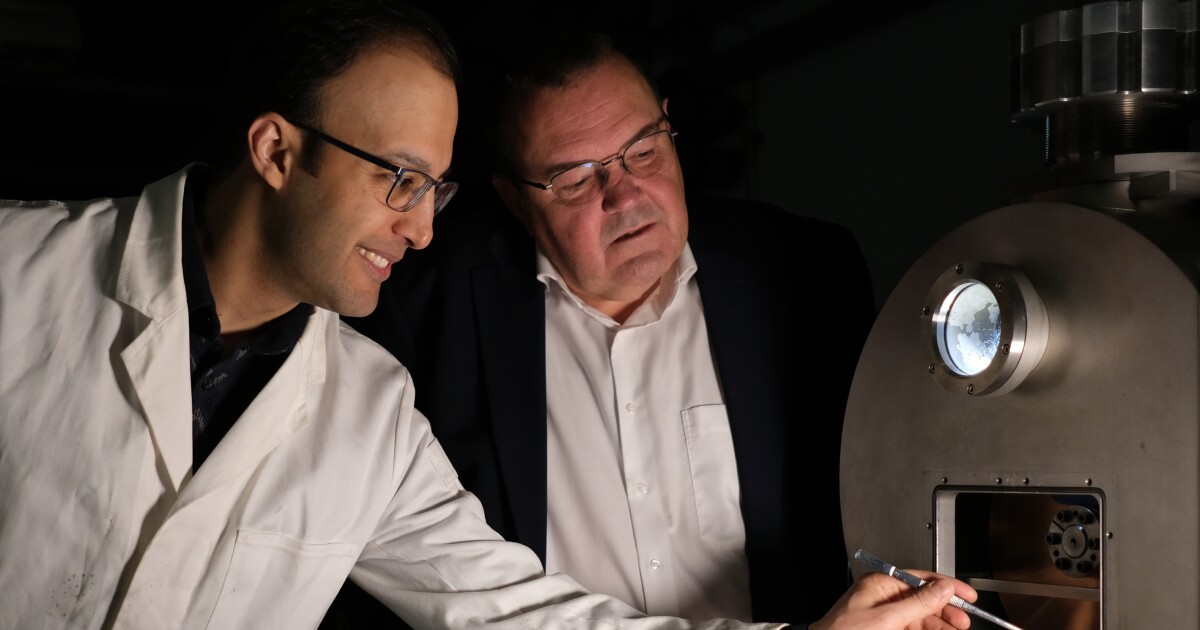
When you think of glass, you probably picture something fragile and brittle, not a material built for high-stress electromechanical components. However, researchers at Germany’s Saarland University are challenging that assumption, using a glass-like metal to significantly improve the efficiency of electric motors.
Inside every electric motor, from those found in electric toothbrushes to those in electric vehicles, a rotating component (the rotor) spins within a stationary part (the stator), creating a constantly changing magnetic field. This continuous switching of magnetic direction forces tiny magnetic regions within the metal to repeatedly realign. In conventional materials with an ordered crystalline structure, this process is inefficient. The internal structure resists these changes, creating friction at the microscopic level. That resistance leads to energy losses in the form of heat, a phenomenon commonly referred to as iron losses.
“We are looking into ways of cutting these efficiency losses by improving the materials used in electric motors. In today’s motors, the stator and rotor components are made from conventional soft magnetic, coarse-grained iron alloys. Although these alloys are already optimized, they still exhibit relatively high hysteresis losses during re-magnetization. We want to replace these conventional crystalline alloys with amorphous, glass-like alloys, as they lose hardly any energy during re-magnetization,” explains Prof. Ralf Busch, head of the research team.
Unlike conventional metals, metallic glasses do not have a crystal lattice. Their atomic structure is amorphous, with atoms arranged randomly rather than in repeating patterns typical of metals, making them more like glass than metal. Without a rigid crystal structure getting in the way, the magnetic domains can reorient much more freely when the magnetic field changes. As a result, far less energy is wasted during magnetization and demagnetization cycles, dramatically improving motor efficiency and reducing heat generation.
“Because metallic glasses have no crystallites, the magnetic regions – known as Weiss domains – are not obstructed and can reorient freely when the magnetic field changes,” says Busch. “The magnetic properties of metallic glasses are therefore exceptionally well suited for use in electric motors.”

Pasquale D’Angiolillo/UdS
The name “metallic glass” can be a bit deceptive, as glass is typically thought of as brittle and fragile. In reality, metallic glass is often stronger than steel! The term “glass” refers purely to its internal amorphous atomic structure. This structure is achieved by carefully selecting a mix of elements, melting them, and then cooling the molten material rapidly enough that the atoms “freeze” in place before they can organize into a crystal lattice.
The manufacturing method for the electric motor components was equally critical in the research. The team explored Laser Powder Bed Fusion, a form of metal 3D printing. In this process, fine metal powder of the alloy is melted layer by layer using a laser, then rapidly cooled so that the material “freezes” into its amorphous, glass-like state before crystals can form. This process is critical, as it maintains the non-crystalline structure that gives the material its beneficial magnetic properties.
Obtaining a metallic glass alloy with the right set of properties to replace conventional electric motor materials, while being 3D printable, has been the key goal of Busch’s EU-funded research project. The team has finally achieved this goal.
“We selected hundreds of alloys and tested their resistance to crystallization. In an alloy containing five elements, that meant searching through a five-dimensional compositional space. If an alloy fails, it’s back to the drawing board for a complete redesign. The breakthrough came just over a year ago,” says Ralf Busch.
Busch and his team successfully identified three alloys that resist crystallization and possess the properties required to reliably 3D print fully glass-like metallic motor components. Given the ubiquity of electric motors, the impact of this breakthrough could be substantial. Better materials mean more efficient, longer-lasting motors with reduced energy losses and heat generation. In practical terms, this could enable faster, more energy-efficient electric vehicles; drones with extended flight times; e-bikes with greater range; and industrial machines that consume less power while delivering higher performance.
The project is supported by the EU and has received over €3.5 million (US$4.035 million) as part of the broader AM2SoftMag (Additive Manufacturing of Amorphous Metals for Soft Magnetics) project consortium.
Source: Saarland University