
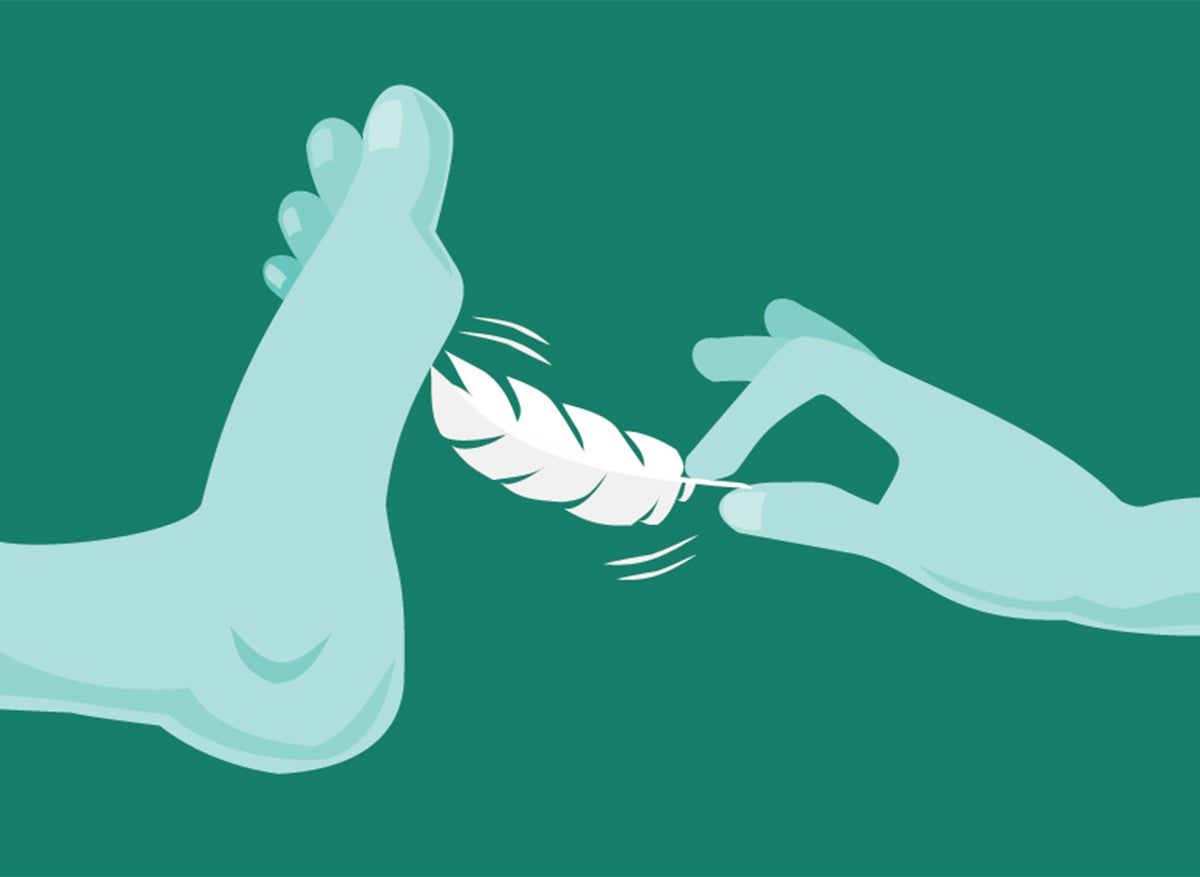
When I walk into my laboratory on weekday mornings, it is not unusual to hear uncontrollable shrieks of glee or fits of giggles. Laughter is not traditionally thought of as the noise of neuroscience, but my research group is somewhat unusual. In the Touch & Tickle Lab, we invite participants to experience Hektor, the tickle robot, in the name of scientific progress.
In a typical visit, participants remove their shoes and socks and then sit in what looks like a dentist’s chair. My colleagues and I position their feet on a platform, under which lies Hektor, a robot composed of three electric motors. During a tickle session, Hektor slides probes along the soles of the participants’ feet, and they report back on just how much each stroke tickled on a scale of one to 10. Throughout this process, we track people’s facial expressions, heart rate, muscle activity, breathing and skin conductance (which tells us if they are sweating). Electrodes placed on participants’ scalps reveal their brain activity.
Being tickled is a sensation most of us instantly recognize, and some of history’s greatest thinkers were fascinated by this odd phenomenon. Socrates described the feeling as a mix of pain and pleasure. Aristotle thought ticklishness was a consequence of humans’ delicate skin. And Charles Darwin wrote extensively on the subject, hypothesizing that we may be most ticklish in spots that are not frequently touched and only in certain psychological contexts.
On supporting science journalism
If you’re enjoying this article, consider supporting our award-winning journalism by subscribing. By purchasing a subscription you are helping to ensure the future of impactful stories about the discoveries and ideas shaping our world today.
Today I and other neuroscientists are still puzzling over many fundamental mysteries: Does tickling have a biological function of some kind—and if so, why did we evolve to have this experience? What happens in our nervous system to cause this unique feeling? Why are certain areas of the body more sensitive than others? Why do people respond in different ways to potentially tickling touches? Answering these questions could expand our knowledge of the way the human body perceives and processes physical sensations. Tickling presents neuroscientists with an opportunity to study how complex systems of the brain and body, including those involved in emotion, movement and sensation, relate—all while answering questions that could help us understand differences in human behavior and development.
Tickling—what we scientists sometimes call gargalesis—may be an evolutionarily ancient behavior.
The research to date suggests tickling—what we scientists sometimes call gargalesis—may be an evolutionarily ancient behavior. Many primates, including chimps, bonobos, gorillas and orangutans, do it, too. And rodents show responses to certain forms of touch that may be relevant to tickling research. For example, when rats are stroked on their belly, they produce far more vocalizations than they do during gentle touch, and the stimulation seems to activate certain areas of the brain that also light up when humans are tickled.
Tickling also seems to transcend culture. In one study, participants with more than 20 cultural backgrounds, including people from the U.K., Poland, India and Hong Kong, listened to recordings of German speakers laughing spontaneously and could recognize which laughs were induced by tickling, as opposed to joy or schadenfreude.
Studies have led to several theories about how and why tickling might have evolved. It could simply be a reflex response with no clear function—perhaps it’s just a by-product of the way our systems for perceiving touch have developed. Or it could help build social bonds between people, such as parents and children. Touch is an incredibly important social signal for our species that can help us communicate with one another and increase our feelings of closeness. Tickling could make us feel especially connected with others because it makes us laugh, a response that often accompanies pleasure.
Another theory is that tickling is a behavior our ancestors used to teach their young where to attack others or how to defend themselves in a fight. This idea draws on observations that the playful back-and-forth interactions involved in tickling children and young apes resemble a “mock battle” and that some of the ticklish areas of our body (for example, the armpit) would be vulnerable if attacked in a real fight.
Still, not everyone responds to being tickled in the same way—people with certain neurodevelopmental or psychological conditions may experience it very differently. For instance, in a study published in 2024, researchers in Japan observed that children with higher scores on tests for autistic traits were less responsive to being tickled and less likely to approach their parents with a positive emotional response to the tickling than their peers with lower scores. Such studies show how scientists can use tickling as a tool to understand differences among people that may one day illuminate important distinctions in how we process and perceive sensations.
People with schizophrenia may also experience tickling differently. When you make a movement—for example, to scratch your head—your brain can typically predict when and where parts of your body will make contact before it actually happens. This ability generally makes people feel their own touch on their body as less intense than when somebody else is touching them, and it’s considered part of why most people can’t tickle themselves. But certain people with schizophrenia struggle to predict and process the sensation of touching themselves. As a result, they perceive self-touch as more intense and more likely to tickle than do people who process touch in a typical way. Something similar can be seen in individuals with high scores for schizotypal personality traits, who tend to show unusual patterns of thinking and social behavior without meeting criteria for a mental disorder.
In our lab, we’re currently investigating how and why the brain may cancel out some sensations of self-generated touch in certain people. As with our work with Hektor the robot, we hope our experiments help to create a clearer picture of the way people predict and perceive physical touch, unraveling some of the mysteries of tickling along the way. Behind every giggle, there’s a fascinating bit of neuroscience waiting to be discovered.
It’s Time to Stand Up for Science
If you enjoyed this article, I’d like to ask for your support. Scientific American has served as an advocate for science and industry for 180 years, and right now may be the most critical moment in that two-century history.
I’ve been a Scientific American subscriber since I was 12 years old, and it helped shape the way I look at the world. SciAm always educates and delights me, and inspires a sense of awe for our vast, beautiful universe. I hope it does that for you, too.
If you subscribe to Scientific American, you help ensure that our coverage is centered on meaningful research and discovery; that we have the resources to report on the decisions that threaten labs across the U.S.; and that we support both budding and working scientists at a time when the value of science itself too often goes unrecognized.
In return, you get essential news, captivating podcasts, brilliant infographics, can’t-miss newsletters, must-watch videos, challenging games, and the science world’s best writing and reporting. You can even gift someone a subscription.
There has never been a more important time for us to stand up and show why science matters. I hope you’ll support us in that mission.