
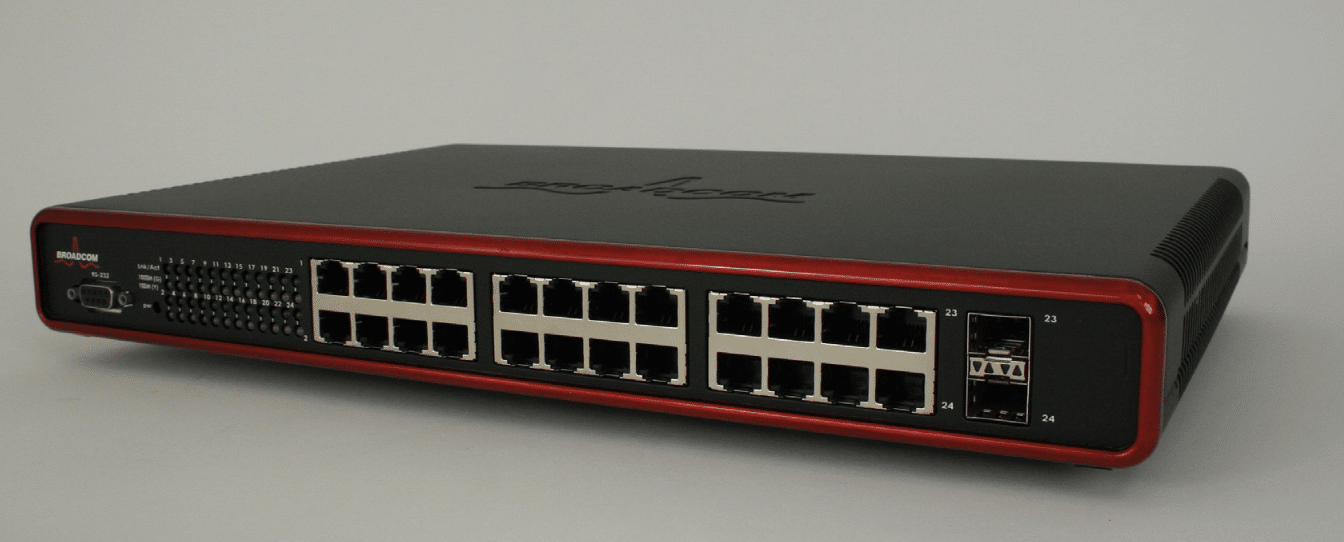
Start building a 24-port Ethernet switch faster. Test features, check performance, save power, and turn an idea into a working system with less effort.
These reference designs from Broadcom Inc. give design engineers a ready starting point to build 24-port Gigabit Ethernet copper switches for both unmanaged and managed systems. Built around the BCM53324U and BCM53324S devices from the StrataXGS III family, the platform supports Energy Efficient Ethernet as defined by IEEE 802.3az. It combines hardware, software, and system-level resources, allowing engineers to move from concept to working prototype with less setup effort.
At the system level, engineers can use these designs to develop Layer 2 switching products with standard features such as spanning tree, traffic prioritization using IEEE 802.1p/Q, and support for both IPv4 and IPv6 networks. The platform helps in testing switching behavior, validating packet handling, and optimizing throughput across 24 ports of 10/100/1000 Mb/s Ethernet. Because the design already reflects a working multilayer switch architecture, engineers can focus more on feature tuning rather than building the base system.

For unmanaged switch development, the reference designs provide a path to create cost-sensitive products for small and medium business environments. Engineers can quickly configure 16- or 24-port switches, validate basic forwarding performance, and optimize power consumption using Energy Efficient Ethernet. This is useful for applications where plug-and-play operation is required without network management overhead.
For smart and managed switches, the designs allow deeper customization. Engineers can build systems with 8-, 16-, or 24-port configurations and integrate management features using the included SmartPATH software. This enables work on user interfaces, remote management, VLAN configuration, and traffic control. It also supports testing of firmware updates, diagnostics, and network monitoring features, which are important in commercial deployments.
The included VxWorks real-time operating system and SDK API source code give engineers a controlled software environment. They can develop and test switching software, implement custom protocols, and integrate additional services on top of the base system. The availability of full design files—schematics, board layouts, Gerber files, and bill of materials—also allows hardware teams to modify the design, adapt it to different form factors, or integrate additional components.
From a hardware perspective, engineers can study and reuse the system architecture, which includes the switch device, PHY transceivers, flash memory, and Gigabit Ethernet interfaces. This helps in tasks such as signal integrity validation, PCB layout optimization, thermal design, and component selection. It also supports faster iteration when creating custom boards based on the reference.
These designs are useful in building switches for home networks, small business servers, and embedded networking systems. They also help in reducing development risk, as engineers work with a proven architecture that already simulates a real deployment environment.
Broadcom has tested this reference design. It comes with a bill of materials (BOM), schematics, assembly drawing, printed circuit board (PCB) layout, and more. The company’s website has additional data about the reference design. To read more about this reference design, click here.