

In August 2012, a single software deployment nearly destroyed one of the largest trading firms in the United States. Within just 45 minutes, Knight Capital lost $440 million after a malfunction in its automated trading system triggered millions of unintended stock orders. What started as a routine software update quickly escalated into a catastrophic failure that pushed the company to the brink of bankruptcy.
While such incidents are rare and not representative of typical system behavior, they highlight how complex and sensitive enterprise software can become when it is difficult to maintain, upgrade, or monitor.
This incident became one of the most famous examples of how fragile critical business software can be when systems are difficult to maintain, upgrade, or monitor. Many enterprise applications today still rely on legacy architectures and outdated processes that increase the risk of similar failures.
For organizations running large-scale Java systems, this raises an important question: how can businesses modernize their applications before technical debt turns into a business disaster?
Why Legacy Java Applications Need Modernization Today
Incidents like the Knight Capital failure clearly demonstrate how critical enterprise systems can be and what risks arise when they rely on outdated technologies. Many of these solutions are built on Java, which has remained one of the leading platforms for developing enterprise applications for decades. Banking systems, corporate portals, data management platforms, and internal business tools are often powered by Java.
Why Legacy Systems Become Difficult to Maintain
Over time, however, many of these systems have evolved into complex legacy applications. As new features, integrations, and business logic were added, the architecture became increasingly complicated and harder to maintain.
The use of obsolete Java runtime versions, as well as dependence on legacy framework components, can create additional issues because these components are often no longer updated or compatible with modern development tools.
One other big problem is complicated deployment pipelines. Many legacy environments do not have automated build, testing, and deployment processes. This can increase the risk of errors and delay the release of updates. At the same time, outdated components can create security vulnerabilities because they may contain known security flaws.
Why Modernization Is a Continuous Process
In practice, building systems that are easy to maintain and evolve over many years requires careful architectural planning from the very beginning. Such systems must be designed to support continuous updates, flexible integrations, and long-term scalability. However, this approach typically requires more time, higher initial investment, and strong engineering discipline, which not all projects can afford.
As a result, many organizations follow a more pragmatic approach. They rely on widely adopted frameworks to speed up development and reduce time-to-market, while planning regular upgrades and migrations to keep the system up to date. This makes initial development faster and more cost-effective, but increases the importance of continuous modernization over time.
Another common strategy is to postpone major changes until risks become significant, and then modernize or redesign the system when maintenance costs or limitations start to impact the business.
At the same time, organizations face growing pressure to adopt cloud-native architecture. Modern applications must scale easily, support microservices-based designs, and integrate smoothly through APIs.
Because of this, more companies now view Java application modernization as a practical step to modernize their architecture, improve security, and prepare their systems for long-term development.
Key Challenges of Legacy Java Applications in Modern Enterprise Environments
Legacy Java systems often support critical business operations, but over time, they accumulate technical debt. As these applications grow older, organizations face several challenges related to architecture, scalability, integration, and system maintenance.
Monolithic Architecture and Limited Scalability
Many legacy Java applications were originally built as monolithic systems. In this architecture, all components of the application are tightly connected and run as a single unit. While this approach worked well in the past, it often creates challenges as systems grow and business requirements change.
One of the main issues is scalability. When a monolithic Java application needs to handle more users or larger workloads, the entire system must usually be scaled at once. This can lead to inefficient resource usage and higher infrastructure costs. It also makes it difficult to scale only the parts of the application that actually need additional capacity.
Deployment processes can be more difficult in monolithic architectures. Because all components are tightly connected, even minor modifications often require rebuilding and deploying the whole application. This approach increases the likelihood of mistakes and can significantly delay the delivery of new features, improvements, or fixes.
Outdated Java Runtime and Framework Dependencies
Another common challenge in legacy systems is the use of outdated Java runtime environments. Older runtime versions may no longer receive security updates or performance improvements, which can increase security risks and limit system stability.
Many legacy applications also rely on older framework technologies. These frameworks may not support modern development practices or integrate well with newer tools and platforms. As a result, maintaining and extending the system becomes more difficult over time.
In addition, legacy systems often accumulate complex dependency management issues. Over the years, applications may rely on many third-party libraries and internal modules. Keeping these dependencies updated and compatible with each other can become a significant challenge.
Integration and API Limitations
Integration is another area where legacy applications often struggle. Older systems were not always designed with modern API standards in mind. As a result, exposing application functionality to other systems can require additional custom development.
This lack of modern APIs can make it harder to integrate legacy Java systems with newer platforms, services, or third-party tools. It can also slow down the development of new digital services that depend on fast and reliable system integration.
Legacy applications may also face difficulties when interacting with cloud platforms. Without proper API support and modern integration approaches, connecting existing systems to cloud services, microservices, or distributed environments can become a complex and time-consuming process.
What Is Java Application Modernization?
Java application modernization is the process of transforming existing Java-based systems so they can better support current technologies and evolving business needs. Rather than replacing legacy applications entirely, companies typically update and enhance them to make the systems more efficient, secure, scalable, and compatible with modern platforms and development environments.
Modernization can involve several different approaches depending on the current state of the application and business goals. Companies may choose to migrate, upgrade infrastructure, refactor code, or redesign the system architecture. Each approach addresses different technical challenges and levels of change within the application.
| Modernization Approach | Description | When It Is Used |
| Migration | Moving a Java application from one environment to another, for example, from on-premise infrastructure to the cloud. The core application usually remains unchanged. | Used when companies want to quickly move systems to a new infrastructure without major code changes. In many cases, this decision is driven by increasing operational costs or growing system load. |
| Replatforming | Moving an application to a new platform while making limited modifications to the code. For example, adapting a Java application to run in containers or cloud platforms like Kubernetes or OpenShift. | Suitable when organizations want better scalability and deployment flexibility without redesigning the entire system. It is often chosen when vertical scaling reaches its limits and the existing infrastructure can no longer efficiently handle growing workloads. |
| Refactoring | Improving the internal structure of the code without changing the application’s functionality. This helps reduce technical debt and improve maintainability. | Used when the application works correctly, but the codebase needs improvement and cleanup. This helps reduce the cost and complexity of future changes and feature development. |
| Rearchitecting | Redesigning the system architecture to support modern approaches such as microservices or cloud-native architecture. | Necessary when the existing architecture no longer supports business or scalability requirements. Often driven by heavy dependence on third-party services and high operational costs, leaving little room for further evolution within the current system. |
Methods of modernisation
The Java Modernization Journey
The Java modernization journey typically begins with a detailed assessment of the existing system. Organizations analyze the architecture, dependencies, infrastructure, and performance of the application.
Based on this evaluation, teams choose the most suitable modernization strategy. This may include migration to a new platform, refactoring parts of the application, or gradually redesigning the system architecture.
After the strategy is defined, companies create a clear migration plan and begin implementing automation in development and deployment processes. Automation helps reduce human error and improves the efficiency of software delivery.
Finally, teams improve the deployment pipeline to make releases faster, testing easier, and updates more reliable.
Strategies to Modernize Your Java Applications
There are several practical strategies organizations can use to modernize Java applications and improve system performance.
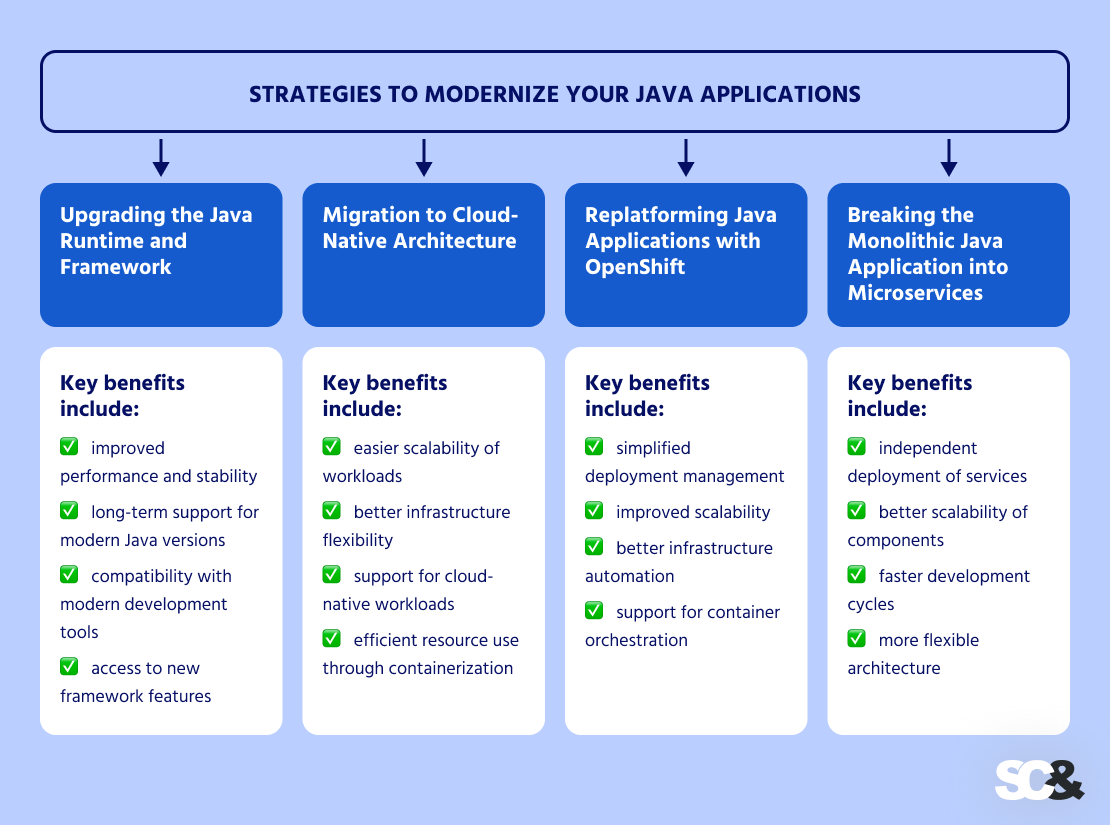
Upgrading the Java Runtime and Framework
Upgrading the Java runtime and updating the application framework is one of the simplest ways to modernize a Java system.
Key benefits include:
- improved performance and stability
- long-term support for modern Java versions
- compatibility with modern development tools
- access to new framework features
Migration to Cloud-Native Architecture
Another modernization strategy is moving a Java application to a cloud-native architecture.
Key advantages include:
- easier scalability of workloads
- better infrastructure flexibility
- support for cloud-native workloads
- efficient resource use through containerization
Replatforming Java Applications with OpenShift
Replatforming moves a Java application to a modern platform like OpenShift without a full redesign, or involves migrating between cloud providers (for example, from Google Cloud to AWS or vice versa).
Benefits include:
- simplified deployment management
- improved scalability
- better infrastructure automation
- support for container orchestration
Breaking the Monolithic Java Application into Microservices
Many legacy systems are built as monolithic applications. Modernization often means breaking them into microservices.
In practice, organizations rarely split the entire application at once. Instead, core parts of the system may remain monolithic, while new features are developed as microservices. A complete transition is typically done only when it is clearly required.
This approach allows:
- independent deployment of services
- better scalability of components
- faster development cycles
- more flexible architecture
Tools and Frameworks for Modernizing Java Applications
Modernizing Java applications often requires the right tools and platforms. Modern frameworks, automation tools, and container platforms help organizations simplify development, improve deployment processes, and support scalable cloud-native workloads.
| Category | Tools / Technologies | How They Support Java Modernization |
| Modern Java Development Frameworks | Spring Boot, Quarkus, Micronaut | These frameworks simplify Java development and help build lightweight, cloud-ready applications. They support faster development, microservice architectures, and better performance. |
| Automation and CI/CD Pipelines | CI/CD tools, automation platforms, deployment pipelines | Automation helps streamline testing, building, and deployment processes. It reduces manual work and accelerates the modernization process by enabling faster and more reliable software releases. |
| Container Platforms | Kubernetes, OpenShift | Container platforms allow organizations to run and manage applications in containerized environments. They simplify workload management, improve scalability, and support cloud-native deployment models. |
Java Application Modernisation Tools and Frameworks
Best Practices for Modernizing Java Applications
Modernizing Java applications can be a complex process, especially for large enterprise systems. Following proven best practices helps organizations reduce risks, manage technical debt, and ensure a smoother modernization journey.
Assess the Existing Architecture
The first step in any modernization project is understanding the current system architecture. Teams should carefully analyze existing dependencies, third-party libraries, and internal modules used by the application.
It is also important to review the current runtime environment. A runtime audit helps identify outdated components, unsupported libraries, and potential performance issues that could affect the modernization process.
Automate Testing and Deployment
Automation plays a key role in successful modernization. Implementing automated testing and deployment pipelines helps teams release updates more quickly and with fewer errors.
Using CI/CD pipelines allows organizations to continuously build, test, and deploy applications. This improves development efficiency and ensures that changes can be delivered reliably.
Adopt Incremental Migration Strategies
Modernizing a large system rarely happens all at once. Instead of replacing the entire application, many companies choose a gradual migration strategy.
An incremental approach allows teams to modernize specific components step by step. This helps reduce operational risks and ensures that the system continues to function while improvements are being implemented.
Optimize API Design
Modern API design is essential for building flexible and scalable applications. Well-designed APIs allow different services and systems to communicate more efficiently.
Improving APIs also makes it easier to integrate Java applications with cloud services, microservices architectures, and third-party platforms. This increases the overall flexibility and interoperability of the system.
The Future of Enterprise Java Applications
The role of Java in enterprise software development continues to evolve as organizations adopt modern architectures and development practices. While many companies still rely on legacy systems, the future of enterprise Java applications is closely tied to cloud technologies, automation, and new development tools that help teams build more flexible and scalable systems.
Cloud-Native Java
One of the most important trends is the growth of cloud-native Java development. Modern Java applications are increasingly designed to run in containerized environments and distributed systems. This allows organizations to scale workloads more efficiently and deploy updates faster. Frameworks and platforms that support cloud-native development are making it easier for companies to adapt existing Java systems to modern infrastructure.
Serverless Computing
Serverless computing is another area that is emerging. Developers will spend more time writing code for their applications, while their cloud provider will manage the infrastructure needed to run them and scale them as required. Although serverless architecture may not be suitable for all workloads, it is likely to be useful for certain workloads, such as event streams, background tasks, and API-based services.
AI-Assisted Java Development
AI tools are becoming part of everyday Java development. They help developers generate code faster, identify bugs earlier, and automate routine tasks. As a result, teams can work more efficiently and spend less time updating or refactoring large codebases.
Automation-Driven Development
Automation is becoming a key part of enterprise system modernization. Automated pipelines simplify testing, deployment, and system monitoring for development teams. When routine tasks are handled automatically, engineers can spend more time improving system architecture and adding new features.
Runtime Optimization
Finally, improvements in runtime optimization will continue to enhance the performance of Java applications. New runtime technologies and performance tuning techniques help reduce resource consumption, improve startup times, and optimize application workloads. Together, these advancements are shaping the future of enterprise Java systems and making them better suited for modern digital environments.
How SCAND Helps Companies Modernize Java Applications
Modernizing legacy systems requires both technical expertise and a clear modernization strategy. SCAND has extensive experience in Java development and helps organizations modernize their Java applications to meet modern performance, scalability, and security requirements.

The company works with businesses that rely on complex enterprise applications, helping them transform legacy systems into modern, flexible platforms. By applying proven best practices, SCAND supports companies at every stage of their Java modernization journey.
SCAND provides a wide range of services related to Java application modernization, including:
- Java application modernization for legacy systems
- Migration to cloud environments and cloud-native platforms
- Replatforming existing Java applications to modern infrastructure
- Transition from monolithic systems to microservices architecture
- API integration to improve system connectivity and interoperability
- Java runtime upgrade to improve security and performance
With strong experience in enterprise software development, SCAND helps organizations reduce technical debt, modernize legacy Java systems, and build scalable solutions ready for future growth.
Start Your Java Modernization Journey Today
Many companies still rely on legacy Java applications that support critical business operations. While these systems may continue to work, over time, they become harder to maintain, scale, and integrate with modern technologies. Ignoring modernization can increase technical debt and slow down innovation.
Modernizing Java applications helps organizations improve performance, strengthen security, and accelerate deployment. Modern architectures also provide greater flexibility, allowing enterprise applications to scale more easily and integrate with new platforms and services.
By adopting modern tools, cloud platforms, and automation, companies can build more flexible and resilient systems. In this environment, Java modernization becomes an important step toward creating future-ready enterprise solutions.
Ready to modernize your Java applications?
SCAND helps businesses upgrade legacy systems, migrate to modern platforms, and build scalable Java solutions tailored to their needs.