

Post Preview
Key Takeaways
- Autonomous systems boost defense efficiency while reducing human risk.
- Advanced aerial and underwater platforms enable real-time detection and response to threats.
- Interoperability across systems is crucial for seamless and coordinated operations.
- Partnerships between defense firms and startups accelerate the development process.
- Ethical oversight and compliance with international law are crucial.
- Responsible integration ensures mission effectiveness, safety, and strategic advantage.
Introduction
Autonomous systems are no longer the subject of distant speculation—they are fundamentally transforming the strategies and capabilities of modern defense forces worldwide. Their integration not only enhances mission efficiency across all domains but also significantly reduces human risk in volatile scenarios. As militaries race to adopt these technologies in everything from battle management to logistics, the urgent need for sophisticated digital solutions grows. For example, manufacturing safety AI weapon software is now central to protecting assets, ensuring compliance, and automating decision-making under pressure.
The implications stretch beyond pure military advantage. Autonomous systems enable faster data analysis, strategic resource allocation, and quicker responses to emerging threats, making them a core aspect of national security policy. As governments and defense organizations invest heavily in research, development, and deployment, keeping pace with the latest advancements is critical for maintaining strategic superiority.
This technological surge is driving the creation of totally new operational concepts—integrated data platforms, cross-domain networked operations, and real-time threat detection, to name just a few. Integration also raises complex questions around ethics, accountability, and international law, underscoring the need for careful governance as autonomous systems proliferate.
Advancements in Autonomous Aerial Systems
Autonomous aerial systems have shifted from experimental prototypes into mission-critical assets for airspace security. Recent advancements include next-generation counter-uncrewed aerial systems (C-UAS) designed to track, identify, and intercept hostile drones in real time. The U.S. Space Force, for instance, is enhancing airspace security at Cape Canaveral by deploying sophisticated detection and interdiction systems, underscoring the growing need to address aerial threats near sensitive installations.
These new systems utilize artificial intelligence to sift through streams of radar and sensor data, prioritizing suspected threats while minimizing the need for human operators to be overwhelmed. Real-world incidents, such as attempted drone incursions near restricted airspace, highlight the necessity for highly responsive and resilient C-UAS solutions. Enhanced vision and detection enable operators to mitigate risks more quickly, thereby boosting overall operational readiness.
AUV deployments enable navies to patrol contested zones, detect adversarial subsurface threats, and respond proactively—all with minimal human involvement. The shift toward intelligent underwater assets marks a significant leap in both technology and strategy, providing persistent coverage and mitigating risks to sailors.
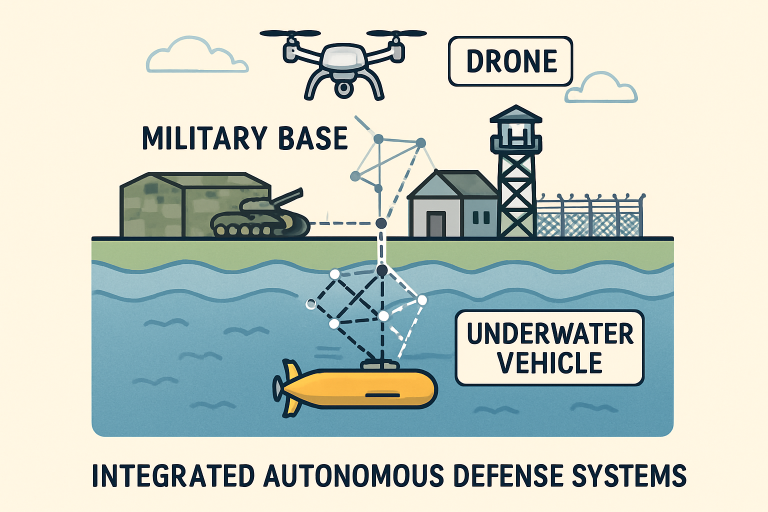
Ensuring Interoperability Among Autonomous Systems
As defense agencies deploy an expanding array of autonomous platforms from multiple vendors, seamless interoperability is essential. This challenge encompasses software integration, secure data exchange, real-time decision-making, and coordinated mission execution. The Center for a New American Security (CNAS) highlights the pressing need to harmonize standards and interfaces, enabling platforms from diverse manufacturers to operate side-by-side in complex joint operations.
Building a “plug-and-play” ecosystem enables militaries to quickly adapt to new threats, harness innovative solutions, and maintain robust situational awareness. Failure to achieve interoperability, on the other hand, could delay critical responses or cause operational friction at the worst possible moments.
Challenges and Ethical Considerations
The advent of fully autonomous weapon systems, especially those capable of selecting and striking targets independently, has sparked vigorous debate worldwide. Ethical concerns center on accountability, transparency, and compliance with the laws of armed conflict. Should autonomous drones make life-and-death decisions, or must a “human-in-the-loop” always hold the final authority?
The U.S. and allied nations are working to establish international standards to ensure accountability when autonomous systems are deployed on the battlefield. Transparent operational parameters, traceable decision-making processes, and rigorous oversight mechanisms are crucial for fostering trust within military ranks and in broader civil society.
Final Thoughts
The rapid evolution of autonomous systems is fundamentally reshaping modern defense at every level—from proactive threat detection to complex multi-domain operations. Cutting-edge developments in aerial, underwater, and ground-based platforms promise greater mission efficacy, lower risk to personnel, and a decisive edge in emerging conflict scenarios.
As technological boundaries expand, careful attention to interoperability, ethical frameworks, and broad collaboration remains vital. Stakeholders in defense must work together to maximize the benefits of autonomy while minimizing strategic, legal, and humanitarian risks. The era of autonomous systems in defense is here; only through considered and cooperative stewardship can their full potential be responsibly realized.