
Days after the U.S. and Israel launched airstrikes against Iran, killing Supreme Leader Ali Khamenei, Iran’s Islamic Revolutionary Guard Corps declared the Strait of Hormuz—the narrow waterway through which roughly one fifth of the world’s oil passes—closed. While oil has dominated headlines, a third of the world’s commercial helium comes from Qatar and has also been cut off.
Often associated with party balloons, helium is indispensable to magnetic resonance imaging (MRI) scanners, aerospace and the manufacture of microchips for artificial intelligence. With the strait closed, the disruption of the global helium supply chain could have ripple effects that might last for months and affect the most advanced technologies on Earth.
Yet the crisis arrives at a time when the helium market has been awash in surplus, which mitigates the war’s immediate effect. “There is going to be a shortage,” says Phil Kornbluth, founder of Kornbluth Helium Consulting. But the big question, he says, is its duration.
On supporting science journalism
If you’re enjoying this article, consider supporting our award-winning journalism by subscribing. By purchasing a subscription you are helping to ensure the future of impactful stories about the discoveries and ideas shaping our world today.
“There are three helium plants in Qatar, and two of them produce helium from the waste gas from LNG [liquefied natural gas] plants,” Kornbluth says. The LNG gets loaded onto tankers whose only path to the ocean is through the Strait of Hormuz. “When the Strait of Hormuz is closed, once the LNG storage tanks get filled, they have to shut down,” he says. Military attacks against Qatar’s facilities have also contributed to the closure of the plants.
Though worrisome, the math is far from catastrophic. With a 30 percent loss of global capacity offset by a recent 15 percent supply overhang, Kornbluth estimates a net shortage of around 15 percent. Suppliers pump most of the world’s helium into 11,000-gallon cryogenic containers that are loaded onto trucks and craned onto cargo ships. The supply chain is long and slow: helium that shipped out of Qatar right before the war started may still be on its journey. “There’s no physical shortage right now at the end-user level,” Kornbluth says. “It’s kind of like a nice sunny day on the beach, but you heard there’s a tsunami out there. You’ve got to get out of the way.”
Because the industry relies on roughly 2,000 expensive helium containers, many of which are now stuck in Qatar or on cargo ships en route, the initial pinch will feel worse until those tanks are repositioned. Even if the strait opened tomorrow, Kornbluth says, the supply disruption will last at least two extra months.
Major suppliers will likely declare force majeure and raise prices, following the playbook of the four previous shortages over the past 20 years.
But this shortage arrives just as the semiconductor industry has become the largest consumer of helium, overtaking MRI scanners in recent years. Chip manufacturers try to keep helium reserves, but the gas is notoriously difficult to contain. “Helium can leak out about 0.1 to 1 percent per month, depending on how good the gaskets are,” says Lita Shon-Roy, president and CEO of TECHCET, a semiconductor materials advisory firm. “There’s never a good gasket or fitting. It just leaks over time.”
Historically, chip fabricators have kept as little inventory on hand as possible. But after pandemic supply chain shocks, she says, fabricators shifted from keeping days of inventory to stockpiling.
If the war continues, the regions that will feel the effect first are those that are dependent on Qatar: Japan, Singapore, South Korea and Taiwan—home to the world’s most advanced chip fabrication facilities, or fabs.
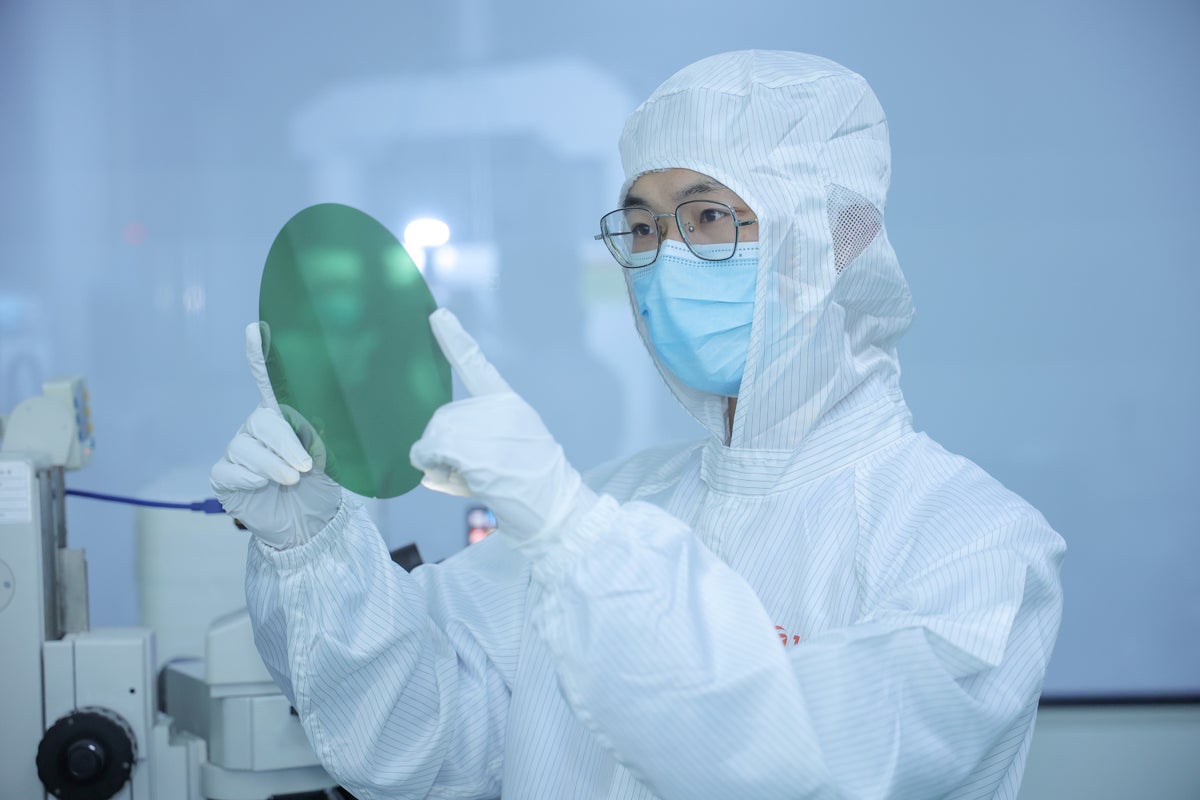
In chipmaking, fabricators rely on helium most crucially during etching—the selective removal of material to give a chip its features. An advanced AI chip can pack tens of billions of transistors, requiring extreme precision. “You’ve got to image it, define a pattern and then etch out unwanted materials,” says Mike Corbett, managing partner and co-founder of Linx Consulting. “Etch could literally be done hundreds of times per wafer. You have to very accurately control the temperature. I can’t etch one wafer at 100 degrees Celsius and then the next one at 150 degrees Celsius because the etch profile would be different based on the temperature.” To maintain stability, fabs blow helium gas on the backs of wafers to draw heat away. Helium’s exceptional thermal conductivity makes it uniquely effective.
Could fabs substitute a cheaper gas like argon or nitrogen? “If there are less expensive alternatives, they’ve gone to them already,” Corbett says. Helium delivers better throughput—more wafers processed per hour. In an industry where a single advanced fab can cost billions of dollars, the economics of yield dictate the materials. “Helium is less than 1 percent of a cost of a processed wafer,” Corbett says. “So you’re not going to shut down a fab because you have to double your helium price.”
Chip plants also carefully control the quality of every material entering the facility. They need helium that meets very tight cleanliness standards, meaning they cannot easily switch suppliers without months of requalification. “Once a process is established and set up, it’s very difficult to change,” Corbett says.
Some manufacturing sectors have developed closed-loop recycling—capturing and reusing the helium after it passes through the process tools—but for chips, Corbett says, “it’s not being used.” Historically, fabs haven’t invested in the piping and mechanical systems for helium recapture because the gas has always been viewed as cheap enough to vent into the atmosphere.
But Corbett doesn’t expect chipmakers to run out—suppliers are allowed to prioritize critical applications during a shortage, and helium will just be reallocated. Kornbluth agrees. “MRI might get everything they need because it’s a medical application, and semiconductor chip manufacturers generally get a pretty high allocation,” he says. “And then, as you might expect, party balloons get less. They might get nothing.”