
This video is part of “Innovations In: Kidney Disease,” an editorially independent special report that was produced with financial support from Vertex.
Imagine it’s the first day of summer, and you have a pool full of water that’s so clear you can see straight through it. You have big plans to splash around and cool off in it all summer long.
But then the filter breaks. Anything that gets into the pool seems to stay there. Leaves, trash and mysterious gunk builds up, and the pool quickly becomes unusable.
On supporting science journalism
If you’re enjoying this article, consider supporting our award-winning journalism by subscribing. By purchasing a subscription you are helping to ensure the future of impactful stories about the discoveries and ideas shaping our world today.
Now imagine that that pool is your body, and the filters that failed are your kidneys. How long do you think you’d last if your filters failed?
Over the course of a day, our kidneys take in around 150 quarts of blood. If you had to drink that much fluid, you’d have to chug a gallon and a half every hour, 24 hours a day, for the rest of your life.
Your kidneys do this automatically by passing your blood through millions of filtering units called nephrons, which have two main parts: the glomerulus and the tubule.
The glomerulus is made up of small blood vessels whose thin walls filter waste and water through – while holding on to blood cells and larger molecules.
The waste and water then goes into the tubule, where it runs next to a blood vessel holding the filtered blood from the glomerulus. This allows the tubule to return the nutrients and water we need back to our blood, which will then go back to our body. Whatever isn’t returned to our blood will get turned into our urine.
Your kidneys do the impossible for you every day of your life—keeping you alive by constantly filtering your blood so that you can maintain the right balance of nutrients, salts and water that our cells all need to function properly. But in people with chronic kidney disease, the kidneys begin to lose their function, disrupting that balance their body relies on and leading to complications such as anemia, nerve damage and bone damage.
Around 10 percent of adults worldwide are affected by kidney disease, but the condition is tricky to diagnose. And the lack of a cure means that more than a million people will die each year from the condition. So what is kidney disease, and why is it so challenging to treat?
The exact cause of a case of kidney disease is not always known, but it often results from diabetes or high blood pressure.
With diabetes, high blood sugar levels can damage the filters in the kidney, making it harder for the organs to carry out their function and causing them to allow important proteins to pass through to the urine.
High blood pressure can cause blood to pass through the kidneys with so much force that it damages their tissues. This damage can create a vicious cycle: declining kidney function allows more waste to remain in the blood, more waste raises blood pressure, and higher blood pressure causes more kidney damage.
Doctors can diagnose kidney disease using tests that assess the amount of waste or protein present in a patient’s blood or urine.
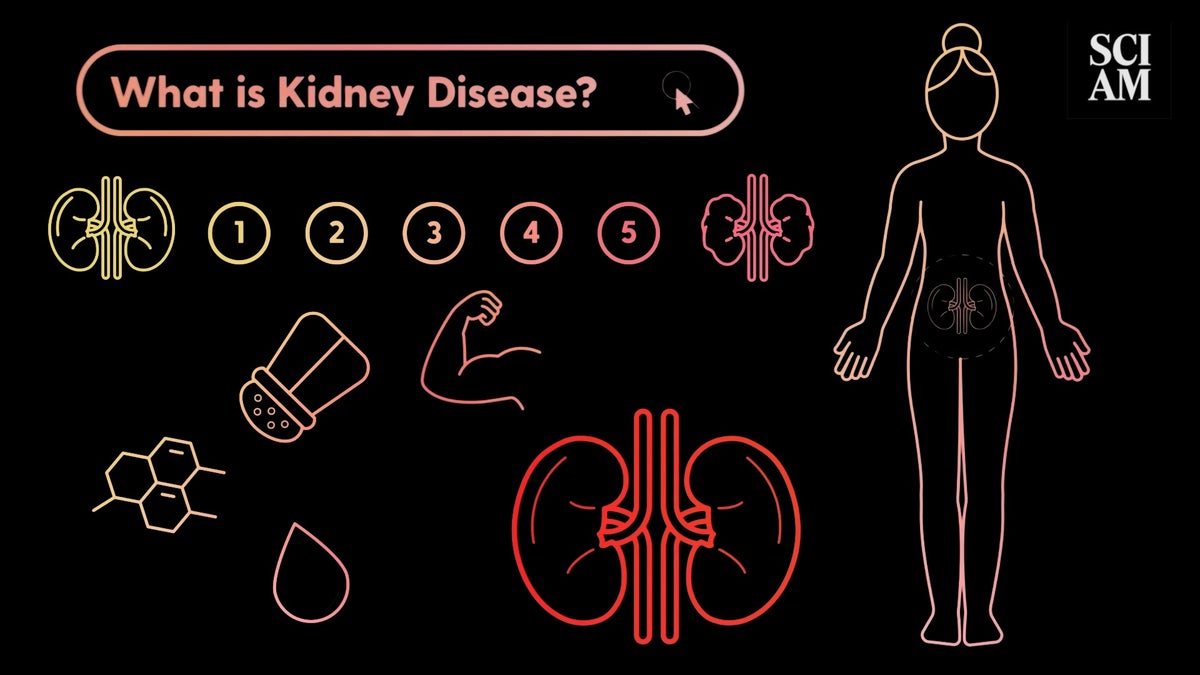
Diagnosed kidney disease has five stages. These range from stage 1, in which the kidneys are still able to function normally, to stage 5, in which the kidneys are close to failure or have failed.
Doctors determine the stage of a patient’s kidney disease by doing a blood test to measure eGFR, their estimated glomerular filtration rate. This reflects how much blood a person’s kidney is able to filter each minute. If less blood is filtered, then more kidney function has been lost, showing that the disease is further along.
Though diagnostic tests exist, one of the major challenges of kidney disease is that many people don’t show symptoms until the disease has become quite advanced. And there is no cure for chronic kidney disease.
As a result, treatments for kidney disease often revolve around managing the causes and complications of the illness, as well as slowing the decline of the kidneys.
For example, if a person’s kidney disease is linked to diabetes or high blood pressure, their treatment will involve managing those conditions as well.
Even if a person’s high blood pressure isn’t the direct cause of their kidney disease, to prevent the disease from worsening, they might be prescribed medications to manage their blood pressure.
In addition, lifestyle changes such as lowering salt intake and increasing exercise can help manage kidney disease and the many complications it can create.
When only 10 to 15 percent of a person’s kidney function remains, they have few options left. They either have to rely on a treatment like hemodialysis, which uses a machine to filter their blood, or get a kidney transplant, either from a living or deceased donor.
Both dialysis and transplants are effective. Neither is a cure for kidney disease. And people who have received a kidney transplant will need to take immunosuppressants to ensure that their body doesn’t attack the new organ.
But scientists are working on new treatments. Some have identified key genes involved with the disease that may provide targets for future therapies.
And a clinical trial is currently underway to test the use of a person’s own kidney cells to treat their disease.
Researchers are taking some tissue from participants’ kidneys, growing larger batches of a subset of cells from that tissue and then injecting those cells back into the participants. The research team hopes that the cells will be able to repair the organs.
Kidney disease is a complex disease. Even though we have the tools to diagnose it, catching the disease in time is difficult. And finding a cure will take the coordinated work of scientists, doctors and patients alike.
What we don’t have to wait on is respect for our kidneys—the humble, bean-shaped filters that keep our bodies as clean and refreshed every day as a well-managed pool in summer.