
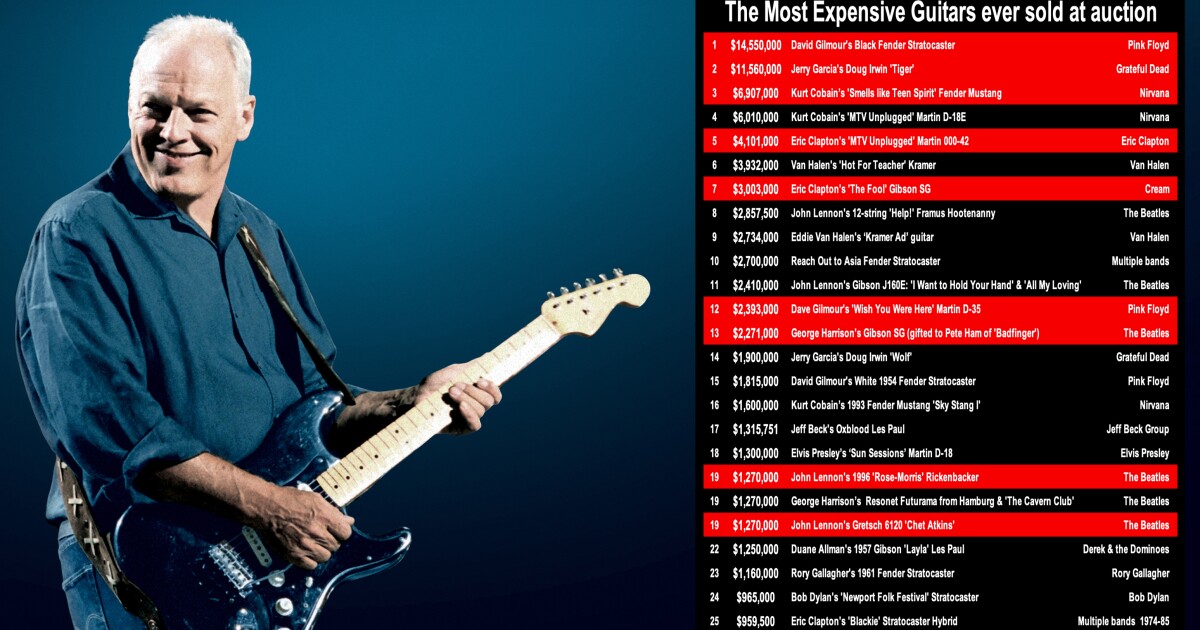
The last of Christie’s four auctions of the Jim Irsay Collection has closed, setting 28 new world record prices, most notably the largest memorabilia auction in history (US$94.5 million), the first two guitars to sell for more than $10 million (here and here), the world’s most expensive trumpet, the world’s most expensive saxophone, the world’s most expensive drum kit (twice), the world’s most expensive music concert poster and a near miss on the world’s most expensive piano. In total, the sale included nine of the top 21 guitars ever sold at auction.
The biggest news was the return of Dave Gilmour’s “Black Strat” to the top of the heavyweight guitar price rankings, with a price of $14,550,000 – Irsay purchased the Fender Stratocaster in 2019 for what was then a world-record $3,975,000. Since then, the prices of elite collectible guitars have skyrocketed.

Hence when the most comprehensive and extensive guitar collection ever assembled began selling on March 12, 2026, we figured we were heading for a major recalibration of society’s cultural self-worth. Everyone reading this has lived through an unprecedented period in human history where technological change has transformed the communication and information vacuum of just 100 years ago, into the information-rich existence we live today.
One hundred years is not long when compared to the eternity that brought us to here, but commercial radio began to emerge just 100 years ago, making music available to the masses for the first time.
For the last century, the subsequent invention of the car and transistor radio, television, the computer, the internet and mobile communications have increasingly enabled us to listen to music at will.
The guitar has been the most prominent musical instrument during the post-WW2 period, and if you look back at the soundtrack of your life, you’ll likely find that there are a few guitars that you remember.

Julien’s / NewAtlas.com
The contest for the top lot in the guitar section of the auction appeared to be a straight shoot-out between David Gilmour’s Black Fender Stratocaster (sold last for $3,975,000 at Christie’s in 2019) and Kurt Cobain’s “Smells like Teen Spirit” Fender Mustang (sold last at Julien’s for $4,550,000 in 2022), and much interest was focused on whether the top guitar price would surpass the $6,010,000 world record held by Kurt Cobain’s “MTV Unplugged” Martin D-18E that was sold at Julien’s in 2020.

Christie’s
Gilmour’s “Black Strat” can be heard on almost everything Pink Floyd created between 1970 and 1983, including all The Dark Side of the Moon (1973), Wish You Were Here (1975), Animals (1977), and The Wall (1979). A half dozen of the world’s most admired guitar solos emanated from Gilmour’s Black Strat, including “Shine On You Crazy Diamond”, which Gilmour insists “came out” of this guitar of it’s own accord, with some of its other guitar solos including “Comfortably Numb”, “Money”, “Another Brick in the Wall, Part 2″, “High Hopes” and “Sorrow.”
Pink Floyd – Shine On You Crazy Diamond [Official Music Video]
Likewise, Nirvana’s “Smells Like Teen Spirit” marked a seminal moment in music history, and the music video release (from Christie’s lot essay): “sparked a cultural sea change that saw grunge break through to the mainstream and let to the widespread popularization of alternative rock.”
Nirvana – Smells Like Teen Spirit (Official Music Video)
For those who grew up watching MTV in the 90s, Kurt Cobain’s teal blue Fender Competition Mustang with racing stripes is equally as important as the Black Strat.
On the big day, Cobain’s Fender increased its price from the $4,550,000 it last fetched at auction in 2022, to $6,907,000 less than four years later, but it didn’t threaten the “Black Strat” for top lot of the sale.
One of the world’s more unpredictable spectator sports

Guernseys
Auctions are one of the world’s more unpredictable spectator sports, though, and surprises are never far away when it comes down to who will bid for a particular prize and how much they’re prepared to pay.
Every auction boils down to a supply/demand equation and when demand is off-the-charts, and the supply is ONE, and every relevant collector in the world is watching, you never know what might happen.
In retrospect, it was entirely predictable that Grateful Dead frontman Jerry Garcia’s “Tiger” Doug Irwin custom guitar might feature at the finish line of the Irsay Auction, because each time an Irwin/Garcia guitar has gone to auction previously, it has either set a world record price or gone close.
In 1971, Garcia began working with Alembic luthier Doug Irwin, with their collaboration eventually birthing a total of five guitars, the best known of which are those known as “Tiger” and “Wolf.”
In May 2002, Guernsey’s auction house sold Jerry Garcia’s “Wolf” guitar for $789,500, breaking the then world guitar price record of $497,500 held by Eric Clapton’s “Brownie” guitar (Christie’s 24 June 1999). When Wolf went back to auction in 2017, it sold for $1.9 million, making it the third most expensive guitar ever sold at that time, behind John Lennon’s 1962 Gibson that was used to write “Please Please Me”, “I Want to Hold Your Hand” & “All My Loving”, and the “Reach out to Asia” Fender Stratocaster that sold for $2.7 million in 2005 to aid victims of the 2004 tsunami.

Reach out to Asia
Generational collector change is happening in all other auction categories right now, so many people discounted the possibility that a niche 1960s band might generate a guitar capable of challenging the famous “Black Strat” or the guitar that produced Nirvana’s generational anthem “Smells Like Teen Spirit.”
Grateful Dead – Touch Of Grey (Orchard Park, NY 7/4/89)
In the end, Jerry Garcia’s glorious Tiger custom came from the clouds to almost upstage the entire auction, becoming the second guitar of the day to sell for more than $10 million.

Heritage Auctions
The Grateful Dead was founded in Palo Alto in the San Francisco Bay Area during the rise of the counterculture movement of the 1960s. Palo Alto at that time was also the epicenter of the fledgling computer industry and the innovative band was at the very core of the evolution of the computer.
Among the long-haired hippy people who turned up in 1965 to see the Warlocks play their first gigs at “Magoo’s Pizza Parlor” in Menlo Park and “The In Room” in Belmont were those who would ultimately change the world: Apple founders Steve Jobs and Steve Wozniak, Electronic Frontier Foundation (EFF) founder John Perry Barlow, Stewart Brand (Founder of the Whole Earth Catalog and co-founder of the WELL, the first virtual communities) and members of the Stanford Artificial Intelligence Lab (SAIL) who were such big fans of the Grateful Dead they created one of the first non-technical communities on ARPANET in 1973, dedicated just to their beloved local band. Also among the audience at that time would have been the likes of Allen Ginsburg, Jack Kerouac, Neal Cassady, and Ken Kesey.
Other emerging San Francisco bands at that time include Jefferson Airplane (featuring Grace Slick), Big Brother & the Holding Company (featuring Janis Joplin), Country Joe and the Fish, and a young Mexican-American named Carlos Santana who kicked away his eponymous band just down the road in 1966.
With an audience largely comprised of high-tech devotees and digital pioneers, the Grateful Dead ethos was constantly infused with new thought and the Dead was one of the first organizations of any type to begin collecting e-mail lists and its interaction with its beloved deadheads was pioneering in many ways not recognized for years.
From Wikipedia: Known for their eclectic style that fused elements of rock, blues, jazz, folk, country, bluegrass, rock and roll, gospel, reggae, and world music with psychedelia, the (Grateful Dead) band is famous for improvisation during their live performances, and for their devoted fan base, known as “Deadheads”. According to the musician and writer Lenny Kaye, the music of the Grateful Dead “touches on ground that most other groups don’t even know exists”. For the range of their influences and the structure of their live performances, the Grateful Dead are considered “the pioneering godfathers of the jam band world”.
The “deadhead” tag has turned out to help identify fans of the band, particularly those who are credible, like Bob Dylan who became a deadhead and close friend of Garcia’s when touring with the band, plus Elvis Costello, Neil Young and Tom Petty … and the diversity of musical genres amongst a long list of high profile endorsees covers … everything.
Hence, although Grateful Dead lead guitar player Jerry Garcia has always been regarded as one of the world’s best guitar players, any Grateful Dead memorabilia has always performed far better at auction than Garcia’s best ranking of #13 in Rolling Stone’s seminal 2002 listing of the world’s foremost guitar players would suggest it should.
We think part of the reason the Grateful Dead consistently performs beyond expectations (Christie’s official guidance for Tiger’s price was $1,000,000 to $2,000,000) is due to the band’s computer-industry-centric roots and the likelihood that the band’s original baby boomer fans are now extremely wealthy, even among the wealthiest generation in history.
Beginning with folk roots, and inspired by Bob Dylan going electric, the Grateful Dead continually adapted and evolved and became indelibly linked with both of the revolutions which began in San Francisco in the post-WW2 period. The Dead might become one of the bands that transcends history as we move into the next era of AI-generated entertainment for 10 billion audiences of ONE.
Our intention at the beginning of this article was to list the history of the world’s most expensive guitars and all the other important musical instruments that were sold during the two-week four-auction Christie’s Irsay epic, but the task was just too great for one article.
Here’s an example of why it’s so complex – the world’s most expensive piano.
John Lennon The making of Imagine 1971
As with guitars, the most expensive piano sold at auction depends on which piano sold most recently as music memorabilia prices continue to rise rapidly.
The Broadwood Upright piano that sat in the lounge room of John Lennon and Yoko Ono’s apartment sold as part of the Irsay auction.
At $3,247,000 (against an estimate of $400,000 to $600,000), it went within a whisker of the world record of $3,413,000 set by the piano from the movie Casablanca on which Sam plays “As time goes by” for Ingrid Bergman.
Play it, Sam
Lennon’s $3.4-million Broadway was nowhere near his most significant piano, but the price it fetched is an indication of what a few other Lennon pianos might be worth next time they cross the block. In the above clip of the timeless classic “Imagine” being first played on a Steinway Model Z (sold for $2.37 million in 2000) you’ll also see the white baby grand piano on which it was recorded. The baby grand piano is still owned by Yoko Ono.
Now you can spend millions buying a new piano of exquisite design, engineering and materials, but we’re only dealing here with pianos with genuine entertainment provenance that have sold at auction, and there are quite a few of those over history as well.
Bono & Chris Martin Perform Perfect Day
The Heintzman Crystal Piano played by Lang Lang at the 2008 Beijing Olympics opening ceremony sold at auction for roughly $3.22 million in 2009. Another to sell past the million-dollar mark was the “Red Pops for (RED) Steinway” which fetched $1.925 million at Sotheby’s original RED charity auction.
Hence, we’ll address the back story to the world’s most expensive trumpet, the world’s most expensive saxophone, the world’s most expensive drum kit (twice), and the world’s most expensive music concert poster over the coming weeks.
Finally, the sale of two guitars for more than $10 million at auction might suggest that the guitar has become the most valuable musical instrument in the world.
That’s not even remotely true, and although we’ve begun compiling a list of the most valuable musical instruments of all-time, we’re not sure yet if both $10-million-plus guitars will make the top 10 of all-time.

There are several more violins that have sold privately for more money than Lady Blunt’s violin in the last 15 years, and the violin is not the most expensive musical instrument to have sold at auction either.
The most expensive musical instrument ever sold at auction is an ancient Chinese Guqin (similar to a zither) from the Song Dynasty (960–1279), which fetched 137 million yuan (US$22 million) at Polyauction (Beijing) in a 2010 Beijing auction. The 900-year-old instrument had imperial provenance, and is believed to have been produced by Emperor Song Huizong’s imperial workshop. There are more than 2,000 extant ancient guqin.