
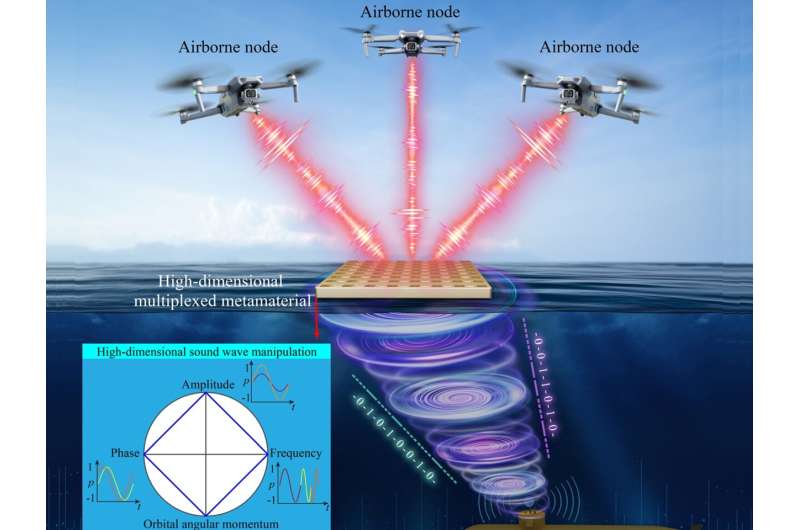
A newly developed acoustic metamaterial could redefine how sound is transmitted across different environments, enabling complex signals to pass directly between air and watersomething conventional technologies struggle to achieve.
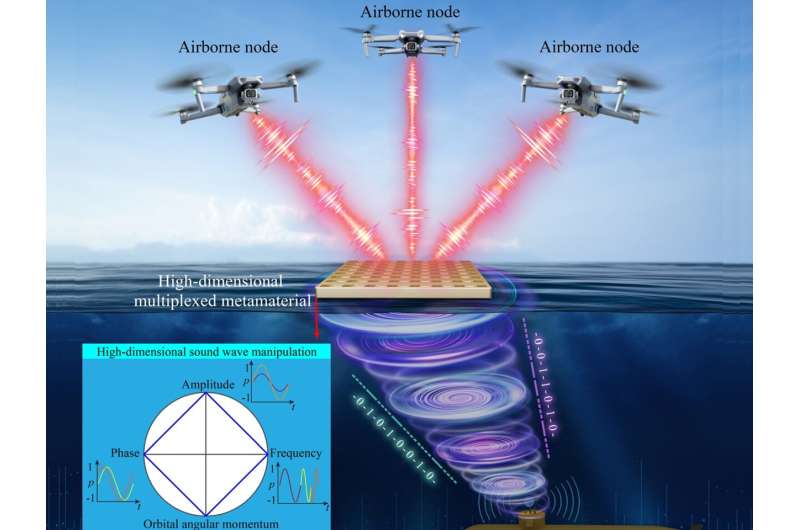
Researchers from IMDEA Materials Institute, in collaboration with China’s Nanjing and Huazhong Universities, have demonstrated a high-dimensional metamaterial (HDM) capable of simultaneously controlling multiple properties of sound waves. Unlike traditional acoustic systems that manipulate limited aspects such as amplitude or frequency, this approach can modulate multiple dimensions of sound waves simultaneously, significantly increasing information capacity.

The breakthrough addresses a long-standing challenge: efficient communication across mismatched media. Sound behaves very differently in air and water due to differences in density and acoustic impedance, making direct transmission complex and inefficient. Existing solutions typically rely on conversion layers or simplified signals, which limit bandwidth and fidelity.
The new metamaterial overcomes this by precisely shaping how sound waves propagate at the interface. By engineering its internal structure, the material can simultaneously control phase, amplitude, and other wave characteristics, enabling seamless transmission of richer, more complex acoustic signals across the boundary.
This capability stems from the broader field of acoustic metamaterialsengineered structures designed to manipulate sound in ways not possible with natural materials. Their properties arise from structure rather than composition, allowing precise control over how waves travel, bend, or interact.
The implications are significant for underwater communication, sensing, and robotics. Applications could range from improved submarine or diver communication systems to more efficient data exchange between aerial and underwater drones. The ability to encode and transmit high-dimensional acoustic information may also open new possibilities in environmental monitoring and defence systems.
Beyond communication, the work highlights a shift toward multifunctional wave control systems. Instead of optimising a single parameter, next-generation designs are focusing on simultaneously controlling multiple wave dimensions, increasing both efficiency and versatility.
As AI-driven modelling and advanced fabrication techniques continue to evolve, such metamaterials are expected to become more practical and scalable. This could accelerate their integration into real-world systems, particularly in scenarios where conventional electromagnetic communication is limited or ineffective.
The research marks a step forward in bridging physical communication barriers, pointing toward a future where complex acoustic signalling can operate seamlessly across fundamentally different environments.