
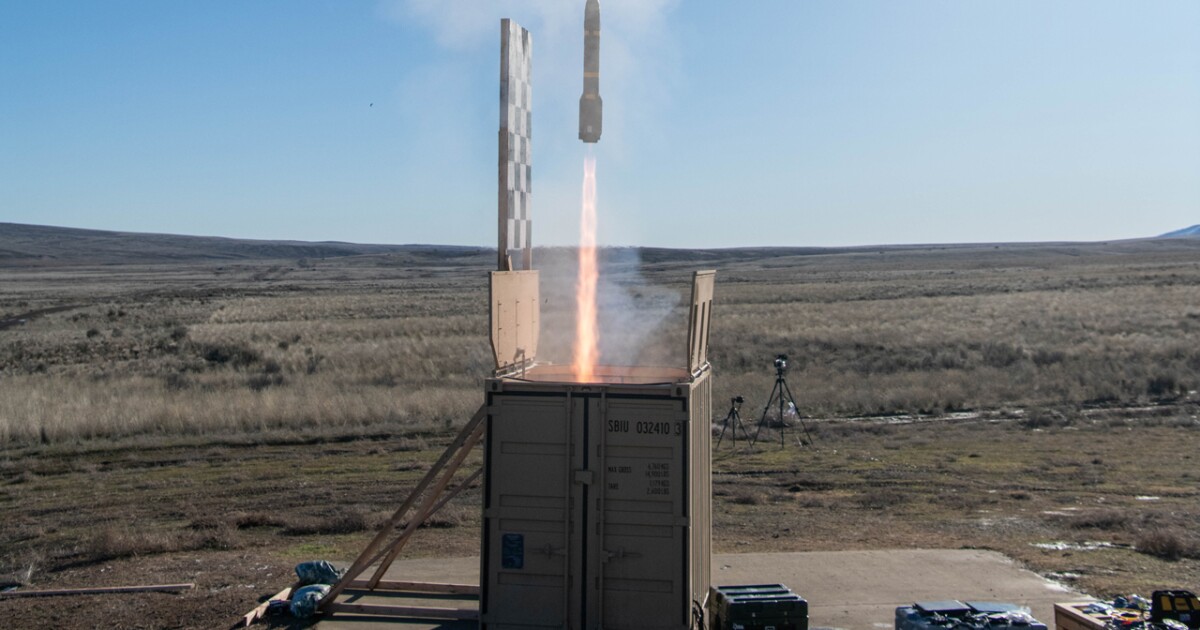
Lockheed Martin has given “pop up” a whole new meaning. Instead of plopping down a shipping container to create an instant cafe, the company used a 10-ft standard container to house a compact GRIZZLY launcher and fire a Hellfire missile.
Small, inexpensive drones are becoming something of a nightmare for military planners who can never quite be sure if there’s a quadcopter with a camera or an explosive charge lurking nearby. The result is not only that we’re seeing a striking change in military tactics, but also the reemergence of the oldest arms race between new weapons and new defenses against the new weapons, followed by new weapons against the new defenses in a seemingly endless cycle.
One way of countering drones is to find ways to detect, track, and destroy or neutralize them, and in recent years we’ve seen a growing number of missiles, projectiles, lasers, nets, jammers, and energy weapons designed to take them down. However, there’s another approach that Lockheed Martin is demonstrating.
During the Second World War, the Allies put a special effort into confusing the Axis powers. They hid whole aircraft factories under fake villages, disguised pill boxes and other vital installations as cottages, set up fake airfields and bases complete with balsa wood fighters and inflatable tanks, and even went in for elaborate ruses like dressing a corpse up as a Royal Marine officer and dumping it in the sea with forged attack plans planted on it.
The point of all this wasn’t so much to bamboozle the enemy as to place a strong sense of uncertainty in their minds. If that could be established, the enemy would waste precious time and resources to deter or destroy threats that did not exist, while ignoring the real threats tucked out of sight.
That’s essentially the idea behind the recent demonstration launch at the Yakima Training Center in Washington State. The Lockheed Martin engineers took a combat-proven M299 launcher used on AH-64 Apache helicopters and MQ-9 reaper drones and modified it to create the GRIZZLY launcher, which is designed to fit neatly inside a standard ISO shipping container along with an AGM-114 Hellfire missile.
It’s that container that’s the key to the whole thing. Not only does it allow a complete launcher system to be moved and installed easily on a wide variety of locations and platforms, it poses a quandary for an attacker. Today, shipping containers are ubiquitous. You find them on ships, trains, trucks and barges. They sit in shipyards, railway yards, storage depots, building sites, farms and private homes, and are even used in beer gardens, apartments, and houses.
In short, that’s a lot of places for a missile to hide and do so very easily. You even leave missile-bearing containers in woodlands or out in fields and an enemy could never be sure what exactly it is. It’s like the comedy sketch where a man buys a cash register at a cash register shop and the salesman can’t ring up the sale because he can’t find the one that isn’t a display model.
“No, that’s not it. No. Not that one. No. This one for sure. No …”
The other side of the demonstration addresses a problem that the West faces, which is the urgent need to innovate and build new military assets much faster than has been the norm for the past 30 years. The GRIZZLY container launch was built from already tested components, uses an agnostic Command and Control system, and the development cycle took only six months. However, it can be integrated into standalone or networked modes and is compatible with standard logistics for transport and installation. In addition to the Hellfire, it can also be armed with the AGM-179 Joint Air-to-Ground Missile (JAGM).
“This is an example of how our Lockheed Martin team is leading innovation for our customers’ needs,” said Randy Crites, vice president, Lockheed Martin Advanced Programs. “Our first live fire tests come just six months after the program began research and development, through internal Lockheed Martin investment, demonstrating our focus on quickly delivering a mobile and versatile launcher capability to defeat evolving threats.”
Mind you, there is still the question of how the Army can find the missile when it needs it. “This is it. No. That one. No …”
Source: Lockheed Martin