

Skin cells remember inflammation for life. Here’s why
Skin conditions such as psoriasis often flare up in the same spots throughout one’s life. Now scientists think they know why
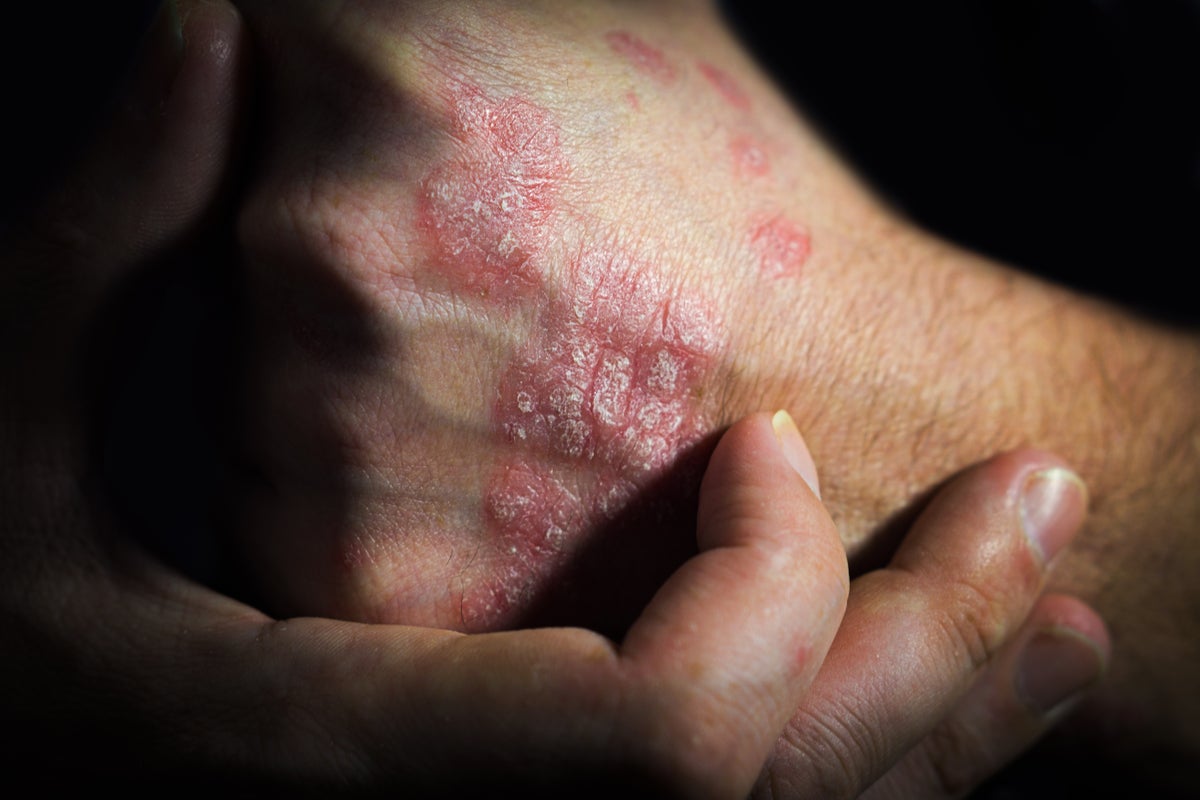
Sergey Dogadin via Getty Images
Skin remembers. That scar above your eye from when you fell at age 6. That freckle from the summer you turned 13. Our skin is a repository of moments from our lives, and now scientists have found it really does remember. For people with inflammatory skin conditions such as psoriasis, the skin’s memory manifests in flare-ups in the same spots over and over. And now scientists think they know precisely why this happens.
In a new study in mice published on Thursday in Science, researchers showed how skin cells inherit patterns of gene expression every time they regenerate. The team found not only that successive generations of skin cells maintain the memory of their DNA’s structure but also that the cells inherit chemical modifications to the DNA called epigenetic marks, which can turn on or off, or turn certain genes up and down in a process called gene expression.
“People knew that stem cells had the ability to change their behavior and remember, but they didn’t know if it was through this epigenetic mechanism,” says Shruti Naik, a molecular biologist at the University of Maryland, College Park, who has previously worked with the study’s senior author, Elaine Fuchs, but was not involved in the new research. “And I think what this paper does is definitively demonstrate that it’s through marking of DNA … that it allows that stem cell to now behave differently moving forward.”
On supporting science journalism
If you’re enjoying this article, consider supporting our award-winning journalism by subscribing. By purchasing a subscription you are helping to ensure the future of impactful stories about the discoveries and ideas shaping our world today.
Skin stem cell memory can be beneficial: if you get a cut, for example, your skin will heal faster in that place if it is injured again because the cells remember the experience. But that becomes problematic in conditions like psoriasis, for which the memory of a flare-up can make the tissue overly sensitive to environmental triggers such as stress, leading to chronic inflammation.
“Your DNA can remember, far longer than we appreciated, a past injury,” says Dana Pe’er, a co-author of the study and chair of the Computational and Systems Biology Program at the Sloan Kettering Institute. “It’s a double-edged sword.”
For the study, the researchers used an artificial intelligence model to help identify specific genetic sequences in mice that drive skin stem cell memory over the long term. They did this by asking the model to look at how regions of the cells’ DNA behaved at different time points before and after an injury—in this case, a punch biopsy, which involved making a very small incision on the mice’s back. The AI findings were like “opening a black box” that the researchers then further verified, Pe’er says.
And while mice are not humans, the biology the team has identified is highly conserved across animals, Naik explains, and this suggests the finding may have some applicability to humans.
The new research opens the door to testing it in humans, Pe’er adds. But these studies will be more difficult because, whereas mouse skin cells regenerate on timescales of days and chronic disease is measured in months or perhaps one to two years, human skin cells do so on the order of several weeks or months, and chronic disease can be lifelong.
What is increasingly clear from the evidence, Naik says, is that inflammation can change the trajectory of the body’s biology. “This, I think, is where the field is going, which is: How do our experiences change the fundamental behavior of ourselves and given the way we live our lives now? What does that mean for disease onset?”
“Can you imagine if you could reverse that imprint? If you could reverse that damage, you essentially control people’s health,” she says.
It’s Time to Stand Up for Science
If you enjoyed this article, I’d like to ask for your support. Scientific American has served as an advocate for science and industry for 180 years, and right now may be the most critical moment in that two-century history.
I’ve been a Scientific American subscriber since I was 12 years old, and it helped shape the way I look at the world. SciAm always educates and delights me, and inspires a sense of awe for our vast, beautiful universe. I hope it does that for you, too.
If you subscribe to Scientific American, you help ensure that our coverage is centered on meaningful research and discovery; that we have the resources to report on the decisions that threaten labs across the U.S.; and that we support both budding and working scientists at a time when the value of science itself too often goes unrecognized.
In return, you get essential news, captivating podcasts, brilliant infographics, can’t-miss newsletters, must-watch videos, challenging games, and the science world’s best writing and reporting. You can even gift someone a subscription.
There has never been a more important time for us to stand up and show why science matters. I hope you’ll support us in that mission.