

Inside NASA’s audacious plan to save a doomed space telescope
NASA’s Swift space telescope is doomed to burn up in Earth’s atmosphere later this year. A daring mission to boost it to safety could have big implications for science
The Swift Observatory is losing altitude—but a new robotic mission could save it.
NASA’s Neil Gehrels Swift Observatory is in a race against time. For more than 21 years the Earth-orbiting telescope has surveyed the sky for gamma-ray bursts—the most powerful and luminous explosions in the universe—and whipped around to take a closer look. But on every orbit, it collides with countless particles from the planet’s atmosphere. Each impact steals a tiny bit of the spacecraft’s speed, pushing it a smidgen closer to Earth.
If left alone, the spacecraft will lose the race later this year and fall out of orbit, bringing a fiery end to its long scientific tenure. But NASA hopes to buy the telescope an extra decade through a long-standing space-technology dream: a mission in which a robot will gently glom on to Swift, push it up into a safer orbit, then set it free. If it works, the technique could open up new possibilities for science spacecraft more generally.
“There have been ideas like this around for a long time, and I think the technology is finally getting to the point where it’s not crazy,” says Jonathan McDowell, an astronomer and space sustainability analyst.
On supporting science journalism
If you’re enjoying this article, consider supporting our award-winning journalism by subscribing. By purchasing a subscription you are helping to ensure the future of impactful stories about the discoveries and ideas shaping our world today.
The Swift Observatory is equipped with a Burst Alert Telescope that surveys a huge amount of the sky at once, looking for flashes of light and pinpointing their locations. When the spacecraft detects something interesting, it pivots within a minute or two to examine the spot with its other two telescopes—one catching ultraviolet and visible light and the other capturing x-rays.
It’s this agility that inspired the mission’s name and has enabled its continuing relevance to astronomy even after scientists solved their most pressing mysteries about gamma-ray bursts. Recently Swift has more often been used to follow up on intriguing detections made by other observatories. And in the coming years, as the Vera C. Rubin Observatory in Chile ramps up its work and NASA’s Nancy Grace Roman Space Telescope launches, there will be many, many more such discoveries in need of swift—or, rather, Swift—observations.
“Swift is really the only facility out there that can provide that very rapid follow-up,” says Brad Cenko, an astrophysicist at the NASA Goddard Space Flight Center in Maryland and principal investigator of the mission. “We think this capability is actually something that the demand is just going to continue to grow for.”
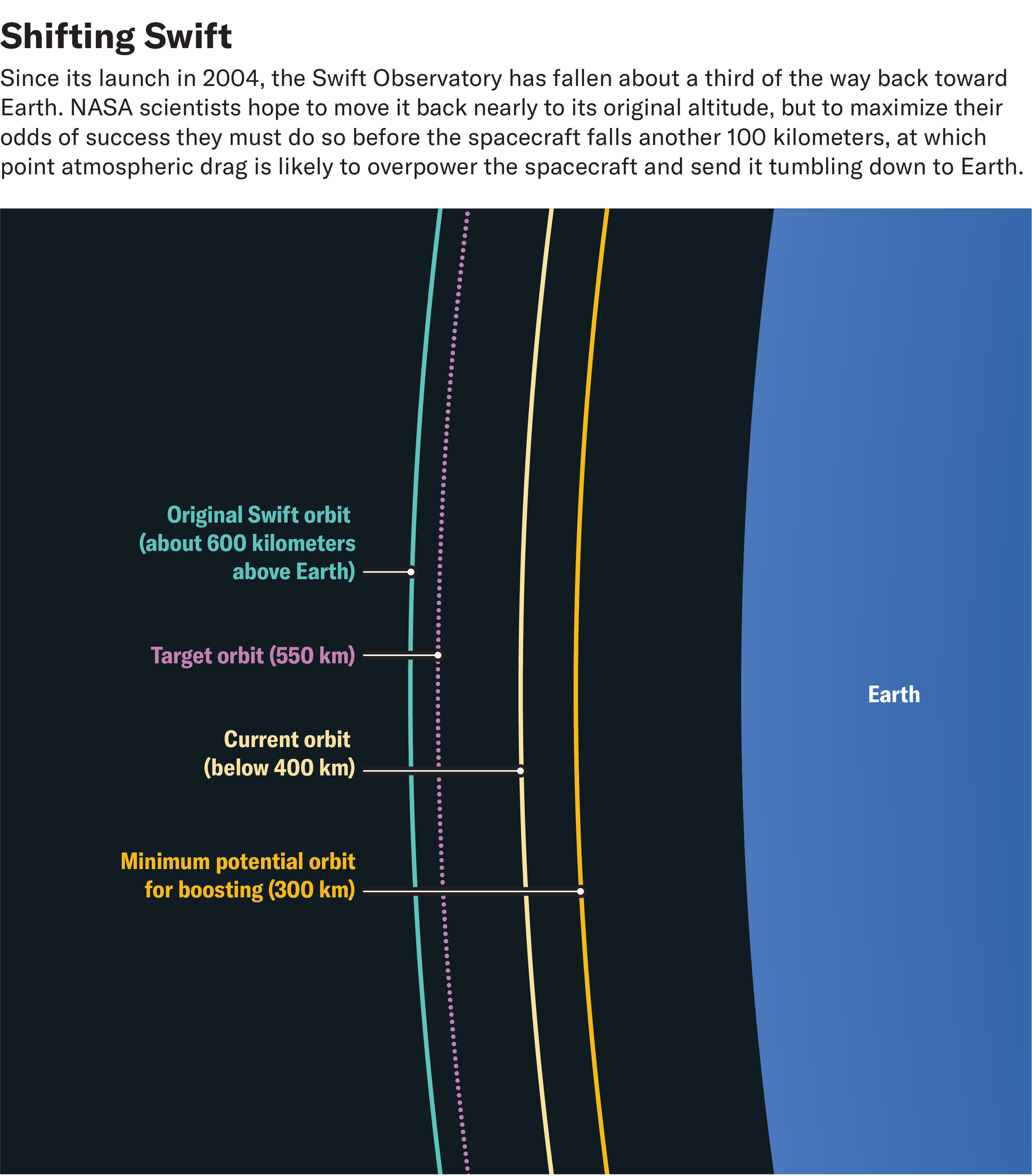
Unfortunately, orbital physics has not cooperated. All spacecraft in low-Earth orbit, particularly the lowest 600 kilometers of space, are subject to drag from the atmosphere. The thicker the atmosphere, the worse the interference and the faster the fall. And the atmosphere’s thickness increases and decreases with solar activity. When the sun is especially active—as it has been in the past couple of years—atmospheric density is higher.
Swift is feeling the burn of that extra atmosphere. The mission launched to an altitude of around 600 kilometers, where satellites can’t avoid atmospheric interference, but as recently as early 2024 it looked likely to withstand solar maximum and operate into the 2030s. But the sun has been more active than expected, and by the beginning of 2025 it was clear that Swift was doomed to burn up later this year.
The observatory’s team lobbied NASA for a rescue attempt based on the scientific value of Swift’s fast-response capability—and the fact that its days are already numbered. “If you’re successful, the scientific benefit is tremendous,” Cenko says. “If you’re not successful, obviously that’s not the outcome that we want, but it’s going to reenter sometime this year anyway.”
In September 2025 NASA signed a $30-million deal with Katalyst Space Technologies to attempt a rescue mission set to launch in early June. That’s an incredibly fast timeline for any mission, let alone one attempting robotic servicing, a feat that has long been a challenge for space technologists and has never been attempted for a science mission. When NASA’s space shuttles were flying, astronauts did carry out occasional servicing missions—most notably five flights to repair, upgrade and boost the Hubble Space Telescope. A robotic mission, though much cheaper, can’t fall back on human ingenuity and quick thinking when a challenge arises, making the tactic much more difficult.
But the moment may finally be ripe. For example, industry behemoth Northrop Grumman has successfully operated two Mission Extension Vehicles to revitalize commercial communications satellites. Now Katalyst is ready to take a shot and is building a three-armed robotic spacecraft to grab hold of the decades-old observatory. “Swift was never designed for capture,” says engineer Kieran Wilson, principal investigator on the Swift reboost mission at Katalyst. “The spacecraft was built more than 20 years ago, so there’s not even great documentation around what some of these interfaces look like that we’re looking to be able to grab on to.”
Once complete, the spacecraft will be loaded onto a Northrop Grumman Pegasus rocket, which launches after being dropped out of a modified jet plane—a necessity to reach Swift’s unusual orbit close to the equator. By July or August, if all goes well, the spacecraft will begin the monthslong process of tugging Swift up, aiming for an altitude of about 550 kilometers. After releasing the observatory, the Katalyst spacecraft will dive down to burn up in the atmosphere, embracing the very fate from which it hopes to save Swift.
It’s a risky mission with no guarantee of success. “What keeps me up at night is the things that we don’t control,” says engineer Ghonhee Lee, Katalyst’s CEO. But if it works, the rescue mission could not just revive Swift but change the blueprint for science satellites in general by making robotic life extensions a spaceflight reality.
“It’s almost like it’s a new mission,” Cenko says. “But you’re getting it for just a fraction of what it would cost to actually build something from scratch and fly it.”
It’s Time to Stand Up for Science
If you enjoyed this article, I’d like to ask for your support. Scientific American has served as an advocate for science and industry for 180 years, and right now may be the most critical moment in that two-century history.
I’ve been a Scientific American subscriber since I was 12 years old, and it helped shape the way I look at the world. SciAm always educates and delights me, and inspires a sense of awe for our vast, beautiful universe. I hope it does that for you, too.
If you subscribe to Scientific American, you help ensure that our coverage is centered on meaningful research and discovery; that we have the resources to report on the decisions that threaten labs across the U.S.; and that we support both budding and working scientists at a time when the value of science itself too often goes unrecognized.
In return, you get essential news, captivating podcasts, brilliant infographics, can’t-miss newsletters, must-watch videos, challenging games, and the science world’s best writing and reporting. You can even gift someone a subscription.
There has never been a more important time for us to stand up and show why science matters. I hope you’ll support us in that mission.