
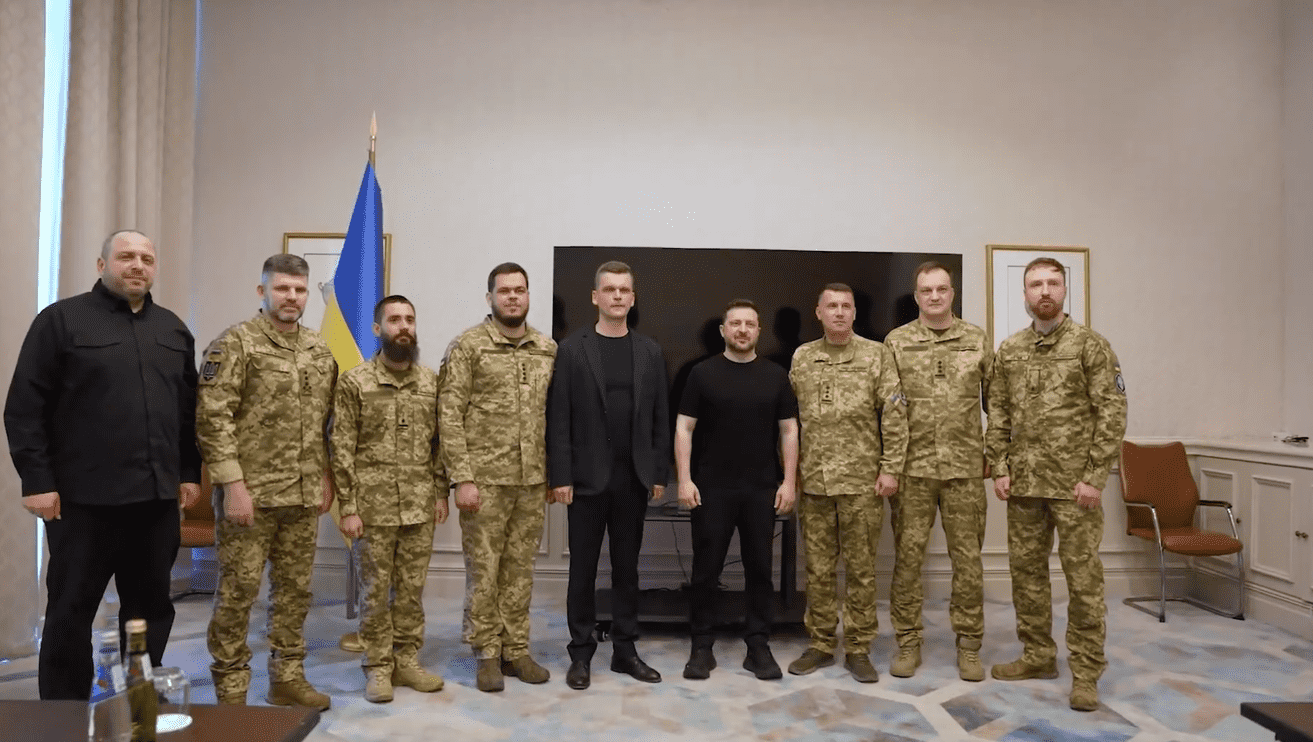
Ukraine’s President Volodymyr Zelenskyy said Ukrainian experts are currently in Qatar helping assess security risks and develop practical solutions to counter aerial threats, as drone and missile attacks become a growing concern across the region.
In a post on X, Zelenskyy said, “A team of Ukrainian experts is working in Qatar, sharing our experience and expertise,” noting that he met with the team in Doha and received a detailed briefing on their work.
According to Zelenskyy, the team has already conducted “an overall assessment of the security situation” and Qatar’s ability to respond to aerial threats, examining current capabilities and potential gaps. He said they have developed “concrete solutions to strengthen the protection of its airspace,” based on Ukraine’s experience responding to sustained attacks.
He added that during his meeting with Amir Sheikh Tamim bin Hamad Al Thani, Qatar’s leadership expressed strong appreciation for the Ukrainian team’s work and the consultations provided so far.
Zelenskyy described ballistic missiles and drones as the main security challenge in the region, noting that “ballistic missile and drone attacks are currently the biggest challenge here.” He explained that while advanced air defence systems are required to intercept ballistic missiles, they are often costly and in short supply.
“In Ukraine, we have developed other, significantly more cost effective solutions to combat drones,” he declared, pointing to alternative methods that can be deployed more widely.
He said these systems have already been tested in real conditions and “have proven their effectiveness against various types of drones,” which has driven growing interest from countries like Qatar looking to enhance their defensive capabilities more flexibly.
Zelenskyy also linked this to Ukraine’s broader wartime experience, saying the country has had to adapt quickly to evolving threats, including the widespread use of Iranian-made drones in the conflict. This, he suggested, has pushed Ukraine to innovate and develop practical, scalable responses.
He stressed that Ukraine is ready to share its expertise with partners, saying it is willing to “help those who can also help us strengthen our own protection in Ukraine,” framing cooperation as mutually beneficial and strategic.
Zelenskyy added that collaboration with Qatar is part of wider long-term efforts to improve regional stability and preparedness, stressing that “by helping one another, we increase security worldwide.”
Zelenskyy outlines defence deals and long-term partnerships with Gulf states
In a separate thread on X, Zelenskyy elaborated on Ukraine’s broader role as a defence partner in the region, linking its expertise to lessons learned during the war.
He said Ukraine has developed its own systems in response to the growing use of Iranian-made “Shahed” drones, adding that it is “sharing what we have developed with countries in the Middle East,” where Ukraine is now “highly regarded” for its experience.
Zelenskyy outlined ongoing discussions on cooperation beyond advisory support, including weapons production, technology exchange, and long-term energy partnerships.
“We’re talking about ten-year partnerships,” he said, noting that Ukraine has already signed agreements with Qatar and Saudi Arabia. Plans include co-production, the construction of manufacturing facilities, and the coordination of resources such as fuel supplies during global disruptions.
He also pointed to the development of “drone deals,” which combine drones, electronic warfare systems, and integrated defence structures, alongside what he described as Ukraine’s “most valuable asset,” the experience of its military.
Zelenskyy said this model brings together the state, private sector, and military into a single system, positioning it as a long-term export framework for partner countries.
In the same thread, he raised concerns about regional security, saying he had been briefed that Russian satellites recently captured images of US and allied military facilities across the Middle East, including sites in the Gulf.
He questioned discussions around easing sanctions on Russia, suggesting the move “looks strange” given Moscow’s continued role in providing intelligence that could be used in future strikes.