

“In modern warfare, secure and undetectable communication is no longer a luxury but a necessity. Li-Fi makes it virtually undetectable, highly secure, and resistant to jamming.” — SLF Telecommunication
As militaries test and deploy the technology, an important question emerges: Could the next decisive edge in warfare come not from weapons, but from how forces communicate?

Radio frequency (RF) networks are increasingly exposed to interference, blocking, and interception. Li-Fi, or light fidelity, helps overcome many of these risks for the Army, Navy, and Air Force. Because light cannot penetrate physical barriers such as walls, Li-Fi signals remain confined to the operational area. Wi-Fi networks, in contrast, pass through such barriers easily, making remote interception easier for adversaries.
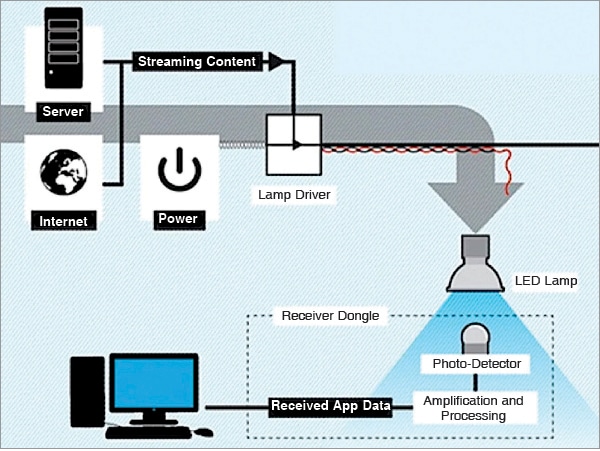
Li-Fi uses the visible light spectrum, 400-800THz. A number of experiments and trials have been conducted, and deployment has begun on the ground.
The technology uses high-speed modulation of LED or laser sources, switching at nanosecond intervals to create binary data streams that can carry vast amounts of information. These high-speed links remain virtually invisible within the electromagnetic spectrum of the battlefield and provide a secure channel for mission-critical data, from submarine hulls to the silent coordination of autonomous drone swarms.
Experiments in the early 2010s demonstrated the suitability of Li-Fi as a channel for secure, short-range, high-capacity communication in restricted environments such as bunkers, depots, and command centres where RF emissions posed risks (Table 1). In contested environments where RF networks are vulnerable, Li-Fi provides covert and interference-resistant communication.
| Contested environments |
| Contested environments are battle spaces where communication systems are under constant threat from adversaries. In such settings, RF networks are liable to be jammed, intercepted, or spoofed, compromising troop positions and disrupting coordination. In dense urban areas, underwater zones, and electronic warfare theatres signal reach is limited, thereby increasing vulnerability. To operate effectively in the contested environments, secure alternatives, like Li‑Fi, are required that resist interference and reduce detection risks. |
| Table 1: Comparison of Wi-Fi and Li-Fi | ||
| Feature | Wi-Fi | Li-Fi |
| Medium of transmission | Radio frequency (RF) waves | Visible light (LED bulbs) |
| Standard | IEEE 802.11 | IEEE 802.15.7 |
| Speed | Up to 1-10Gbps (Wi-Fi 6/7) | Up to 224Gbps (lab conditions) |
| Range | Works through walls, ~tens of metres | Line-of-sight, ~10 metres |
| Interference | Susceptible to RF interference | No RF interference; safe in EM-sensitive areas |
| Security | Easier to intercept | More secure (light cannot penetrate walls) |
| Availability | Widely deployed globally | Emerging, limited deployment |
| Applications | Homes, offices, public spaces | Hospitals, aircraft cabins, underwater, and defence |
| Cost and infrastructure | Mature, low cost | Requires LED infrastructure, higher cost |
By the mid-2020s, defence agencies worldwide began adapting Li-Fi technology for dynamic platforms such as drone swarms, underwater teams, and armoured vehicles operating in diverse domains.
Building indigenous Li-Fi systems for defence
Communication signals in border areas, no-man’s-land, mountainous regions, and naval bases are prone to interference, blocking, or eavesdropping because they rely on radio and satellite links that remain vulnerable. The danger increases further as some countries deploy advanced electronic warfare capabilities.
The National Research and Education Network of India (ERNET), in partnership with IIT Madras, conducted feasibility studies that confirmed the need for Li-Fi to reduce these risks. Encouraged by these results, India has initiated several efforts towards deploying Li-Fi technology.
The Defence Research and Development Organisation (DRDO) and the Defence Innovation Organisation (DIO) are among the organisations facilitating these initiatives. Some of the major programmes are listed in Table 2.
| Table 2: Some major defence Li-Fi initiatives in India | |||
| Programme | Sponsoring Body | Support Available for Li-Fi Projects | Projects Availing Support |
| iDEX (SPARK) | Defence Innovation Organisation (DIO) | Grant for prototype development and challenge-based funding for secure, RF-free systems | Velmenni Li-Fi deployment project for Indian Navy |
| iDEX Prime | Defence Innovation Organisation (DIO) | Grant for mature, high-impact Li-Fi systems in defence and strategic applications | Velmenni project for providing Li-Fi systems for secure indoor communication in defence environments, particularly naval and tactical use cases |
| Technology Development Fund (TDF) | Defence Research and Development Organisation (DRDO) | Funding for indigenous R&D in secure optical communication, photonic components, and embedded systems | Recipients not listed publicly for industry-led projects for the development of Li-Fi hardware and secure data transmission modules |
DRDO has developed a secure Li-Fi optical communication system for deployment in submarines, bunkers, missile facilities, and forward bases where RF emission control is required.
The system consists of a transmitter, a confined optical channel, and a receiver. At the transmitting end, data is encrypted and converted into light pulses using a high-intensity LED or laser diode. These pulses are directed into a confined optical channel such as optical fibres, reflective conduits, or sealed line-of-sight corridors to minimise leakage.

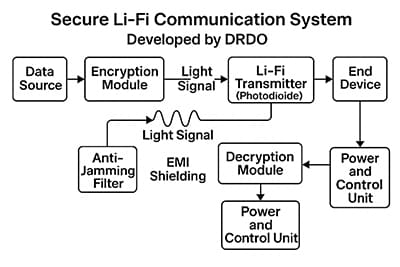
The receiver captures the light pulses, demodulates them, and restores encrypted data streams. These streams are then decrypted and delivered to end users, such as command systems or operational terminals. After laboratory validation, the prototypes are now being evaluated for link stability under varying lighting conditions and for seamless switching between RF and optical channels.
DRDO secure Li-Fi backhaul node
DRDO has developed the secure Li-Fi backhaul node to provide a protected optical link between communication nodes such as command centres, forward bases, and mobile platforms, thereby reducing reliance on RF backhaul channels.
The node confines signals to optical paths, minimising RF signatures in contested environments and enabling covert communication within submarines, bunkers, missile facilities, and hardened shelters. Field trials are underway to assess resilience against ambient light variation, vibration, and RF interference.
Vehicular communication systems (VCS) for defence fleets

EFY++ CONTENT: ACCESS TO THIS CONTENT IS FREE! BUT YOU NEED TO BE A REGISTERED USER.