
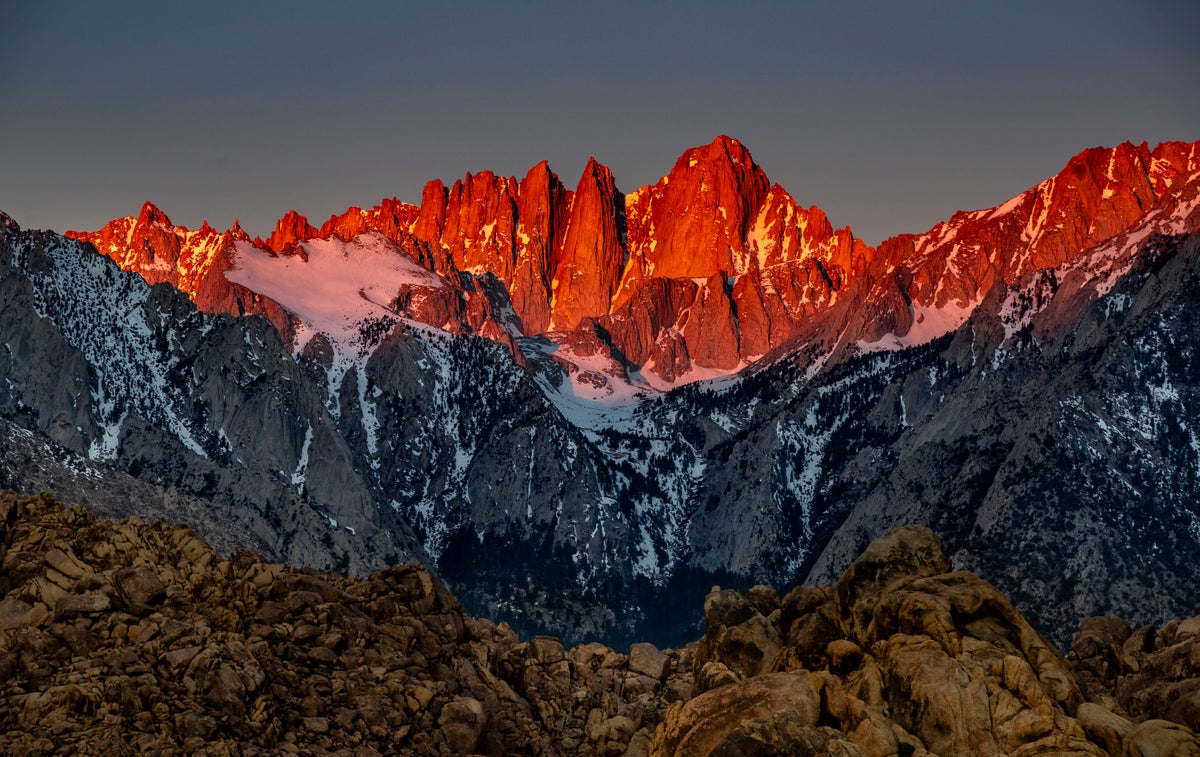

April 1 is supposed to be peak snow. But this year’s western snowpack is utterly dismal
A record warm winter meant that snow levels across the western U.S. were already low, but an incredible March heat wave has made things even worse
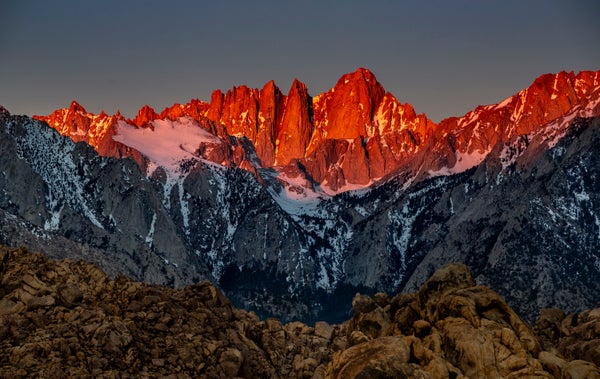
Record heat meltied the Sierra Nevada snowpack at a fast pace as viewed along the mountains including a sunrise view of Mt. Whitney on March 19, 2026, near Lone Pine, Calif.
The western snowpack is in dire straits. Already, the snowpack that coats the mountains of the western U.S. by this point of the year was dismally low compared with past seasons. Then came the record-shattering March heat wave. That caused a massive melt of what little snow there was, leaving many slopes almost completely bare at a time when the snow should be at its peak.
“The March snowpack is doing something that it really hasn’t done before on a widespread basis, to my knowledge, ever in recorded history, which is plummet,” said climate scientist Daniel Swain on his YouTube channel on March 23, during the heat wave’s height.
The snowpack’s condition is a massive concern for communities and water managers in these regions because it typically serves as the West’s water bank, enabling rivers and reservoirs to stay topped up as it slowly melts during the spring and summer. Without the snow, the threat of water shortages and wildfires fueled by parched vegetation rises.
On supporting science journalism
If you’re enjoying this article, consider supporting our award-winning journalism by subscribing. By purchasing a subscription you are helping to ensure the future of impactful stories about the discoveries and ideas shaping our world today.
Somewhat ironically, some western states, particularly California, saw a wet winter. But mild weather made it the warmest winter on record for nine western states, so much of that precipitation fell as rain, not snow. Other areas saw below average precipitation. That’s why the snowpack was already anemic going into March.
Then came the heat wave. From March 15 through 26, more than 700 daily temperature records and more than 100 monthly records were tied or broken—sometimes back to back—according to the National Weather Service. Some of the record-busting temperatures would’ve also set records if they occurred in April or even May.
It was the most anomalous heat wave on record for the Southwest at any time of year. “In other words: there has never been, in all of recorded history, a Southwestern U.S. heat event that yielded departures from typical seasonal temperatures as large as what were observed during the March 2026 event. And it’s not even close,” Swain wrote on his blog on March 28.
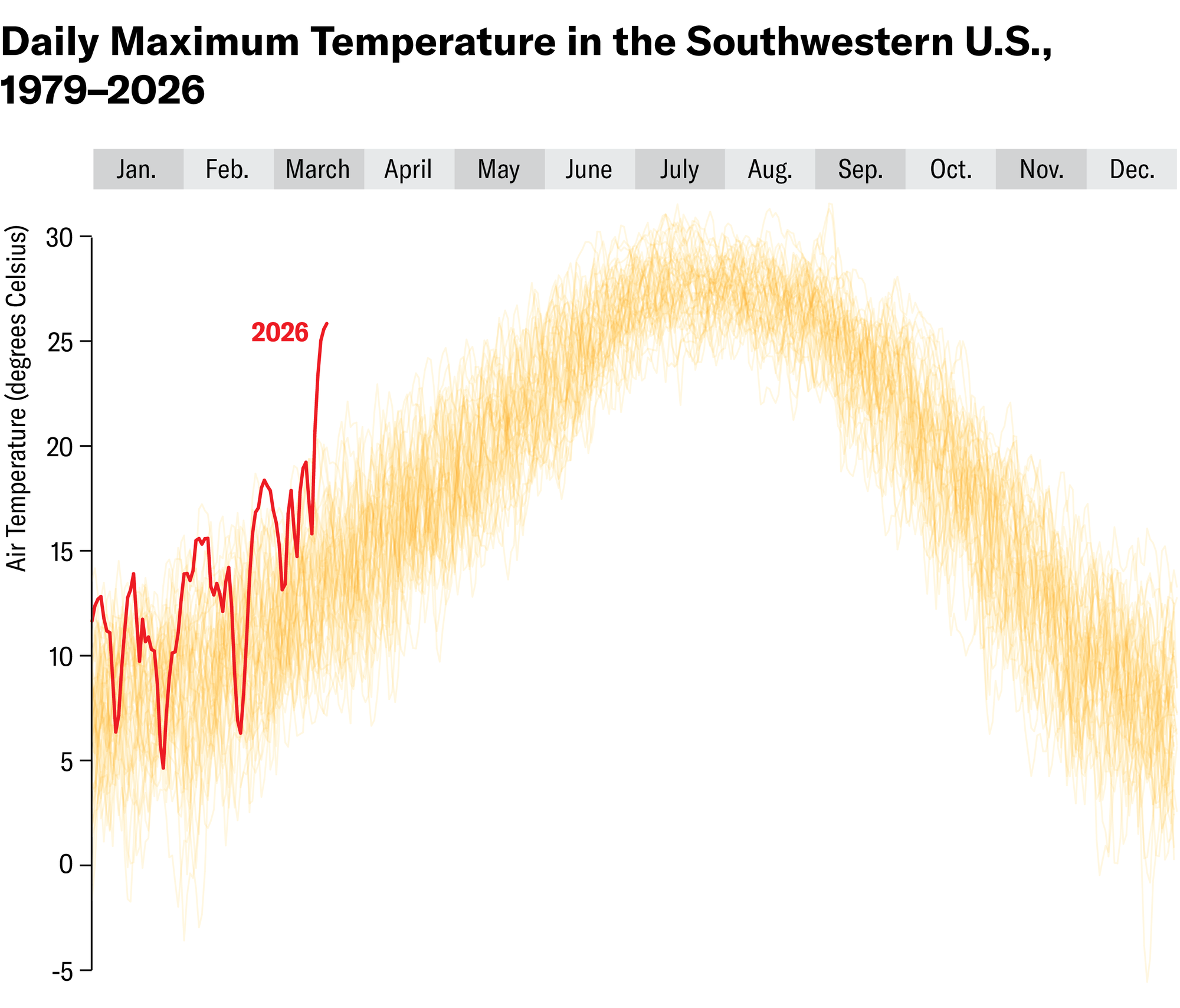
Under such relentless, record-obliterating heat, what snowpack there was has taken a nosedive. Though there have been some past winters with similarly woeful snowpacks in particular areas, the effect is being felt almost everywhere there is meant to be snow in the West. “We’ve got what we’ve got for the rest of the season,” Swain said in his video.
Some states are more insulated than others. California’s water managers, aware of the snowpack issues, have been keeping reservoirs above average levels to hold on to as much water as they can without causing flooding risks.
The Colorado River Basin is another story. Snowpack here has been exceptionally low all winter, often at or near record lows. Once the heat wave began, it was game over. “We are at really unprecedented territory,” Swain said in his video. The previous record low in the modern era—going back to about 1980—was 10.3 inches of what is called snow-water equivalent. As of March 23, it had reached what was “clearly a record low by an enormous margin,” Swain said. By March 28, it had dwindled even more, to 4.3 inches.
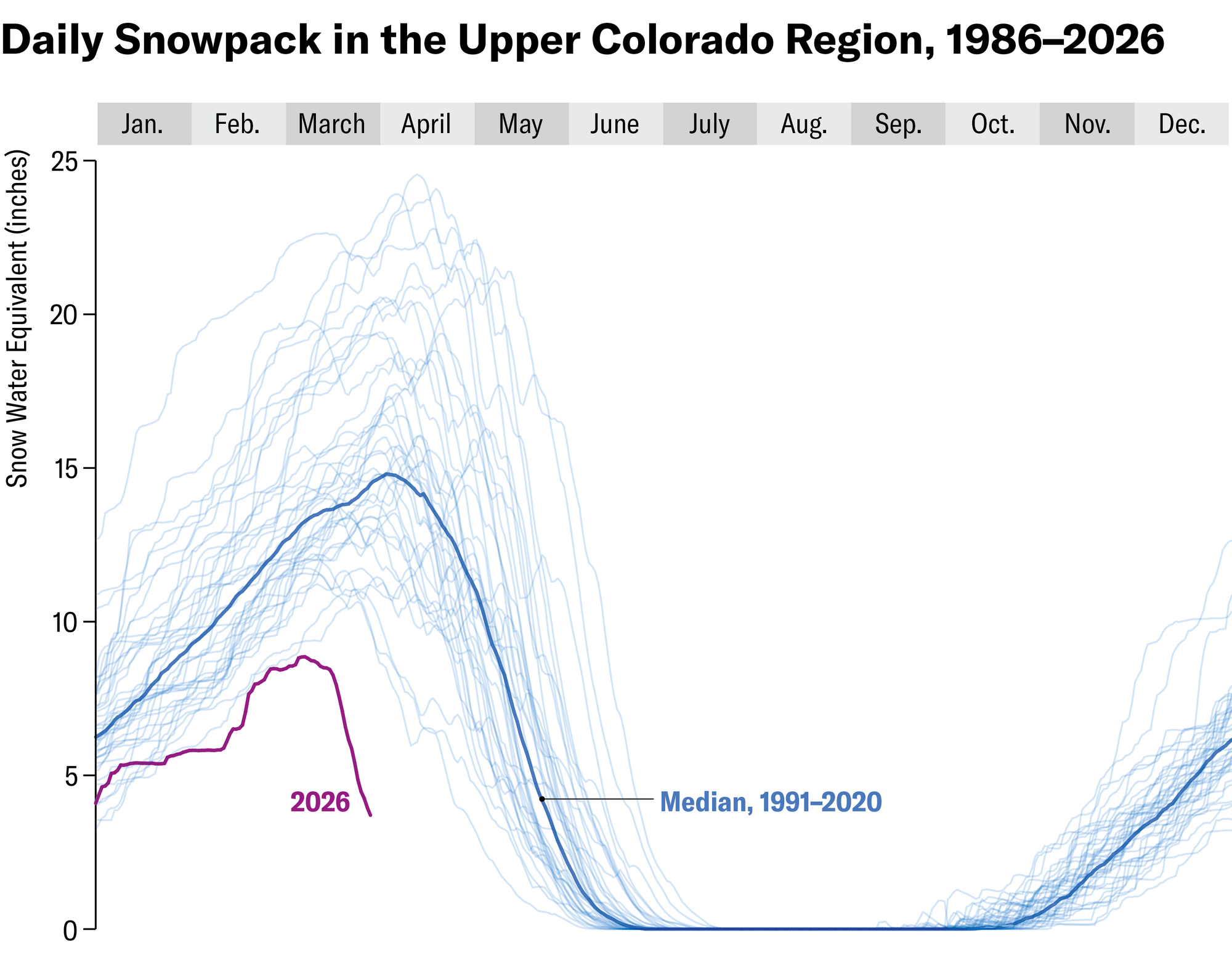
“These numbers are highly alarming,” he added, because they set up the possibility of water shortages, particularly along the struggling Colorado River, which is mired in severe and multidecade drought. Forecasts show that water levels in Lake Powell could dip below what can generate electricity at the Glen Canyon Dam in Arizona. States have spent years disputing how to handle the shrinking, overallocated water supply for 40 million people; the current agreement is set to expire at the end of the year.
Wildfire is also a major concern across a vast portion of the West, as vegetation dries out without the water to sustain it through the summer months. Already, 1.5 million acres have burned in the U.S. this year (although not just in the West), which is more than twice the average by now.
Climate change underlies the entire situation. Rising global temperatures make heat waves hotter, more frequent and longer. Research shows that the most recent heat wave was made about four times more likely and up to 1.4 degrees Fahrenheit (0.8 degree Celsius) hotter than it might otherwise have been because of global warming.
Climate change is also visible in the year-to-year changes in the snowpack. The average is slowly declining, but it masks the real situation. The snowiest winters are about as snowy as they were in the past, but the lean years are both more frequent and more lean than they used to be.
It’s Time to Stand Up for Science
If you enjoyed this article, I’d like to ask for your support. Scientific American has served as an advocate for science and industry for 180 years, and right now may be the most critical moment in that two-century history.
I’ve been a Scientific American subscriber since I was 12 years old, and it helped shape the way I look at the world. SciAm always educates and delights me, and inspires a sense of awe for our vast, beautiful universe. I hope it does that for you, too.
If you subscribe to Scientific American, you help ensure that our coverage is centered on meaningful research and discovery; that we have the resources to report on the decisions that threaten labs across the U.S.; and that we support both budding and working scientists at a time when the value of science itself too often goes unrecognized.
In return, you get essential news, captivating podcasts, brilliant infographics, can’t-miss newsletters, must-watch videos, challenging games, and the science world’s best writing and reporting. You can even gift someone a subscription.
There has never been a more important time for us to stand up and show why science matters. I hope you’ll support us in that mission.