
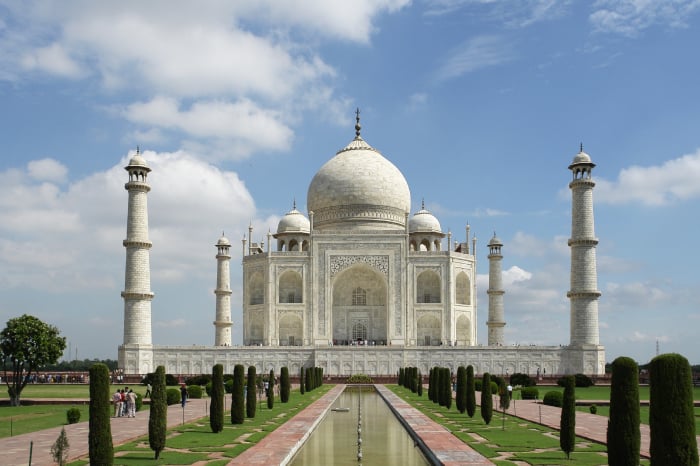
Taj Mahal – Originally Tejo Mahalaya – A Hindu temple dedicated to Bhagwan Shiva

For centuries, the world has been told that the Taj Mahal is a grand mausoleum built by Mughal Emperor Shah Jahan in memory of his beloved wife, Mumtaz Mahal. But the renowned historian Prof. P.N. Oak challenged this narrative head-on in his book Taj Mahal: The True Story.
Prof. Purushottam Nagesh Oak (1917–2007), popularly known as P.N. Oak, was a prominent Indian historian and author known for his bold research challenging conventional historical narratives. He founded the Institute for Rewriting Indian History and wrote several books, including the widely discussed Taj Mahal: The True Story.
As per his research, the Taj Mahal is not a 17th-century Mughal tomb at all. It is an ancient Hindu temple-palace originally known as Tejo Mahalaya, dedicated to Bhagwan Shiva.
Oak argued that the entire romantic love story of Shah Jahan and Mumtaz Mahal was largely a fabrication by court flatterers, careless historians, and archaeologists. He claimed Shah Jahan simply commandeered an existing magnificent Hindu structure for his wife’s burial.
Key evidences cited by Prof. P.N. Oak
1. The name “Taj Majhal”
The term “Taj Mahal” never appears in any Mughal court records or chronicles from Shah Jahan’s time, and not even in Aurangzeb’s era. Oak pointed out that “Mahal” is not a word used for buildings in any Muslim country from Afghanistan to Algeria. The popular explanation linking it to “Mumtaz Mahal” is flawed – her actual title was Mumtaz-ul-Zamani, and arbitrarily dropping “Mum” from her name makes little sense.
Instead, Oak proposed that “Taj Mahal” is a corrupted form of Tejo Mahalaya — meaning the “Palace of Teja” (a reference to Bhagwan Shiva). European travelers even called it “Taj-e-Mahal,” which closely matches the ancient Sanskrit name.
2. Shah Jahan’s own records
In the official court chronicle Badshahnama, Shah Jahan himself admits that he took over a grand, exceptionally beautiful mansion in Agra from Maharaja Jaisingh of Jaipur, to bury Mumtaz. Oak noted that two such orders for surrendering the building are reportedly still preserved in the Jaipur royal collection. Using captured temples and palaces as tombs for royalty and nobles was a known practice among some Muslim rulers (other examples include the tombs of Humayun, Akbar, Itmad-ud-Daula, and Safdarjung).
3. Architectural and design features
Oak highlighted several elements he considered typically Vedic rather than Islamic:

- The overall layout resembles a Hindu temple-palace complex, with corridors, arched verandas, terraces, and multi-storeyed towers.
- The entire complex faces south, which is atypical for mosques, and follows the Chaturmukhi (four-sided) Hindu architectural style.
- Four corner pillars are Hindu-style lamp towers used to demarcate holy precincts.

Typical Vedic-style corridors inside the Taj Mahal complex - The pinnacle on the dome features a trident-like design (Trishul) and lotus motifs, both of which are sacred Hindu symbols.

Detailed close-up of the pinnacle atop the dome — resembling a ‘trishul’ (trident). - “OM” symbols and red lotus patterns are said to be visible in the inlay work and floral designs on the walls.

The symbol ‘OM’ within the floral inlay work on the walls. 
Red lotus motif at the apex of one of the main arched entrances.
4. Pre-Shah Jahan evidence
Several foreign visitors recorded observations that contradict the official construction timeline:
- Peter Mundy (English traveler, 1632) described the “Taj-e-Mahal” and its gardens as noteworthy — within a year of Mumtaz’s death, which clearly indicates that the structure was already existing then.
- Johan Albert Mandelslo in 1638 wrote about Agra, but made no mention of any massive new construction project.
- French jeweler Jean-Baptiste Tavernier noted that the 22 years of “work” involved plundering fixtures, removing Hindu idols, installing cenotaphs, and adding Koranic inscriptions rather than building from scratch.
Aurangzeb’s 1652 letter (preserved in Aadaab-e-Alamgiri) describes the Taj buildings as seven-storeyed, old, leaking, and with a cracked dome. He ordered repairs at his own expense — a clear proof that the structure already existed and was in need of maintenance, not newly built.
Carbon dating of a wooden door sample from the riverside doorway (conducted by Prof. Marvin Miller) reportedly showed it was about 300 years older than Shah Jahan’s reign.
5. The sealed chambers and hidden relics


Oak and later researchers pointed out that the Taj has 22 rooms in the red-stone basement below the marble plinth. These were walled up by Shah Jahan.
In 1934, a peep through a sealed corridor reportedly revealed a beheaded Shiva statue and other huddled Hindu idols. A crack in the central chamber wall (1959–62) briefly exposed embedded marble images before they were secretly reburied.
The Archaeological Survey of India has never allowed proper investigation of these chambers.
6. The love story questioned
Oak maintained that no contemporary royal chronicle from Shah Jahan’s reign actually supports the famous tale of undying love and 22 years of mourning-inspired construction involving 20,000 workers.
Supporting observations
- Mumtaz Mahal died in Burhanpur, and a pavilion there is sometimes linked to her initial burial.

Palace in Burhanpur where Mumtaz is said to have died 
Pavilion in Burhanpur said to be the initial burial site of Mumtaz. - The Taj complex includes features like secret walled doors, Vedic-style corridors, and inlaid patterns that some interpret as non-Islamic.
Oak’s central assertion: The Taj Mahal was originally a Shiva temple-palace worshipped by the Rajputs of Agra, later usurped and repurposed. He believed many sealed rooms and underground areas still hold the key to uncovering its true history.

Sources
Photographs: Courtesy of Stephen Knapp’s website
Information & Research: Based on the writings of P.N. Oak and material compiled on Stephen Knapp’s website.
Further Reading: Islamic Destruction of Hindu Temples