
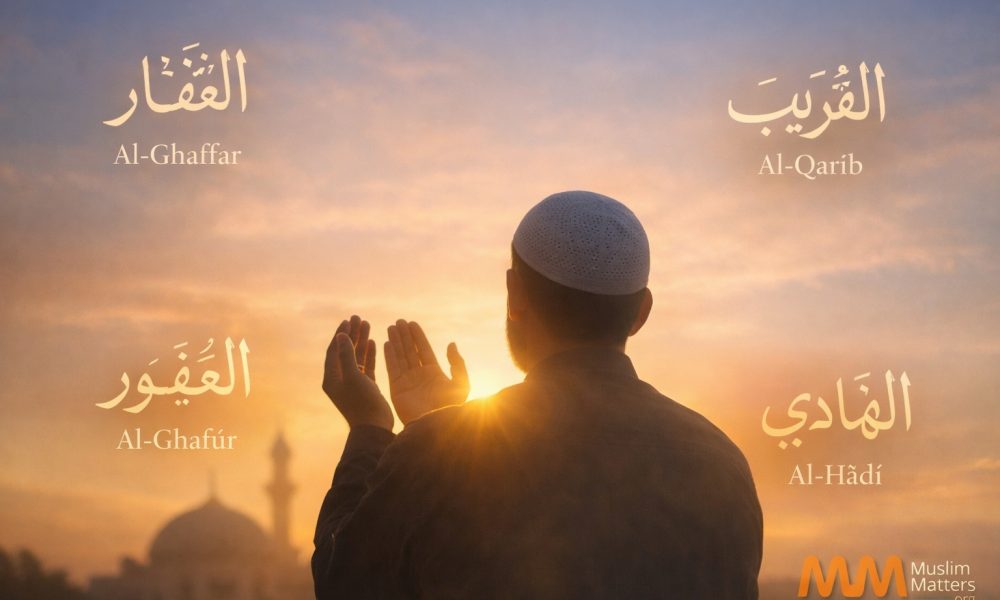
Discover how to stay spiritually connected after Ramadan by deepening your relationship with Allah through His Beautiful Names.
The Gradual Fade
Ramadan has passed, and as we return to the hustle and bustle of our daily lives, we may begin to notice the focus and consistency we experienced during the blessed month gradually fading. Perhaps we stop praying tahajjud, or forget to read the Quran for a few days, or pass an entire week without visiting the masjid, except for Jum’ah.
During Ramadan, we became more conscious of Allah—more aware of His mercy, more hopeful in His forgiveness, and more observant to His presence. Our days were shaped by fasting, our nights illuminated by prayer, and our hearts were tranquil with the remembrance of Allah.
Keep supporting MuslimMatters for the sake of Allah
Alhamdulillah, we’re at over 850 supporters. Help us get to 900 supporters this month. All it takes is a small gift from a reader like you to keep us going, for just $2 / month.
The Prophet (SAW) has taught us the best of deeds are those that done consistently, even if they are small.
Click here to support MuslimMatters with a monthly donation of $2 per month. Set it and collect blessings from Allah (swt) for the khayr you’re supporting without thinking about it.
As we return to the rhythm of everyday life, the challenge before us is to preserve the awareness of Allah that Ramadan nurtured within us. Ramadan was never meant to be restricted to a single month; rather, it was meant to cultivate a lasting consciousness of Allah that continues to guide our hearts long after the month has passed.
Allah calls us in the Qur’an to reflect:
“O mankind! What has deceived you concerning your Lord, the Most Generous?” (Qur’an 82:6)
This verse invites us to pause and ponder over the nature of our relationship with Allah. In the busyness of everyday life, we can become consumed with responsibilities and distractions, yet as believers we are continuously called to reconnect with our Lord with awareness, humility, and hope. Our connection to Allah is not meant to fluctuate with changing circumstances; rather, it is meant to remain a constant source of guidance and stability.
Reconnecting to Allah Through His Names
One of the greatest ways Allah has made Himself known to us is through His Beautiful and Majestic Names. Allah says:
“To Allah belong the most beautiful names, so call upon Him by them.” (Qur’an 7:180)
Through His Names, Allah makes Himself known to us as the Most Merciful, the Most Generous, the All-Knowing, the Most Gentle, the One who forgives, the One who guides, the One who restores what is broken, and the One who is always close to those who call upon Him.
It is through His Beautiful and Majestic Names that we feel His presence in moments of strength and in moments of weakness, in times of clarity and in times of uncertainty. One of the best ways we remain connected to Allah beyond Ramadan is by knowing Him and living with His Beautiful Names.
Al-Ghaffār & Al-Ghafūr — The One Who Forgives

When a person recognises that Allah is Al-Ghaffār and Al-Ghafūr — the One who forgives repeatedly, and whose mercy is vast beyond measure— the heart finds reassurance that returning to Allah is always possible. No matter how many times a person stumbles, the door to Allah’s forgiveness remains open.
Allah reassures us in the Qur’an:
“Do not despair of the mercy of Allah. Indeed, Allah forgives all sins.” (Qur’an 39:53)
The Prophet ﷺ reminded us:
“All of the children of Adam sin, and the best of those who sin are those who repent.” (Tirmidhi)
These reminders teach us that mistakes are not barriers between us and Allah; rather, they can become means of turning back to Him with greater sincerity and humility. Knowing Allah as Al-Ghaffār and Al-Ghafūr allows us to move forward with hope, trusting that Allah’s mercy is always greater than our shortcomings.
As human beings, we are prone to error, yet we are never taught to despair of Allah’s mercy. Rather, we are reminded that Allah loves those who turn to Him in repentance. Allah says:
“Indeed, Allah loves those who constantly repent.” (Qur’an 2:222)
Knowing Allah as Al-Ghaffār and Al-Ghafūr reassures the heart that even when we fall short, the door to our Lord remains open, and His mercy is always greater than our sins.
Al-Qarīb — The One Who Is Near
Another way we remain connected to Allah is through recognising that He is Al-Qarīb — the One who is always near. Even when Ramadan has passed, the believer is reminded that closeness to Allah is not restricted to a particular time or place.
Allah says:
“When My servants ask you concerning Me, indeed I am near.” (Qur’an 2:186)
This verse reminds us that Allah’s nearness is constant. Whether we turn to Him in remembrance, in duʿā’, or in moments of quiet reflection, we are reminded that Allah is fully aware of us and always listens.
Knowing that Allah is near encourages us to continue turning to Him consistently, allowing the connection nurtured in Ramadan to continue throughout our lives.
Allah’s Nearness in Times of Hardship

This awareness of Allah’s nearness was deeply rooted in the life of the Prophet ﷺ. During the Hijrah, when the Prophet ﷺ and Abu Bakr were hiding in the cave while being pursued, Abu Bakr feared that they would be found. The Prophet ﷺ reassured him with words that continue to bring comfort to believers:
“Do not grieve; indeed Allah is with us.” (Qur’an 9:40)
The Prophet ﷺ also experienced Allah’s nearness in moments of deep hardship. After being rejected in Ṭā’if, he turned to Allah with a heartfelt supplication, expressing his weakness and complete reliance upon his Lord. In this moment of deep pain and rejection, the Prophet ﷺ demonstrated that even when people abandon us, Allah is always near and fully aware of every struggle.
These moments remind us that the believer is never without support. The One who was near to the Prophet ﷺ in the cave, and near to him in Ṭā’if, remains near to those of us who turn to Him today.
Knowing Allah as Al-Qarīb transforms how we experience difficulty. In moments of loneliness, we are reminded that we are not alone. In moments of uncertainty, we find comfort in knowing that Allah is aware of every difficulty we are facing. Turning to Allah regularly nurtures a sense of reassurance, strengthening the believer’s trust that Allah is always present and attentive.
Al-Hādī — The One Who Guides
As we continue seeking closeness to Allah, we also acknowledge our need for guidance. The quest to remain consistent and sincere often brings an awareness that the heart requires guidance in order to stay firm. In these moments, we turn to Allah as Al-Hādī — the One who guides hearts and gently leads us towards what is good.
The Prophet ﷺ would frequently supplicate:
“O Turner of hearts, keep my heart firm upon Your religion.”
This supplication reminds us that steadfastness is not attained through our own efforts alone; rather, it is a gift from Allah. The believer therefore continues to seek His guidance, asking Allah to keep the heart sincere, firm, and aligned with what is pleasing to Him.
Knowing Allah as Al-Hādī reassures us that guidance is ongoing. Allah continues to guide those who turn to Him, opening paths for growth, strengthening faith, and nurturing a deeper awareness of Him.
Through these Beautiful and Majestic Names, we begin to understand that our relationship with Allah is not confined to a particular time or season. Rather, every stage of life becomes an opportunity to know Him more deeply and to strengthen our connection with Him.
Turning to Allah Through Duʿā
Recognising Allah through His Beautiful and Majestic Names naturally transforms the way we turn to Him. The more we come to know Allah as the One who forgives, the One who is near, and the One who guides, the more our hearts learn to rely upon Him. The believer does not merely learn the Names of Allah, but lives through them—calling upon Allah with hope, humility, and trust.
The Prophet ﷺ reminded us that duʿā’ is worship. One of the most powerful expressions of our connection to Allah is to call upon Him through the very Names by which He has made Himself known to us.
Use These Duʿās
O Allah, allow our hearts to remain connected to You beyond Ramadan. Do not allow the sweetness of drawing near to You to fade from our hearts, and do not allow us to return to heedlessness after You have allowed us to taste the sweetness of closeness to You.
O Allah, You are Al-Ghaffār and Al-Ghafūr, the One who forgives again and again, whose mercy encompasses all shortcomings. Forgive us for our mistakes and do not allow our sins to distance us from You. Let our shortcomings become a means of returning to You with humility, sincerity, and hope.
O Allah, You are Al-Qarīb, the One who is near. Allow us to feel Your nearness in our lives, and make us among those who remember You often. When we feel distracted or distant, gently bring our hearts back to You.
O Allah, You are Al-Hādī, the One who guides hearts. Keep our hearts firm upon Your guidance, and allow the sincerity we experienced in Ramadan to continue shaping our intentions, our actions, and our choices.
O Allah, allow this journey to You to continue throughout our lives. Strengthen our remembrance of You, increase us in awareness of You, and draw our hearts closer to You through Your Beautiful and Majestic Names.
Āmīn, Allāhumma Āmīn.
Related:
What Shaykh Muhammad Al Shareef Taught Us About Making Dua
Du’a: The Weapon of the Believer