
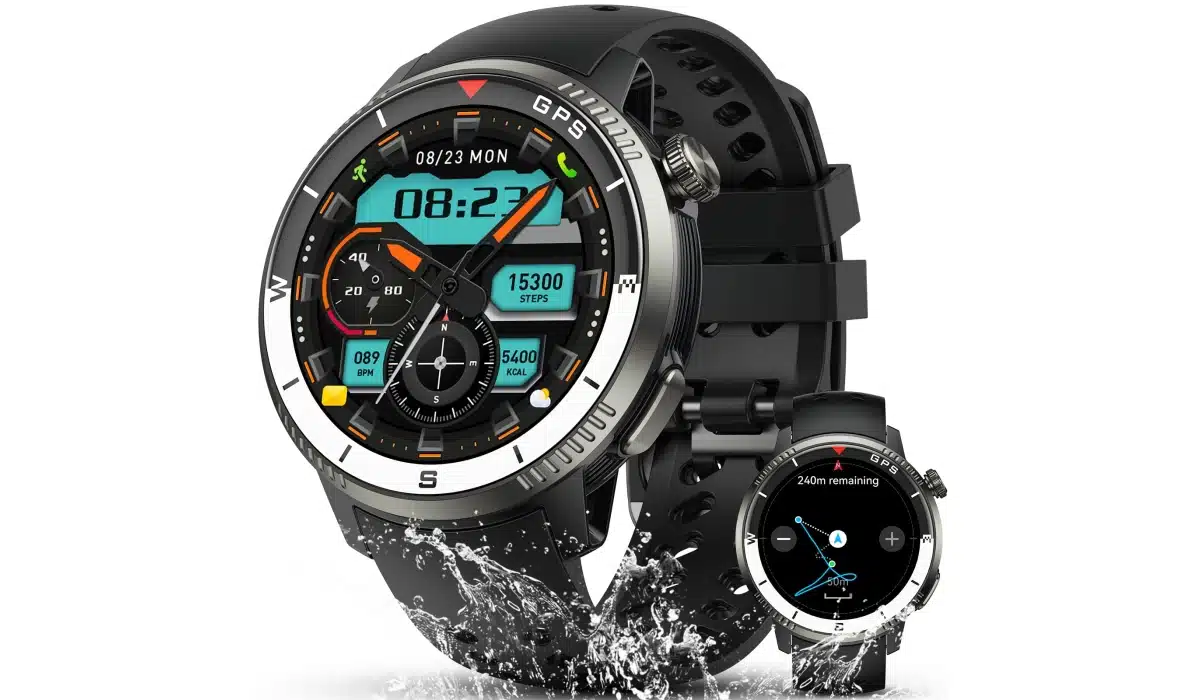
If you’ve been shopping for a smartwatch and stumbled across specs like “5ATM” or “IP68,” you’re not alone in wondering what they mean. These ratings tell you how well a watch holds up against water — but they work differently and are not interchangeable. Here’s what you need to know before you buy.
What Does ATM Mean?
ATM stands for atmospheres, a unit of pressure. On a smartwatch or fitness tracker, the ATM rating tells you how much water pressure the device can withstand before water penetrates the casing.
One ATM is roughly equivalent to the pressure experienced at 10 meters (33 feet) of water depth. So a watch rated at 5ATM can theoretically withstand pressure equal to 50 meters of water depth, and a 10ATM watch is rated for the equivalent of 100 meters.
However, those depth numbers are based on static pressure tests — meaning still water in a controlled lab setting. Real-world conditions are different. The force of jumping into a pool or a wave crashing against your wrist creates dynamic pressure that can exceed the rated limit. So always treat the depth equivalent as a guide, not a hard guarantee.

ATM Ratings and What They Mean in Practice
Here is a quick breakdown of common ATM ratings and what activities they are realistically suited for:
| ATM Rating | Depth Equivalent | Suitable For |
|---|---|---|
| 1 ATM | 10m / 33ft | Accidental splashes only |
| 3 ATM | 30m / 100ft | Rain, handwashing, brief splashes |
| 5 ATM | 50m / 165ft | Swimming in a pool or ocean |
| 10 ATM | 100m / 330ft | Swimming, snorkeling, water sports |
| 20 ATM | 200m / 660ft | Recreational scuba diving |
Most mainstream smartwatches in the US market — including the Apple Watch Series 10, Samsung Galaxy Watch 7, and many Garmin Forerunner models, such as the Forerunner 955 and 965 — carry a 5ATM rating, making them safe for swimming and showering.
What Is an IP Rating?
IP stands for Ingress Protection. It is a formal international standard (IEC 60529) that rates a device’s resistance to both solid particles and liquids. You will see it on smartwatches, smartphones, earbuds, and other consumer electronics.
An IP rating uses a two-digit code. The first digit rates protection against solids like dust and sand, on a scale of 0 to 6. The second digit rates protection against water, on a scale of 0 to 9.
For example, IP68 — the most common rating on premium smartwatches and smartphones — means:
- 6 = fully dustproof
- 8 = protected against continuous submersion in water beyond 1 meter (exact depth is defined by the manufacturer)
A rating of IP67 means dustproof with submersion protection up to 1 meter for 30 minutes.
ATM vs IP Rating: Key Differences
While both ratings relate to water resistance, they are measuring different things and serve different purposes.
ATM focuses solely on water pressure. It gives you a pressure depth equivalent and is almost exclusively used in the watch industry. It tells you nothing about dust or particle protection.
IP is a broader, formal standard. It covers both dust and water, uses defined international test procedures, and is applied across a wide range of electronics — not just watches.
The water resistance numbers are not directly comparable. An IP68 rating does not automatically mean the same level of protection as a 10ATM rating. The test methods differ, and manufacturers set their own depth and duration parameters for IP68 certification.
A device can carry both ratings. Many smartwatches list both an ATM and an IP rating because they communicate different things. For example, a watch might be rated 5ATM and IP68, meaning it handles swimming pressure and is also fully dustproof.
Which Rating Should You Care About When Buying a Smartwatch?
For most buyers in the US and Canada, here is a simple way to think about it:
- If you plan to swim or shower with your watch regularly, look for at least 5ATM.
- If you want dustproof protection as well — useful if you work outdoors, hike, or spend time in sandy environments — look for an IP6x rating (where x is any number).
- If you want both, look for a watch that carries both ratings, such as 5ATM + IP68.
- If you are into water sports or snorkeling, go for 10ATM.
- For recreational scuba diving, you need at least 20ATM and ideally a watch designed specifically for diving.
Frequently Asked Questions
Is 5ATM good enough for swimming?
Yes. A 5ATM rating is sufficient for lap swimming, ocean swimming, and showering. Most major smartwatches sold in the US, including the Apple Watch and Samsung Galaxy Watch, carry this rating.
Can I wear a 10ATM watch in the ocean?
Yes. A 10ATM watch handles ocean swimming and snorkeling comfortably. Just avoid deep diving or high-impact water entry like cliff jumping.
Is IP68 the same as waterproof?
Not exactly. IP68 means the device can withstand submersion in water beyond 1 meter, but the exact depth and duration depend on the manufacturer’s own testing parameters. “Waterproof” is not an official standard — IP68 is the closest practical equivalent for consumer electronics. For context, watch this video about what happened when Mister Mobility went swimming with his IP68 smartwatch.
Do ATM ratings apply to phones too?
ATM ratings are almost exclusively used for watches. Smartphones use IP ratings. If a phone is listed as IP68, it can handle submersion — but you will not typically see an ATM rating on a phone.
Can I take my Apple Watch swimming?
Apple Watch Series 2 and later models carry a 50-meter water resistance rating, which corresponds to 5ATM. Apple officially supports swimming with these models. The Apple Watch Ultra carries a 100-meter rating, equivalent to 10ATM.
Related reading:
Best Smartwatches for Swimming | IP68 vs IP67: What’s the Difference? | Best Waterproof Fitness Trackers
Disclosure: When you purchase through links on our site, we may earn an affiliate commission.