
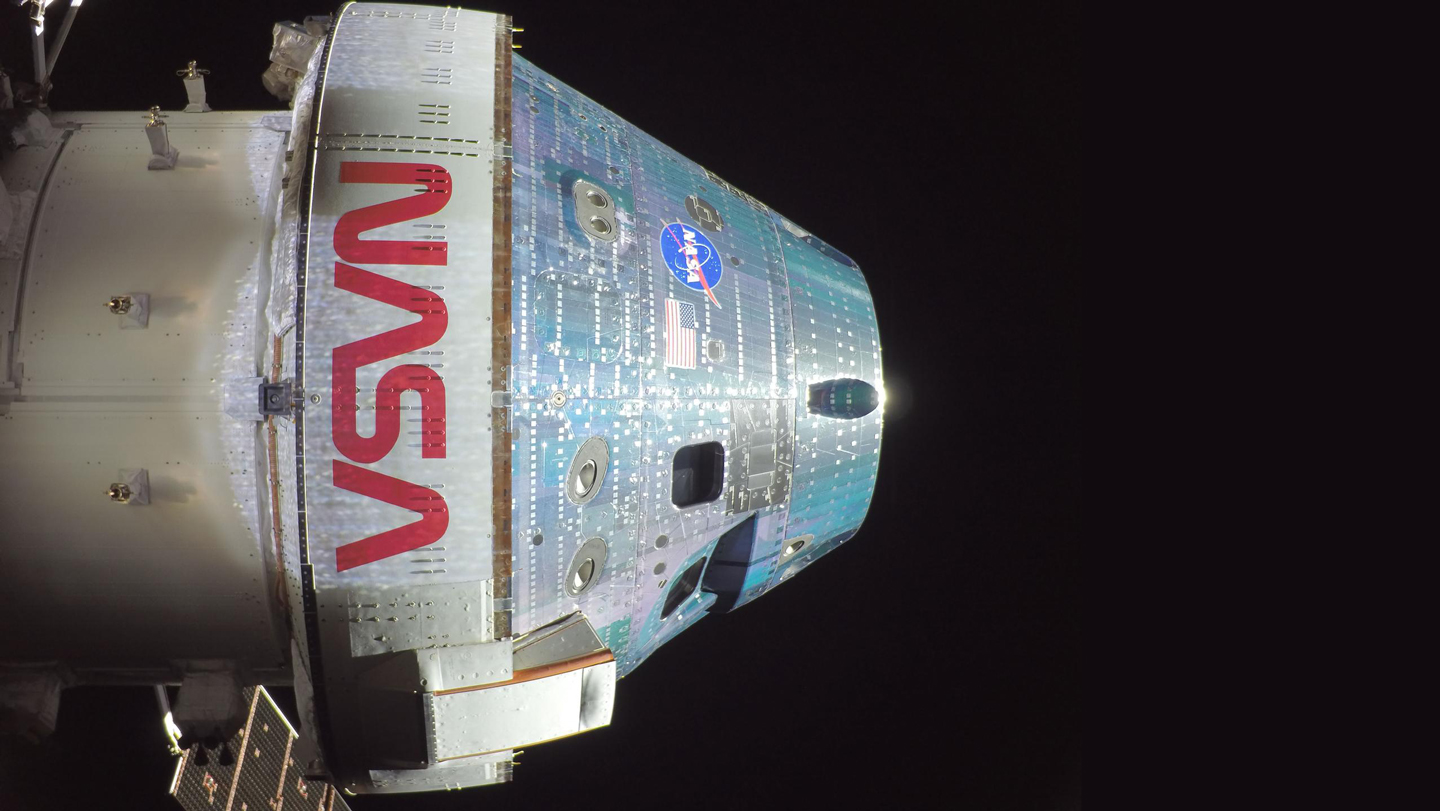
HOUSTON — After five days in space and five decades of waiting, human astronauts just got an unprecedented view of the moon.
With Earth in the rearview mirror, the Artemis II mission’s Orion spacecraft entered in the lunar sphere of influence, where the moon’s gravitation pull is stronger than Earth’s. As Orion swung around the farside of the moon on April 6, the four astronauts aboard Orion saw lunar features that have barely been glimpsed before by human eyes, and never in such detail. The astronauts — NASA’s Christina Koch, Victor Glover and Reid Wiseman and Canadian Space Agency’s Jeremy Hansen — have spent years preparing to take scientific observations during the few hours they had with the moon in their sights.
The seven-hour flyby included about 45 minutes when the spacecraft was in the moon’s shadow and out of contact with Earth. While only about 20 percent of the moon’s farside was illuminated in sunlight at flyby time, the astronauts still got the clearest view yet of the region. The team also anticipated seeing the Apollo 12 and 14 landing sites, an eclipse as the moon blocks the sun from Orion’s perspective and possibly flashes of light when meteorites strike the moon.
Science News’ astronomy reporter, Lisa Grossman, is on the scene at NASA’s Johnson Space Center and is providing updates as the flyby progresses.
9:40 p.m.: It’s a wrap
And with a sighting of a solar eclipse from space, the lunar flyby came to an end.
“This is basically wrapping up your flyby day observations,” said Kelsey Young, the Artemis Science Flight Operations Lead. “I can’t say enough how much science we’ve already learned, and how much inspiration you’ve provided to our entire team, the lunar science community and the entire world with what you were able to bring today. You really brought the moon closer for us today, and we cannot say thank you enough. And Science signing off and we can’t wait to talk to you tomorrow morning.”
8:50 p.m.: “We just went sci-fi:” A first eclipse seen from the moon
The astronauts are now seeing a total solar eclipse, the first time humans have seen an eclipse from the moon. They had to wear eclipse glasses for the first two minutes while the sun was still visible. But then the moon slid over the sun’s disk, and the wispy corona came into the astronauts’ view.
“This continues to be unreal,” said Victor Glover. “The sun has gone behind the moon, the corona is still visible. It’s bright and it creates a halo almost around the entire moon.” But the side of the moon facing Earth is illuminated by earthshine, sunlight reflected off the Earth. “The Earth is so bright out there and the moon is just hanging in front of us, this black orb…. It creates quite an impressive visual illusion. Wow. It’s amazing….”
“We just went sci-fi,” he added. “It just looks unreal. You can see the surface of the moon between the earthshine, I guess earthshine. You can actually see a majority of the moon. It is the strangest looking thing.”
While the moon is blocking the sun, it’s dark enough for the astronauts to observe other planets in the solar system. One pinpoint of light was Venus; they also spotted a red smudge of Mars and tracked Saturn setting behind the moon. The astronauts also saw the impact flashes from at least four meteorites, a moment that made the science officers’ jaws drop.
7:30 p.m. Back in communication and Orion heads toward home
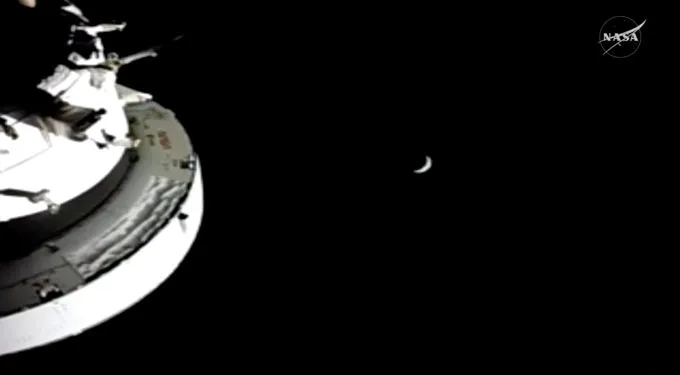
“Orion has come back around the other side of the moon, and that little crescent you see is Earth, over 250,000 miles away. With this transit complete, lunar flyby continues, but Orion has also technically begun its journey home,” said NASA public affairs officer Leah Cheshier Mustachio.
7:15 pm: Re-creating the original Earthrise
On Christmas Eve, 1968, Apollo 8 astronaut William Anders took one of the most famous photos in history. As he became one of the first people to enter lunar orbit, he snapped a photo of the Earth coming up over the edge of the moon. That photo came to be known as Earthrise, and is partially credited with starting the environmental movement.
The Artemis II astronauts will have a chance to re-create that photo in just a few minutes. Near the end of their lunar flyby, the astronauts will see a crescent Earth peek from behind a crescent moon. Asia, Africa and Oceania will be illuminated from the astronauts’ perspective, said Kelsey Young, the Artemis Science Flight Operations Lead. If you look up at the moon from that part of the world, the astronauts will be looking back at you.
7:05 p.m.: Farside science: “No one is worried about not having enough to do”
While the astronauts are out of touch with Earth, they have the chance to make some more unique observations. They can compare how colors on the moon might look different when Earth is out of view — the crew has noted already that the Earth looks surprisingly bright, even from so far away. They’ll watch for impact flashes, short-lived spikes of light visible on the dark parts of the moon when they’re struck by an impact. Citizen scientists will be watching for similar flashes from Earth.
Just before Earthrise, the astronauts will look for lofted lunar dust, specks which may be visible only when backlit by earthshine. Apollo astronauts saw such dust, so the science team is interested to see if it will show up again.
Back on Earth, the science team will be busy analyzing the descriptions they’ve heard so far and preparing questions to ask the astronauts while their observations are still fresh.
“It’s only 40 minutes, which sounds like a long time, but it’s actually not,” NASA program scientist Amanda Nahm told me this morning in the Science Mission Operations Room. “No one is worried about not having enough to do.”
6:43 p.m.: Loss of signal
The Orion spacecraft just flew directly behind the moon. For the next 40 minutes, the Artemis II crew will be out of radio communication, since signals can’t travel through the moon’s rocky body.
During that time, around 7:02 p.m., Orion is expected to make its closest approach to the moon, flying just 6,545 kilometers (4,067 miles) above the surface. Minutes later, the astronauts will reach their farthest point from Earth, setting a new record.
The previous record for farthest humans from the Earth was 400,171 kilometers (248,655 miles) and was set by the Apollo 13 crew in 1970. Those astronauts were supposed to land on the moon, but after an oxygen tank exploded two days into the mission, they switched to a gravitational slingshot around the moon.
The Artemis II crew surpassed Apollo 13’s distance record at 1:57 p.m. The crew’s maximum distance from Earth will be 406,771 kilometers, 6,600 kilometers farther than Apollo 13.
6:15 p.m.: Expecting to see an eclipse from space
The moon isn’t the only thing the Artemis II astronauts will have in their sights. They’ll also get a unique view of the sun.
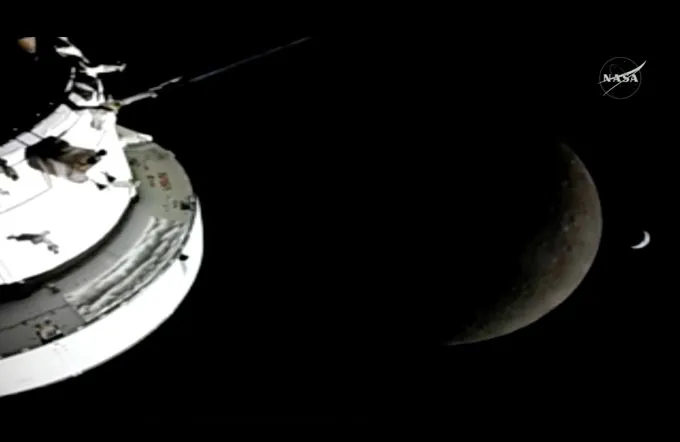
As the astronauts head back toward Earth, they will orient the spacecraft so that the moon blocks the sun. The lunar disk will completely block the sun, creating a total eclipse and bringing its wispy corona into view. Normally, the corona is observable from Earth only when the moon passes in front of the sun. Earthly solar eclipses happen infrequently, are visible only from one spot on the planet at a time, and usually last just a few minutes.
This is not the first time astronauts have seen a total eclipse in space. Apollo astronauts saw similar eclipses in the 1960s and 70s. In 1975, astronauts aboard a Russian Soyuz spacecraft viewed an eclipse when an American Apollo spacecraft deliberately moved between it and the sun, creating an artificial eclipse.
The Proba-3 spacecraft currently is in the midst of a two-year mission to provide eclipses on demand, but it’s robotic, not crewed.
5:30 p.m.: Lunchtime!
If it’s the 5 o’clock hour, it must be lunchtime somewhere. Some of the items on the astronauts’ menu: Beef ravioli, salmon, butternut squash, sweet and savory kale, pickled beets, cherry cobbler, tuna noodle casserole, tomatoes and artichokes, broccoli and chocolate peanut butter bar.
5 p.m.: Painting a picture of the moon
The moon has been thoroughly photographed by robots, but it looks different to human eyes. Humans can pick up details in color and texture that don’t come through on cameras, similar to how the moon always looks better in person than when you try to capture it on your phone. The Artemis II astronauts are seeing browns and greens where cameras picked up grays. Some of their descriptions are downright poetic.
Christina Koch: “Something I’ve never seen in photographs but is really apparent, all the really bright new craters, some of them are super tiny, most of them are pretty small. What it looks like is a lampshade with pinprick holes and light shining through. They are so bright compared to the rest of the moon.”
Victor Glover: “I wish I had more time to just sit here and describe what I’m seeing but the terminator right now is just fantastic. There are little islands of terrain out there that are completely surrounded by darkness…. To the north, there’s a really nice double crater, it looks like a snowman. On the southern edge it looks like there’s a gigantic hole.”
“Oh my gosh, that was an amazing picture you just painted,” Kelsey Young, the Artemis Science Flight Operations Lead, said after Glover’s stirring description of the terminator, the line between light and dark on the moon. “Those kinds of observations are things that humans are uniquely able to contribute and you just brought us along with you. Thanks for that.”
And if you want more, Koch again: “At one point towards the end of my time in window 3, I just had an overwhelming sense of being moved by looking at the moon. It lasted just a second or two, and I actually couldn’t even make it happen again. But something just drew me in suddenly to the lunar landscape, and it became real. The truth is the moon really is its own unique body in the universe. It’s not just a poster in the sky that goes by, it is a real place. And when we have that perspective and we compare it to our home of the Earth, it just reminds us how much we have in common. Everything we need, the Earth provides, and that truly is somewhat of a miracle.”
3:50 p.m.: Shift change
The crew are taking turns making science observations, with two of them taking photos and recording verbal observations for 55 to 85 minutes while the other two communicate with the ground, exercise or do other tasks. Reid Wiseman and Jeremy Hansen had the first shift at the windows, and are swapping places with Christina Koch and Victor Glover now. The photos and recordings will be sent back to Earth once the flyby is over, and the science team will analyze them through the night.
Glover noted how difficult it is to switch between looking at the moon and looking inside the spacecraft, where the crew turned off almost all the lights. “This is a very taxing event on the eyes,” he said. “As soon as I look back into the cabin after looking out the window I can feel my eyes adjusting.”
3:30 p.m.: Why we are fascinated with the farside of the moon
The nearside of the moon is an old friend. It always faces Earth. The Apollo missions all landed there. Its familiar flat lava flows make up the man in the moon (or the rabbit, depending who you ask).
The lunar farside is more mysterious. It has thicker crust, more craters and different chemistry in its rocks. Only a few spacecraft have ever landed there: China’s Chang’e-4 mission in 2019 and Chang’e-6 in 2024, which returned the first farside samples. Those rocks showed evidence of relatively recent volcanic activity on the moon, just 2.8 billion years ago.
2:45 p.m.: A matter of scale
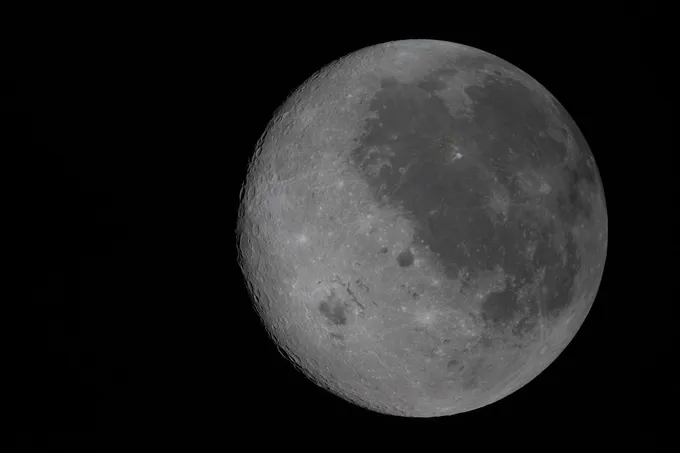
Just moments before observing the transition from the nearside to the farside of the moon, Commander Reid Wiseman said “we just realized we have Earth out window 4 and moon out window 3 and it gives you the best idea of scale we’ve had yet. The moon is about three to four times the size of the Earth and it is almost full. And the Earth is just a small crescent out there. It’s magnificent. I got a picture of it with the wide lens. Such a majestic view out here.”
Said mission specialist Christina Koch: “The moon is still noticeably getting bigger as we go.” She noted that the Earth looks brighter than the moon, even though it’s so much smaller and farther away. She also noted the size of the Hertzprung Basin, an old and relatively degraded impact structure on the lunar farside. It appears about the same size as the younger Orientale Basin, which is known as the Grand Canyon of the moon and had never been seen by humans before this mission.
1:45 p.m.: Prepping for science
The crew just had their pre-flyby science conference with Kelsey Young, the Artemis Science Flight Operations Lead.
“Kelsey, it’s so great to hear your voice on the loops,” astronaut Christina Koch said. “I just want to channel everything you guys are probably feeling right through my eyes and heart. It is awesome to see the sight of the moon. You guys made us excited about this day, and we couldn’t appreciate it any more.”
Young will act as the liaison between Mission Control and two background science rooms, the Science Evaluation Room (SER) and the Science Mission Operations Room (SMOR). The science team will support astronaut observations in real time, analyzing the astronauts’ descriptions of what they’re seeing and helping to guide their next observations.
-
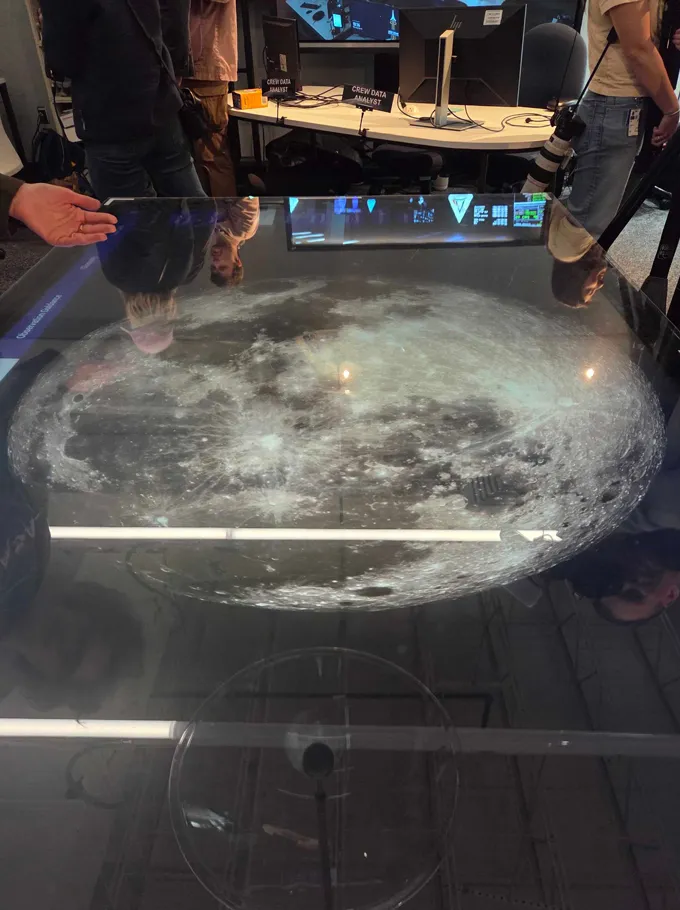
Lunar scientists in the Science Mission Operations Room will use this touch table to display views of the moon, including the same screens the astronauts will see on their tablets. Lisa Grossman -
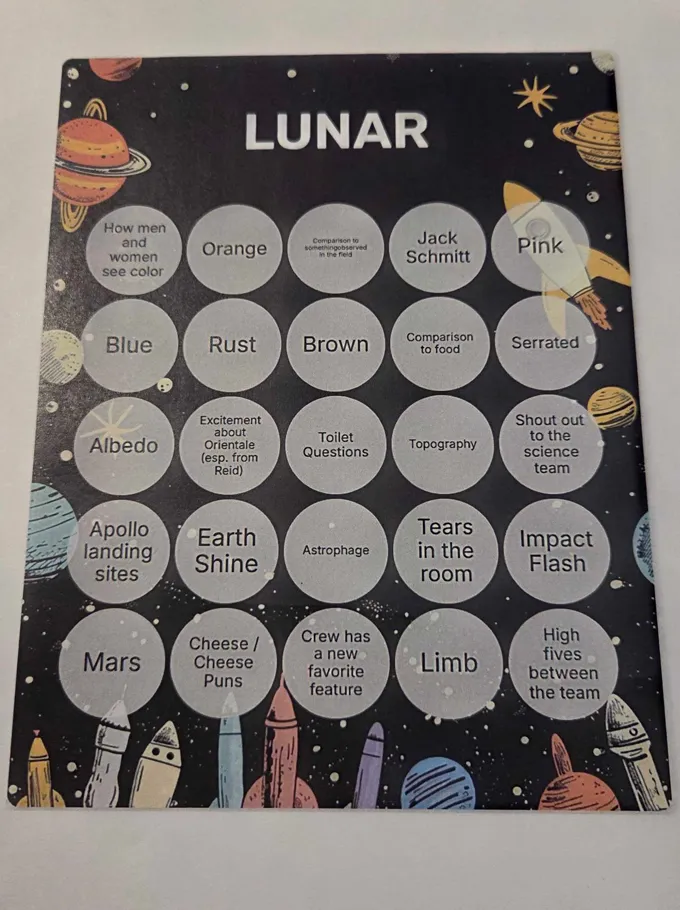
Lunar bingo sheets sat on a table in the Science Mission Operations Room, giving a sense of what the science team expects to happen. Lisa Grossman -
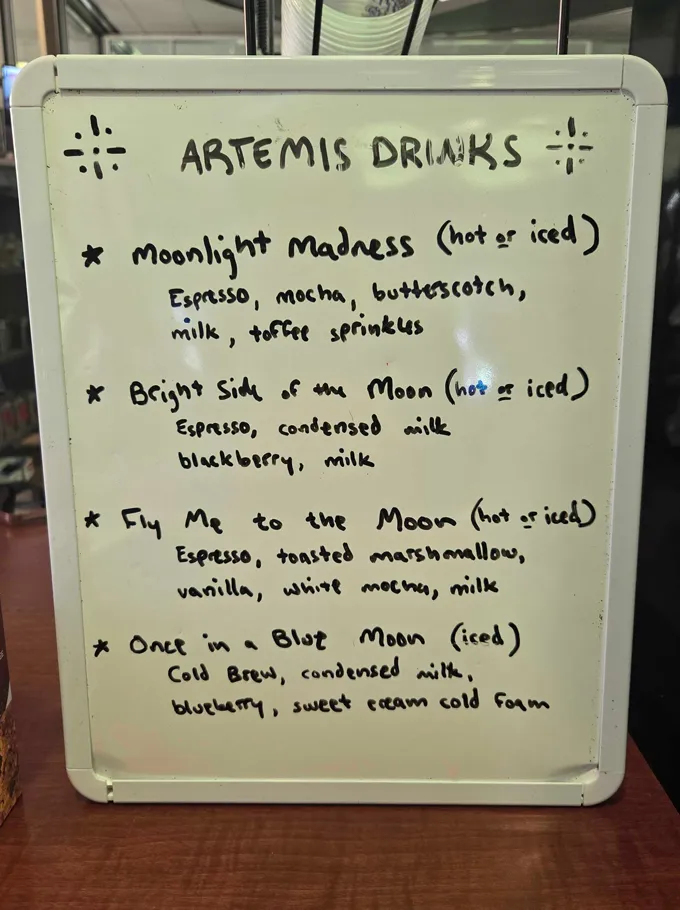
The cafe at Johnson Space Center in Houston is serving Artemis-themed drinks. Lisa Grossman
The team expects thousands of pictures of about 35 targets, Young said in a briefing on April 5. But the target list is only a guide. The astronauts “are the field scientists and they are encouraged to go off book” if something pops out to them.
As important as the observations themselves is the collaboration between the astronauts and the scientists on the ground. Artemis II is in essence a test flight, and that includes testing the choreography of taking observations. Mission operators will learn from this flight to inform how future moon missions work, including landings.
11:40 a.m.: “I wasn’t expecting so much joy”
On a visit to the Science Mission Operations Center, I had the chance to catch up with planetary geologist Sarah Noble from NASA HQ.
Grossman: What are you most looking forward to today?
Noble: Oh gosh, it’s hard to say. This whole day is pretty amazing. I have my favorites among the targets. Probably for me it’s probably Reiner Gamma, which is a lunar swirl [on the nearside]. There are these really weird swirly patterns that exist in a handful of places on the moon, but nowhere else have we found them anywhere else in the solar system. We don’t really understand them, and I love a good mystery. So I’m hoping that they’ll be able to take a look and see if they can see any cool color patterns or albedo patterns that we don’t normally notice in our images.
Grossman: Have there been any surprises so far?
Noble: Just listening to [the astronauts’] descriptions … their passion, the way that they have gotten so excited about lunar science. They’re professionals and they’re doing their job. But I love to see their joy at looking out the window and seeing those things. I wasn’t expecting so much joy.
Grossman: Is there anything that you wanted to see, but will be too dark to see?
Noble: I like to think about the things we’re getting and not the things we aren’t getting. We all had to have our little moment of grief where we let go of some of our favorite targets. But still thinking about the things we are going to see, it actually is a pretty amazing set of observations they’re going to make. We’re going to see stuff that literally no humans have ever seen with eyes before, which is amazing.
11 a.m.: An astronaut wake-up call
I and other members of the press walked into the viewing area for the Mission Control Center right as the team was posing for a group photo. Reporters held phones up to the windows to take our own photos of the photo, a sort of meta moment.
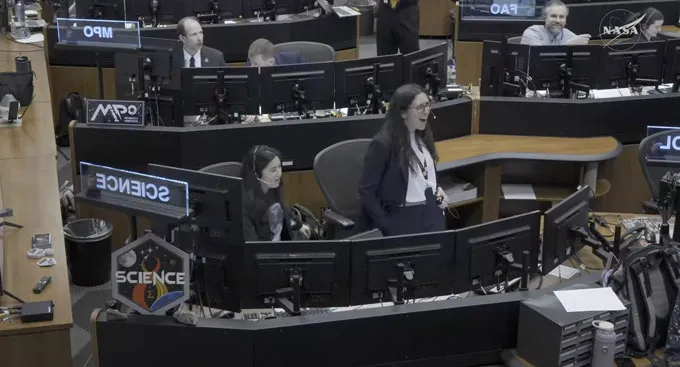
Live video from the Orion spacecraft showed the moon looming large. Many of the stations in the room will be familiar to anyone who has seen movies set at NASA like Apollo 13 or Hidden Figures. But one of them is new: For the first time, there’s a SCIENCE console in the room.
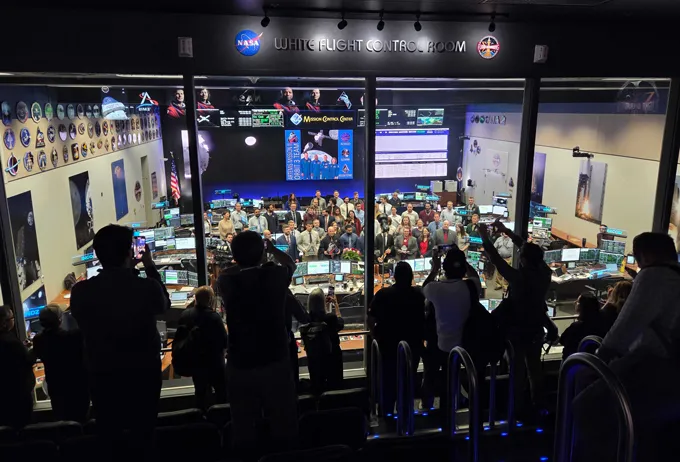
A little before 11 a.m. ET, the astronauts’ wake-up song, “Good Morning” by Mandisa and TobyMac, came over the loudspeakers. We also heard a prerecorded message from Apollo 8 pilot Jim Lovell, who died in August 2025.
“Welcome to my old neighborhood,” Lovell said. “It’s a historic day, and I know how busy you’ll be. But don’t forget to enjoy the view.”