
As the U.S. government slashes its spending on basic science, one thing seems certain: there’s still plenty of money to go back to the moon.
NASA’s Artemis II mission is only the tip of the space agency’s lunar-exploration spear: planning for a plethora of additional crewed and robotic follow-ups is well underway. And all of these trips could carry equipment for groundbreaking research, too.
There’s a lot to learn on the moon. Most of it is about the moon itself—its murky origins, expansive history and even the vital resources it might hold. But some astronomers, faced with increasingly austere government funding for their ground- and space-based projects, are beginning to see the moon as a more fiscally-stable scientific stage for some of their most ambitious cosmic studies.
On supporting science journalism
If you’re enjoying this article, consider supporting our award-winning journalism by subscribing. By purchasing a subscription you are helping to ensure the future of impactful stories about the discoveries and ideas shaping our world today.
An Antenna on the Lunar Far Side
Anže Slosar, a physicist at Brookhaven National Laboratory, had once hoped to put a radio telescope on the far side of the moon, but abandoned his dream years ago. The mission just seemed too expensive, and there wasn’t enough interest in it. “After the Apollo landings, the thinking was, ‘we’ve done it,’ and that was that,” he recalls.
Sentiments changed during the first Trump administration. One day Slosar got an e-mail from a Department of Energy program director asking him if he still thought building a far side radio telescope was possible and whether he was interested in leading the DOE’s involvement with such a project.
“This is an unusual way for science to go,” Slosar says. “Usually you have to jump through so many hoops, and now we just got funding for this project out of nowhere.”
It was the easiest choice of his professional career. “I said, ‘Of course!’” he recalls. “It changed my life forever.”
The reason for Slosar’s enthusiasm is that a radio telescope on the moon could do things none on Earth can. Radio telescopes on the ground can only collect signals from a limited range of wavelengths. That’s because, as air molecules in the upper atmosphere soak up the sun’s ultraviolet rays, they get so excited that they shed their electrons and become “ionized” in the process. For most radio waves, the resulting ion-filled layer—the ionosphere—is like a giant mirror, blocking many inbound cosmic messengers.
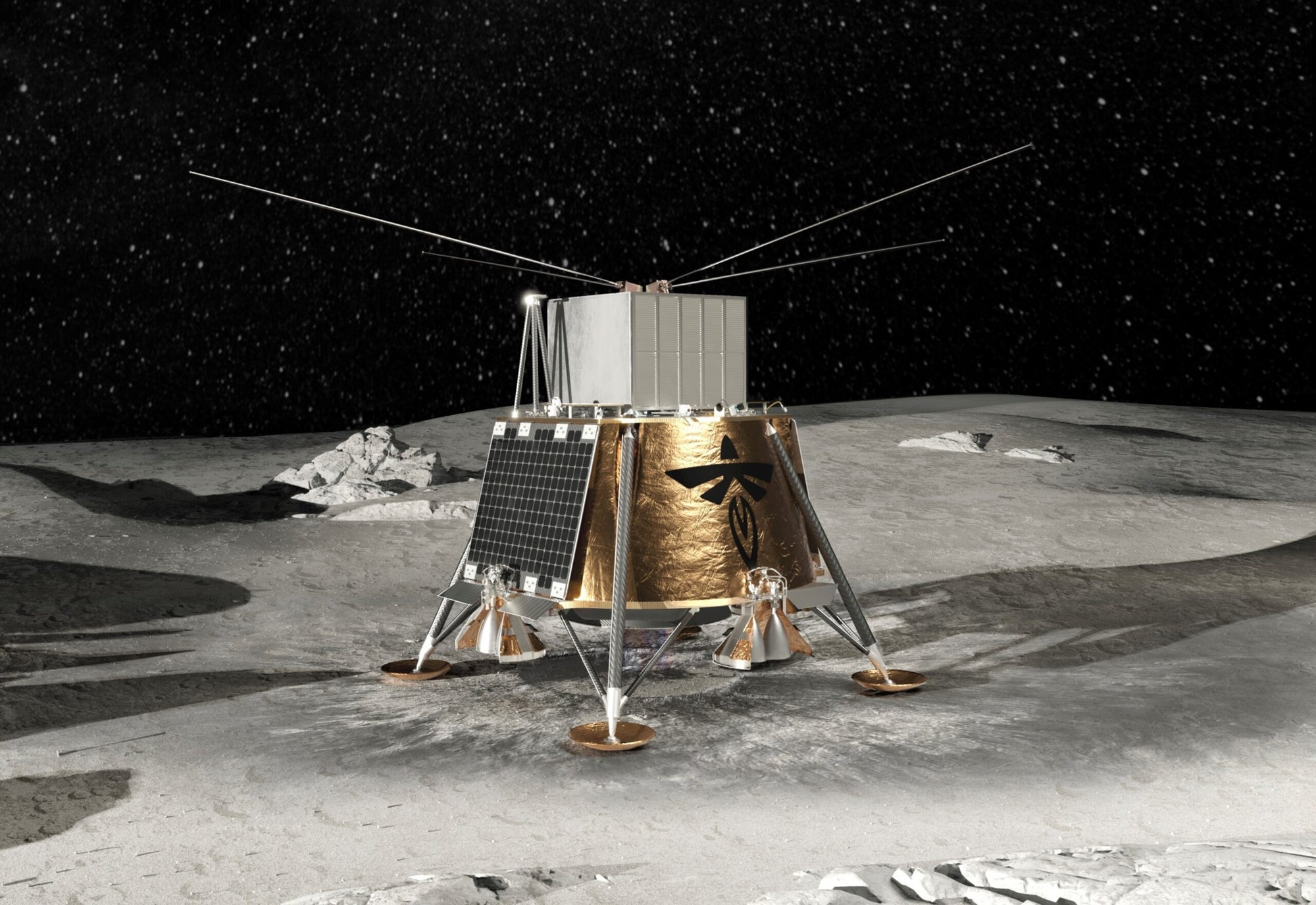
Lunar Surface Electromagnetics Experiment–Night (LuSEE-Night) is the first step toward building a radio observatory on the far side of the moon to investigate the mysterious “cosmic dark ages.”
Unfortunately, the solution isn’t as simple as removing Earth’s atmosphere—or, more plausibly, launching a radio telescope into space. To be of much use to radio astronomers, any spaceborne observatory would need to be exquisitely sensitive—so sensitive, in fact, that its observations would be inevitably swamped by telecommunications emanating from Earth. To tune in to distant galaxies and other faraway objects, astronomers would need an antenna somewhere with no atmosphere that also would be somehow protected from all our terrestrial chatter.
Such a place exists, of course, and it’s only a proverbial stone’s throw from our third rock from the sun. Earth is locked in a synchronous dance with the moon, so the same lunar hemisphere always faces away from us. On that far side surface, the moon itself acts as a shield from Earth’s cacophony of radio signals. This is exactly why Houston Ground Control lost contact with Artemis II for about 40 minutes during its April 6 lunar flyby, when the mission’s Orion spacecraft was masked by the moon.
“Behind the moon, at the right time, you can avoid interference from both the sun and the Earth,” Slosar says. “It becomes one of the quietest places in our solar system for observing these radio frequences.”
That span of wavelengths happens to be a window into the most mysterious epoch of the universe’s history.
Our oldest snapshot of the universe comes from some 380,000 years after the big bang. It’s known as the cosmic microwave background, or CMB, and is made up of the light that was released when the hot, dense plasma that suffused the early universe cooled enough to form hydrogen atoms. Much like the radio-blocking swarms of electrons in Earth’s ionosphere, unbonded electrons in that ancient, ionized plasma blocked light, too—so when they all settled down into atomic hydrogen, light that had spent millennia hidden by the primordial fog was liberated to stream freely across the universe. Today we see this “last scattering surface” as a diffuse all-sky radio glow.
But for hundreds of millions of years after that singular moment in time, we have essentially no data at all. That’s because the universe was full of relatively cool, light-smothering hydrogen, which scarcely emitted any light of its own. Only when stars and galaxies started forming from all that hydrogen was there enough light and heat to reionize some of the hydrogen atoms, making those growing cosmic structures visible to our telescopes.
There was a bit of light in the so-called cosmic dark ages, though: a faint trickle of 21-centimeter-wavelength radio emissions emanating from the hydrogen atoms. Astronomers have managed to detect some 21-cm cosmic signals through heroic efforts using ground-based instruments, but the noisy, patchy view painted by these detections is woefully incomplete. To map the dark ages in all their hidden majesty—to discover how, exactly, cool matter coalesced into luminous cosmic structures—the best option, by far, is to search from the far side of the moon.
This is where Slosar comes in. He now directs the DOE’s contributions to its partnership with NASA on a project called the Lunar Surface Electromagnetics Experiment–Night (LuSEE-Night), which aims to launch to the lunar far side in December 2026. It will fly onboard a Blue Ghost lander from Firefly Aerospace as part of NASA’s Commercial Lunar Payload Services (CLPS) initiative, which relies on landers built and operated by private industry to deliver spacecraft, experiments and other payloads to the moon’s surface.
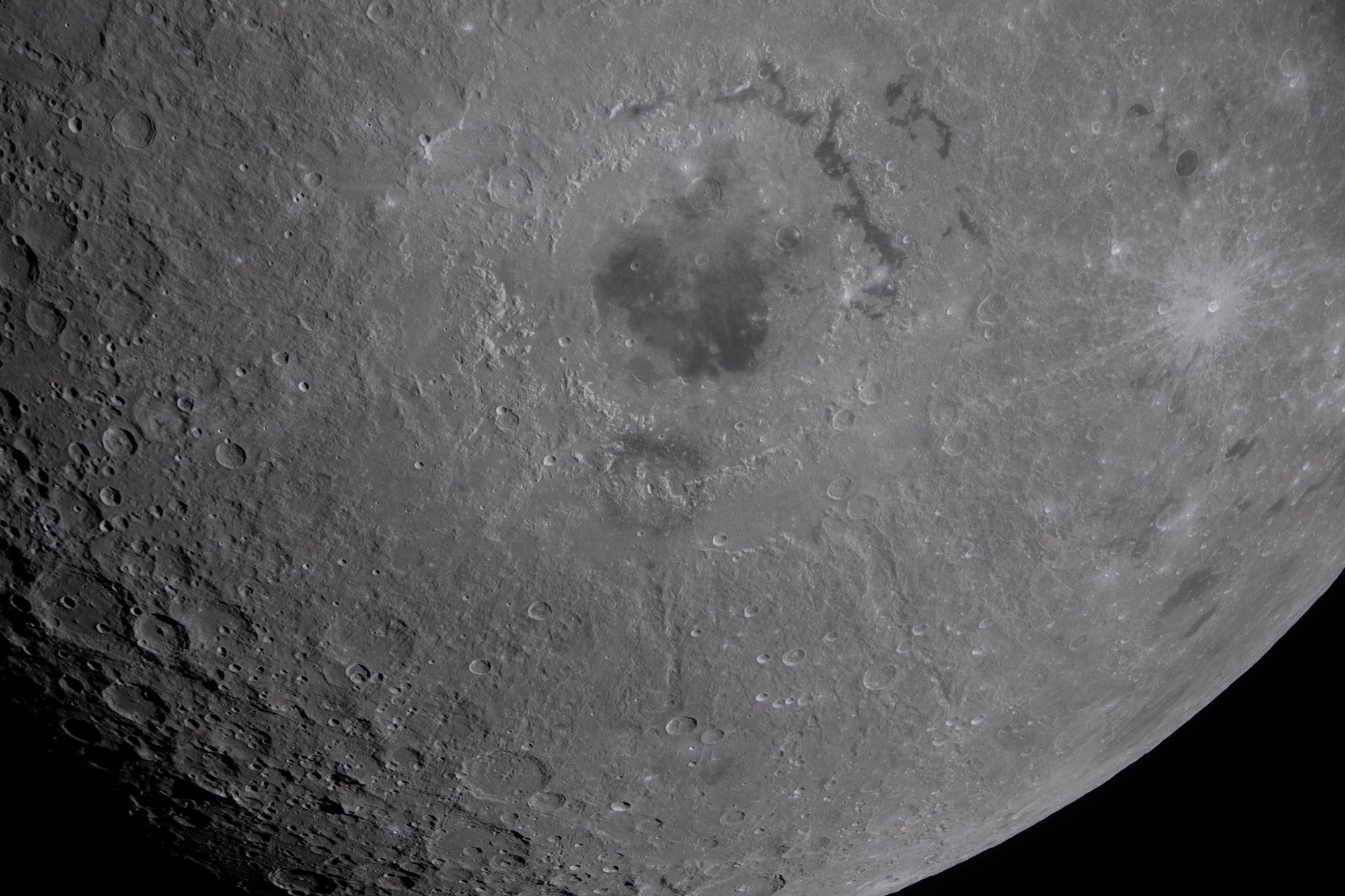
A photo of the far side of the moon, taken by the crew of the Artemis II mission. The far side is an ideal place for radio astronomy.
Once there, LuSEE-Night’s greatest challenge will be getting through the cryogenically cold lunar night, which lasts for the equivalent of about 14 Earth days. Pink Floyd may have misled you: the moon’s far side isn’t always dark. When it is, though, it’s an inhospitable place—few experiments have ever survived the night.
Ultimately the mission is meant to be a pathfinder, proof that even larger and grander radio telescopes can be built and operated on the moon’s far side.
A Gravitational Troika
A free trip to the moon would be a dream for the newest addition to the ranks of astronomers—devotees of gravitational waves.
It was just 11 years ago that science gained the ability to scan the skies for these elusive waves, thanks to the Laser Interferometer Gravitational-Wave Observatory. Better known as LIGO, this project uses—you guessed it—lasers to sense the subtle stretching of space and time from the cataclysmic merger of two gigantic black holes.
The European Space Agency’s upcoming Laser Interferometer Space Antenna (LISA) mission—essentially LIGO in space—will expand on the revolution LIGO started. Launching as soon as 2035, LISA could sense waves from much more massive mergers of supermassive black holes rather than the waves from puny 50-stellar-mass black holes that are within LIGO’s purview. It will also spot the slower ripples of calmly orbiting binaries, emitted long before their death spiral begins. Both of these sources make waves with millions of miles between peaks, too long for any Earth-based instrument to register.
But to complete their coverage of the gravitational-wave spectrum, astronomers have their eyes on the moon. The Laser Interferometer Lunar Antenna (LILA) would close the gap between LIGO and LISA by tuning in to waves with intermediate wavelengths. These would include those from the mergers of white dwarfs, the astronomical objects that produce many of the supernovae we see and study by analyzing their electromagnetic emissions. LILA would also capture the gravitational waves from neutron star and black hole binaries just as they began their final descent towards coalescence, providing an early-warning system that could alert LIGO to collisions two weeks before they happened.
“There is no other place in the solar system that you can detect gravitational views in this mid-band,” says Karan Jani, an astrophysicist at Vanderbilt University who is a principal investigator of the LILA project. “There is only the moon.”
That’s because the moon is much more geologically inert than our rowdy planet. “It doesn’t have as active a core,” Jani says, meaning the lunar surface can be a quiescent platform for gravitational-wave-spotting laser systems custom-made for the mid-band.
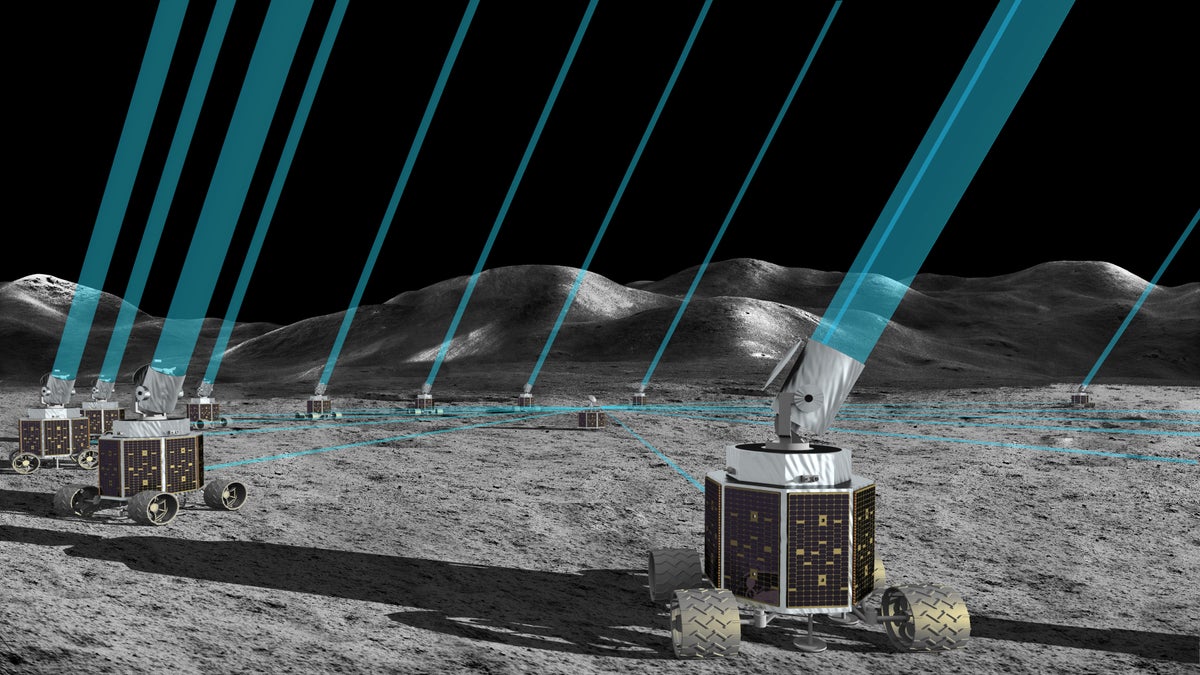
LILA will essentially be built of mirrors mounted on rovers. The project team hopes to hitch a ride on an upcoming CLPS mission. When the lander opens onto the lunar surface, two rovers with mirrors will head in different directions, forming a five-kilometer triangle with the lander as the triangle’s third point. Then an instrument on the lander will beam lasers outward to the rovers to compare their distances with microscopic precision.

The Laser Interferometer Lunar Antenna (LILA) would use the moon as a seismically quiet environment to detect the tiny ripples in spacetime beamed out by rotating pairs of black holes and neutron stars just before they spiral to their death.
Vanderbilt Lunar Labs Initiative/Karan Jani
“To be honest, we wouldn’t be thinking about LILA if the United States was not going to the moon,” Jani says. The LILA team is hoping to reach a later phase of the project that would be in collaboration with NASA’s Artemis program and rely on astronauts for operation and maintenance.
A Stellar Feat
Observatories such as the James Webb Space Telescope (JWST) and the Hubble Space Telescope—and, for that matter, your typical consumer-grade reflector telescope—are all based on the same principle: a mirror curved just so in order to channel incoming light from many directions onto a single focal plane. Large telescopes use segmented mirrors to collect more of a faraway object’s light and produce a crisper image; JWST’s primary mirror is composed of 18.
Optical interferometry is a way to make a telescope’s light-gathering surface far bigger by spreading out such segments over an even larger area. In this approach, individual mirrors are interlinked in an array, with each node channeling its light to a central facility that carefully corrects and combines these inputs, effectively forming a much more powerful telescope.
By piggybacking on the Artemis program, NASA scientist Kenneth Carpenter aims to build an optical interferometry facility on the moon. This proposed Artemis-Enabled Stellar Imager (AeSI) consists of 15 to 30 rover-mounted mirrors, allowing for reconfiguration and other fine-tuning on the fly so the imager can fixate on any target in the lunar sky. Besides being a potent technological pathfinder, AeSI could also monitor many stars throughout a sizable swath of the Milky Way. By studying them in ultraviolet light that terrestrial observatories can’t access because of Earth’s UV-blocking ozone layer, the project could literally shed more light on the still-mysterious details of stellar activity across the galaxy.
“We have wonderfully high-resolution data on the sun,” Carpenter says. “But we still haven’t come up with a good predictive model of future activity.” Scientists’ best solar models presently struggle to precisely predict flare-ups on our own, most familiar star. But the hoped-for expansive stellar data sets that AeSI could provide may help change that.
The project could also benefit from astronautical interventions, Carpenter says, meaning maintaining AeSI could be another possible task for the Artemis crews that NASA plans to land on the moon by 2028 and throughout the 2030s. If his decades of experience working on the Hubble Space Telescope taught him one thing, it’s that troubleshooting an experiment is infinitely more effective with a human on-site.
“The space shuttle and Hubble were kind of designed with each other in mind,” he says, pointing to the STS-61 mission in 1993, which included a spacewalk to fix a critical problem with Hubble’s mirror. That historic telescope, Carpenter says, “probably would have been a failure without the collaboration of the human space flight program.”