

Heat shield worries resurface as the Artemis II moon mission nears reentry
Before NASA’s moon mission launched, experts sounded the alarm over the Orion capsule’s heat shield and reentry. Now splashdown is just one day away
NASA has launched four astronauts on a pioneering journey around the moon—the Artemis II mission. Follow our coverage here.
NASA’s Artemis II moon mission is coming to an end. On Friday at approximately 8:07 P.M. EDT, its Orion capsule, named Integrity, is due to splash down into the Pacific Ocean off the coast of San Diego, Calif., delivering astronauts Reid Wiseman, Christina Koch, Victor Glover and Jeremy Hansen back to Earth. But before that, Integrity must endure a perilous journey through our atmosphere: reentry.
Reentry is hard. When an object falls from space into our planet’s atmosphere at hypersonic speed, it heats up and is engulfed in a fireball. This is caused mostly by compressed air in front of the object and atmospheric drag. It’s stressful: if the falling object is small or relatively fragile, without protection from the heat it typically breaks apart and burns up. In the case of crewed vehicles like Orion, however, engineers carefully map out a reentry trajectory and build in protection such as heat shielding to minimize the risk of harm to both the spacecraft and the astronauts inside.
Integrity is projected to reenter Earth’s atmosphere on Friday at approximately 7:45 P.M. traveling at nearly 24,000 miles an hour. Without a protective layer, anything inside the crew cabin could be exposed to temperatures as high as 5,000 degrees Celsius—twice the temperature of magma and hot enough to vaporize steel.
On supporting science journalism
If you’re enjoying this article, consider supporting our award-winning journalism by subscribing. By purchasing a subscription you are helping to ensure the future of impactful stories about the discoveries and ideas shaping our world today.
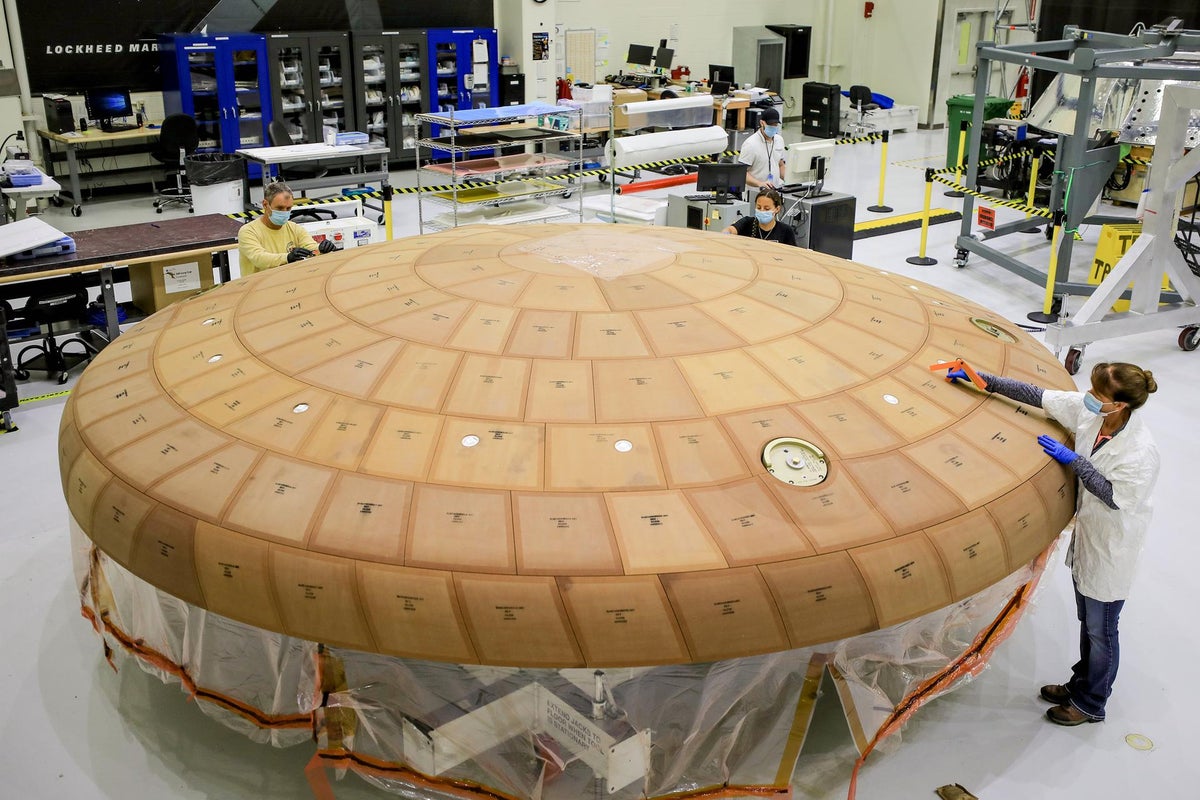
Like all Orion capsules, Integrity has a heat shield made of AVCOAT, a mixture of silica, epoxy and resins that NASA also used for the original Apollo missions to the moon. AVCOAT protects a spacecraft by charring, melting and ablating away, carrying excess heat along with it. Orion’s AVCOAT has been slightly reformulated, and the design of its heat shield is not the same as for the Apollo missions: while in the past, the Apollo heat shields had a honeycomb-like structure made up of 36,000 small cells of AVCOAT, the Orion heat shield is made up of less than 200 large tiles of the material.
Before Artemis II, an uncrewed Orion capsule flew in 2022 as part of the Artemis I mission, allowing a test of its heat shield without risking anyone’s well-being. During reentry, that heatshield cracked and shed more material than NASA engineers had expected. The space agency performed an urgent investigation into the anomaly, and released a report detailing its findings in 2024. Ultimately, citing the expense and time any replacement would’ve taken, NASA decided not to change the heat shield design for Artemis II’s Orion capsule. Instead, mission planners adjusted the capsule’s reentry trajectory so that its heat shield will be exposed to higher temperatures for a shorter time.
Orion’s heat shield has been extensively tested on the ground, and NASA officials have said that their models show the new reentry profile effectively minimizes the reentry risk for the Artemis II crew.
“I am confident in the NASA approach and solution,” says Jud Ready, a materials expert and executive director of the Space Research Institute at Georgia Institute of Technology. “It was a rigorous study using ground-based experimentation at representative pressures, temperatures, and—crucially—temperature ramp rates.”
But the decision to leave the heatshield as it was for Artemis I has been met with criticism by other heat shield experts and even former astronauts. “This approach doesn’t mitigate the flaws in the design and manufacture of the original heat shield itself,” says Ed Pope, a heat shield expert who has been critical of NASA’s decision. He points out that NASA is using a different heat shield design and yet another formulation of AVCOAT for the Orion capsule on Artemis III. “That change is an acknowledgement that there’s a known risk to the current design and manufacturing method, in my opinion,” he says.
After Integrity bleeds off most of its speed during reentry and is deeper in Earth’s atmosphere, it will use its thrusters and, eventually, parachutes to slow down, reaching a stately 17 miles an hour. The entire process should take about 13 minutes, according to Artemis II entry flight director Rick Henfling. There will be a several minute long period where the spacecraft loses communications with Mission Control as it passes through Earth’s upper atmosphere, says Jordan Bimm, a space historian at the University of Chicago.
“For me, this will be the most stressful part of the entire mission,” Bimm says.
Presuming a nominal reentry and an on-target splashdown, U.S. ships awaiting nearby will retrieve the astronauts and bring the mission to its official close.
It’s Time to Stand Up for Science
If you enjoyed this article, I’d like to ask for your support. Scientific American has served as an advocate for science and industry for 180 years, and right now may be the most critical moment in that two-century history.
I’ve been a Scientific American subscriber since I was 12 years old, and it helped shape the way I look at the world. SciAm always educates and delights me, and inspires a sense of awe for our vast, beautiful universe. I hope it does that for you, too.
If you subscribe to Scientific American, you help ensure that our coverage is centered on meaningful research and discovery; that we have the resources to report on the decisions that threaten labs across the U.S.; and that we support both budding and working scientists at a time when the value of science itself too often goes unrecognized.
In return, you get essential news, captivating podcasts, brilliant infographics, can’t-miss newsletters, must-watch videos, challenging games, and the science world’s best writing and reporting. You can even gift someone a subscription.
There has never been a more important time for us to stand up and show why science matters. I hope you’ll support us in that mission.