

NASA’s Artemis II moon mission faces the final hurdle—coming home
After a hectic eight days in space, the Artemis II crew—and the many NASA personnel supporting their journey—are ready for the mission’s final milestone
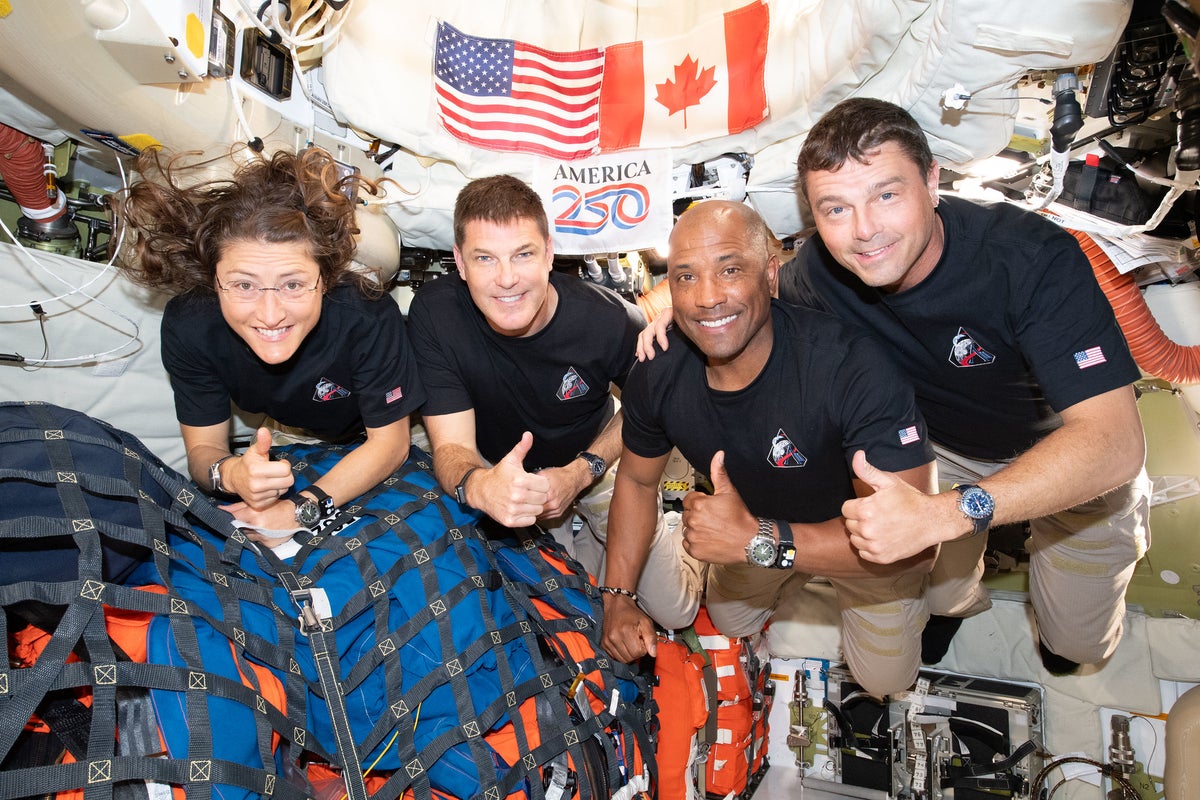
The Artemis II crew on April 7.
NASA has launched four astronauts on a pioneering journey around the moon—the Artemis II mission. Follow our coverage here.
The Artemis II crew is in for a wild ride on Friday, when their Orion capsule will carry them home through Earth’s atmosphere.
Over the course of less than an hour, the capsule will shed its clunky service module and dive toward Earth at 24,000 miles per hour. If all goes according to plan, its protective heat shield and a sequence of massive parachutes will ensure that the capsule—and the four astronauts inside—will land with a gentle splash in the Pacific Ocean at a leisurely 17 miles per hour.
“They’re going to feel and hear when all the various chutes deploy and when the forward bay cover comes off—all of the pyrotechnic events that are part of a nominal entry, descent and landing sequence,” said Artemis II’s flight director Jeff Radigan at a press conference on Thursday. “It’s actually, I think, going to be a fun ride for them.”
On supporting science journalism
If you’re enjoying this article, consider supporting our award-winning journalism by subscribing. By purchasing a subscription you are helping to ensure the future of impactful stories about the discoveries and ideas shaping our world today.
As soon as Orion splashes down, the crew will be busy shutting down the spacecraft, figuring out where they are and opening the hatch. During that time—but only after any threat of debris from reentry has cleared—NASA’s waiting recovery team will come to meet the astronauts and fish them out of the capsule. Within an hour of splashdown, they should be snug onboard the USS John P. Murtha and headed for home.
That’s assuming everything goes to plan—and there’s no guarantee of that. “It’s 13 minutes of things that have to go right,” Radigan said. If Orion hits Earth’s atmosphere even a single degree off of the planned angle, reentry could devastate its heat shield—a potential that NASA learned from the uncrewed Artemis I mission, which revealed the shield was not as resilient as expected.
The Artemis II crew still has a full day in space ahead, most of which they will spend preparing for reentry. That work includes stowing everything they used during flight, arranging the cabin and gathering data on an unexpected situation that has arisen with the propulsion system of the service module. The module has guided the astronauts’ journey so far, but it will be jettisoned and will mostly burn up in the atmosphere as part of the reentry procedure, Radigan said. The spacecraft will also carry out up to two further maneuvers to make sure it will be at the right angle and on track for its descent to the Pacific Ocean.
Although only the four astronauts—Reid Wiseman, Victor Glover, Christina Koch and Jeremy Hansen—will experience the drama of reentry firsthand, Friday night will be a moment of truth for the entire Artemis program and NASA.
“Every system we’ve demonstrated over the past nine days—life support, navigation, propulsion, communications—all of it depends on the final minutes of flight,” said NASA associate administrator Amit Kshatriya during the same Thursday briefing. “To every engineer, every technician that’s touched this machine, tomorrow belongs to you. The crew has done their part. Now we have to do ours.”
It’s Time to Stand Up for Science
If you enjoyed this article, I’d like to ask for your support. Scientific American has served as an advocate for science and industry for 180 years, and right now may be the most critical moment in that two-century history.
I’ve been a Scientific American subscriber since I was 12 years old, and it helped shape the way I look at the world. SciAm always educates and delights me, and inspires a sense of awe for our vast, beautiful universe. I hope it does that for you, too.
If you subscribe to Scientific American, you help ensure that our coverage is centered on meaningful research and discovery; that we have the resources to report on the decisions that threaten labs across the U.S.; and that we support both budding and working scientists at a time when the value of science itself too often goes unrecognized.
In return, you get essential news, captivating podcasts, brilliant infographics, can’t-miss newsletters, must-watch videos, challenging games, and the science world’s best writing and reporting. You can even gift someone a subscription.
There has never been a more important time for us to stand up and show why science matters. I hope you’ll support us in that mission.