
Kendra Pierre-Louis: For Scientific American’s Science Quickly, I’m Kendra Pierre-Louis, in for Rachel Feltman.
Most of us know the story of Moby-Dick, the 1851 novel by Herman Melville that dots many a high school required-reading list. That book, told from the perspective of Ishmael, a sailor aboard the whaling ship the Pequod, takes us on a journey of obsession. The ship’s captain, Ahab, has a compulsive desire that goes beyond the point of self-preservation to find and kill Moby-Dick, the giant sperm whale who bit off his leg. Let’s just say it doesn’t end well.
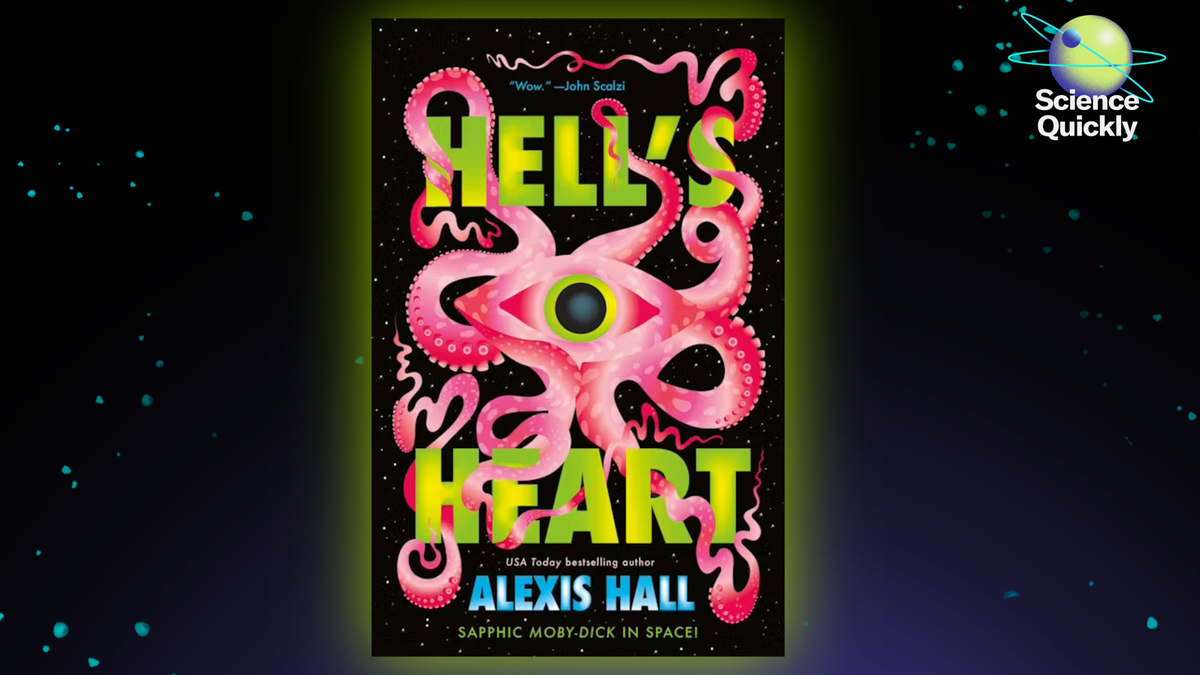
Hell’s Heart, by author Alexis Hall, takes that famous story and reenvisions it as a queer sci-fi space opera. Ishmael is now a trans woman who joins the crew of the spacecraft the Pequod. It’s a story that is equal parts funny, saucy and philosophical.
On supporting science journalism
If you’re enjoying this article, consider supporting our award-winning journalism by subscribing. By purchasing a subscription you are helping to ensure the future of impactful stories about the discoveries and ideas shaping our world today.
SciAm associate books editor Bri Kane talked with Alexis. Here’s their conversation.
Bri Kane: I just am so eager to talk to you about how you took this incredible, like, pillar of the English literary canon from Melville, everyone’s favorite book they read in high school, obviously, and you somehow made it into a queer sci-fi, alien-hunting adventure story. [Laughs.] So I just wanted to start with, like, why did you do that? How did you do that? Why did you even want to take on such an important literary work and adapt it in this way?
Alexis Hall: So you might recall in 2020, there was, you know, this little thing called COVID. And the first lockdown happened, and I was like, “Okay, we’re locked down. I should do something to try and make the time go faster. I know—I’ll read a famously long book, one chapter a day. That way, when the lockdown ends and I haven’t finished the famously long book yet, it will feel like it went faster.”
Spoiler: that did not work. But I spent quite a large chunk of lockdown reading a chapter of Moby-Dick every day and then tweeting about the silly bits ’cause obviously things have value in context, but, you know, I think Melville is big enough to take it, and I think the fact that he’s constantly going on about flukes is funny. And because I’m a professional novelist, I inevitably went to “What would I do with this?” And I went to “You could be doing space whales on Jupiter, obviously!”
I think part of the other reason for picking science fiction specifically is there is a certain perspective from which Moby-Dick is a science-fiction book. In a totally not real sense, it’s a science-fiction book about whaling. Like, the level of detail you have about how whaling works—first of all, quite a lot of it’s made up, but also, like, the modern genre you can still do that in is science fiction. There is no other genre where you can have just a whole chapter about how they process a whale’s penis, which is a real thing that is in Moby-Dick, or a whole chapter about how they weave a particular kind of mat, which, again, is a real thing in Moby-Dick.
And I wanted to capture that energy because I always like focusing on the bits of things that perhaps other people don’t focus on as much. I think most people look at Moby-Dick, and they’re like, “It’s a story about a boat that gets destroyed by a whale”—spoiler for a 175-year-old book. Whereas I just look at it and go, “It’s a book that’s got a lot of really random detail in it and has whole long sections about, like, made-up whale biology.” [Laughs.]
Kane: Yeah, I mean, I think that’s something that we talk about at Scientific American often, are these fiction books that are interested in science, that are using science or have a character who is using science in the work, and what do we call them? Because they’re not quite science fiction, but they are fiction that has kind of a hand out towards the sciences.
And that was something that I was really interested in in your process in writing this book because how much time did you actually spend concerned with real Jupiter, like, real science and real physics here? And then when did you decide to, just to quote yourself here, make a mockery of physics instead? [Laughs.]
Hall: [Laughs.] I think I can say with relative certainty that the book contains the most scientifically accurate description of the atmospheric composition of Jupiter to be included in a sapphic sex scene.
Kane: [Laughs.] I don’t know how much competition there is for that specific award, but I think you won it.
Hall: I don’t think there’s much competition. [Laughs.]
There is a lot of stuff about the atmospheric composition of Jupiter. There’s a line, I think, about how it rains diamonds—I believe that’s a real thing; there are bits of Jupiter where [scientists believe] it rains diamonds. I try to be fairly correct about which gases they’d be passing through at which levels.
There are things which I cared enough to have in the back of my mind but not enough to really sit down and work it out in detail. So Jupiter has a stronger gravitational field than Earth, but because it’s a gas giant, it hasn’t got a surface, and I’m pretty sure the strength of the gravitational field will vary as you go down, in the same way that if you dig down into the earth, gravitational field gets weaker as you get nearer the center. And it goes down linearly, if you assume Earth has a linear density, which, near enough, horseshoes and hand grenades. Whereas Jupiter it’s a gas giant. There’s a whole lot of stuff about how the gravitational field probably changes as you go down, which I elided.
But things about it being, like, kind of colder, then hotter, then colder, then hotter, that’s based on actual temperature profiles I looked up. I don’t like patting myself on the back about doing research ’cause I think it’s really important to recognize that, you know, I write fiction. Please don’t learn about Jupiter from my fiction. I look some stuff up, and I have enough of a science background that I can kind of see what passes the sniff test, but obviously, it’s not super realistic.
There’s a bit quite early on in the book where the narrator is talking about her religious background, she talks about the book of [Jonah], and she talks about how if you spoke [with] the church fathers, the people from biblical times, about what she does for a living, the concept of being so far from Earth that the distance is measured in light-minutes or being inside a gas giant, where there are storms the size of a planet, would be completely alien to them. But the idea that there are just kind of big monsters would make complete sense.
One of the things that Moby-Dick is arguably about—and again, I am not an expert on Jupiter; I am also not a Melville scholar—but one of the things that Moby-Dick is about is it’s about sort of the unknowability of things, and it is about kind of perception and things that cannot truly be understood. ’Cause one of the things that’s really weird to think about Moby-Dick in its context is that Moby-Dick is from a time when you couldn’t really know what a whale looks like unless you had got on a boat and looked at one, and even then it’s mostly underwater. Like, you can see a dead one, you can see a picture of one—and that’s why there’s [a chapter] in the book called “[Of] the Monstrous Pictures of Whales,” because, you know, there’s no photographs, so you’ve got drawings done by people based on descriptions. And that’s part of what I wanted to recapture with a lot of the weirder bits in the book.
Kane: Yeah, I mean, it seems like the book overall is really interested in this question of endlessness, right? So you—the titular Hell’s Heart is, in the book, the storm cloud at the center of Jupiter. And the real-life Jupiter in space right now has the Great Red Spot, which is of—a very oversimplified definition of it could be an endless storm, right? That’s what the Great Red Spot is. And it seemed like this—you know, the Möbius strip and we’re chasing after a Möbius beast. We know that a Möbius strip is an endless kind of figure.
It just seemed like you’re really interested in searching for something that is endless: so the endlessness of space itself, the endlessness of exploration of space, the endlessness of resource hunting, right—we are hunting physical animals and boiling them down, in some point literally, for resources; that has an end as well—as well as our protagonist’s just kinds of endless search for self. So it seemed like the book overall really wanted to play with how much we want to know about space, but our desire to know about space is without end; there will always be more questions.
Hall: Exactly, and, and obviously not just about space but also about ourselves, about other people, about etcetera, etcetera, etcetera. And part of what I was trying to do was to riff on themes that I feel, partly from my own reading and partly from, like, you know, [what] Moby-Dick is also about because there’s—so much of Moby-Dick is just Ishmael pontificating about the vastness of the ocean and the unknowableness of humanity.
And obviously, in some ways, almost a way to make that accessible again to a modern audience is to say, okay, well, we don’t think about the oceans that way anymore—even though, of course, the oceans are actually extremely unknown—but that makes more sense when you think about space.
Kane: I have about a million questions about these space whales. As this planet’s titanologist, right, a study of these titan animals, I wanted to ask about your process in creating them, ’cause not only did you create from whole cloth many, many aliens—like, many, many aliens—but a whole classification system that they fall within and the rules and boundaries between them. So I wanted to ask you about those ’cause there are how many main types of Leviathans? I think there’s four in the book?
Hall: Oh, it’s three or four. You’ve got your true Leviathans, you’ve got your Wyrms, you’ve got your Krakens, and you’ve got your Behemoths. And so a lot of it is just kind of loosely inspired by, you know, real-world marine biology, like …
Kane: That’s why I wanted to ask you: What inspired these specific different types of Leviathans? ’Cause the Wyrms are described as “eel-like,” which is terrifying—that’s a horrible image to place in my brain. [Laughs.]
Hall: [Laughs.]
Kane: And the Krakens are described as, like, floating sacs that just kind of bounce around space until they bump into your ship, and then they eat you, like—[Laughs.] So can you talk to me about the differences between these different leviathans?
Hall: So the Leviathans are basically whales, like—and they have roughly the place that whales have in both my understanding of real biology and also of, like, the popular imagination.
The Wyrms are very much in there to do the job that sharks do in Moby-Dick and also, to some extent, to do the job that, like, kind of birds do in Moby-Dick. Because one of the things that is tricky about the process of working on the book is converting a really well-established genre into a science-fiction setting and keeping the trappings. And you need things like the sharks that follow the boat, the flocks of, like, scavenger birds that follow the boat ’cause it’s iconic. And so the Wyrms exist to fill that narrative role in the book, but then also that biological role in the ecosystem.
The Krakens are there partly ’cause I just love Krakens, but also we do specifically know that sperm whales eat giant squid.
The Behemoths are there because the Leviathans are quite danger-coded. They were there to have the—sort of the role of, of the larger, more sedentary whales that exist in the real world and other large marine mammals. There also—there is a thing where when a whale dies, it sinks to the bottom of the sea and it just becomes this, like, kind of nexus for new life. And there needed to be something that did that job in this weird version of Jupiter, and the Behemoths very much do that.
Kane: So one thing that really struck me that is real science-ish—it seems to be where you’re really taking that step between real science into science fiction—is the hydrogen sea at the center of the planet and floating through these ammonia skies. How much chemistry should readers refresh on before picking up this book? [Laughs.]
Hall: So there’s—chemistry’s not hugely relevant. So as I understand it, we don’t know for certain what the structure of Jupiter is, but my understanding is that at least one of the major theories is that the center of Jupiter, it has got a liquid center, like a [Cadbury] Creme Egg, and so the center of Jupiter is liquid hydrogen.
I don’t think you should, like, brush up on chemistry. You should kind of look at, like, liquid hydrogen and liquid helium ’cause they’re really cool and they do, like, weird superfluidity stuff. So you should look into that for its own sake.
Kane: [Laughs.]
Hall: I don’t think it’s necessary to understand the book …
Kane: It’s just fun by itself, yeah.
Hall: It’s fun by itself.A lot of the images I had in my head when I was thinking about the hydrogen sea was to do with, you know, images I have seen of liquid hydrogen—or liquid helium ’cause they can behave in quite similar ways—doing its sort of weird, mirrored superfluid nonsense.
Kane: Yeah, especially—when you get into fluid, like, fluid physics and just what happens when you bring things into a fluid state in space, things get weird real fast. [Laughs.]
Hall: Yeah, no, exactly.
Kane: One question that I absolutely have to ask you today: this book, Hell’s Heart, is very clearly based on Moby-Dick, right? You have “Call me Ishmael”; in this work we don’t really have an exact name for our protagonist. We have our protagonist’s kind of ride-or-die through this adventure, called Q, right; that is a not Queequeg from Moby-Dick. And then we have Captain A, which is not Captain Ahab, right?
They’re very different characters, but you have a very clear tether between them, I would say. If you’re familiar with one, you’ll be familiar with the other. And I wanted to ask you about how you developed Captain A and, specifically, what games you are playing with their AI navigator.
Hall: Oh, gosh. So A is basically—she’s basically hot-girl Ahab ’cause in many ways I’m extremely basic. She’s inspired by my reaction to the character of Ahab. As part of my research, I listened to a bunch of random, like, lectures on YouTube ’cause this is how I get to sleep at night, and I heard this really interesting one about Ahab as heroic figure. Because often people will interpret Ahab as the villain of Moby-Dick, but there is a case that what Ahab is doing is standing against an unfeeling world and demanding justice. And at the very least, that’s certainly how, at least my version of the character, perceives herself.
As for the AI navigator, okay, if you have not read the book recently, you may not remember the character of Fedallah, who is the extremely racist [depiction of] kind of Persian guy, and basically, he’s not really a person in it. And obviously, POC characters who aren’t really people in historical texts are, like, a complex thing to engage with, and my feeling is when you’ve got a, an irreducibly racist portrayal of someone like that in a historical text, you either need to keep the role they play in the book but change their identity or keep the identity but radically change the role they play in the book.
And the role that Fedallah plays in Moby-Dick is kind of to be an externalization of the worst parts of Ahab’s psyche. It’s to be—essentially to reinforce all of Ahab’s worst impulses, essentially kind of to give Ahab a ton of bad advice. That role, I think, in something science fiction, in something—this is obviously, to some extent, about the world we live in, actually. Part of my intent with the book was for it to be, in some ways, about the modern world, the same way that Moby-Dick is about America of the 1850s. I think, to me, the role of “entity that reflects our worst impulses back at us” is definitely AI. [Laughs.]
Kane: Yeah, I mean, Captain Ahab is maybe one of the most famously singular-minded characters in all of fiction. [Laughs.] Captain A is no exception to that. They only care about one thing: capturing the Möbius Beast. They do not care what gets in their way in between there. And they have this little AI navigator that’s just like, “Yeah, that’s a great idea. You should just fly into the center of Jupiter. It’ll probably be fine.” [Laughs.]
Hall: Exactly, and maybe I’m doing the technology an injustice, but maybe I’m not being satirical enough.
Kane: I also really wanted to ask you—’cause I thought the character development of Q, who is not Queequeg, was really interesting because Q is from Earth; Q is from Terra, as it’s referred to now, and is speaking Latin and so cannot communicate with our protagonist. I have a million questions on how you did that and how much Latin you know, but what I really wanted to ask you is how you developed this future Earth, this Terra, and why you wanted Q to be from there.
Hall: One of the things that’s really complex about Moby-Dick is that Melville was a man of his art and his time, but “of his time” is actually a much more complicated thing than you might say. So whereas Fedallah, who I replaced with an AI, is just kind of irreducibly racist, the actual character Queequeg is much more complicated. Like, there are definitely people who are like, “No, this is just a ‘noble savage’ stereotype.” There are people who say, “Actually, it’s more complicated than that.”
What I needed was for the character who filled the role of Queequeg to be meaningfully from outside the system that [the narrator] I lives in and has inhabited her entire life but to try and portray that in a way that in no way frames it as lesser. So part of the reason that she speaks Latin—and let’s be very clear: I don’t speak a huge amount of Latin. I, you know, relied on the Internet, and there’s a reason a lot of it’s direct quotations. The reason she speaks Latin is because I needed there to be this communication barrier, much like there is in the original Moby-Dick.But there’s a difficult thing where, generally speaking, if you’ve got an Anglophone character and a character who doesn’t speak very good English, and they therefore can’t communicate, it’s very hard to see that as the Anglophone character’s problem if you are yourself an Anglophone and you have, essentially, Anglophone privilege.
There’s basically only one language that someone whose native language is English will think it’s their fault for not speaking enough of, and that’s Latin because Latin—when you think about it, it is mad how long this prestige has been attached to this language because it was the language of, essentially, an imperialist power that kind of stopped existing. So it’s not been the dominant language of a global power since, like, the fifth century, but it’s still got this cachet and this prestige to it.
And so I wanted it to come across clearly to the reader, even when it doesn’t come across necessarily to I, that Q is from a society that is radically different from the Commonwealth, that is doing its own thing and is basically fine, and which is clearly a complex society and isn’t just an ideal. In my head it’s sort of solarpunk. It’s the kind of thing where, in a more optimistic form of sci-fi, the book would be set in this postcapitalist utopia she comes from, rather than being set in the late-stage capitalist hellscape that everyone else lives in. [Laughs.]
Kane: Yeah, I mean, it’s a postapocalyptic Earth, but it doesn’t sound too bad. I think I might rather hang out with Q on Terra than on the whaling ship. If you had to place yourself inside this sci-fi world that you have created, what on the science-fiction leviathan-hunting ship would you be doing? Would you be a harpooner?
Hall: I don’t have the skills necessary to be a harpooner. I would definitely just be, like, a hand before the array. I would be doing general dogsbody stuff. I would be babysitting robots and flushing coolant lines. [Laughs.] Or ideally, yeah, I’d go and live on Earth, where it’s actually nice. [Laughs.]
Kane: Yeah, where they seem to be having a great time. [Laughs.]
Hall: Yeah.
Kane: Thank you so much, Alexis.
Hall: Thank you so much for having me. It’s been wonderful.
Pierre-Louis: That’s it for today! See you on Monday for our weekly science news roundup.
Science Quickly is produced by me, Kendra Pierre-Louis, along with Fonda Mwangi, Sushmita Pathak and Jeff DelViscio. This episode was co-hosted by Bri Kane and edited by Alex Sugiura. Shayna Posses and Aaron Shattuck fact-check our show. Our theme music was composed by Dominic Smith. Subscribe to Scientific American for more up-to-date and in-depth science news.
For Scientific American, this is Kendra Pierre-Louis. Have a great weekend!