
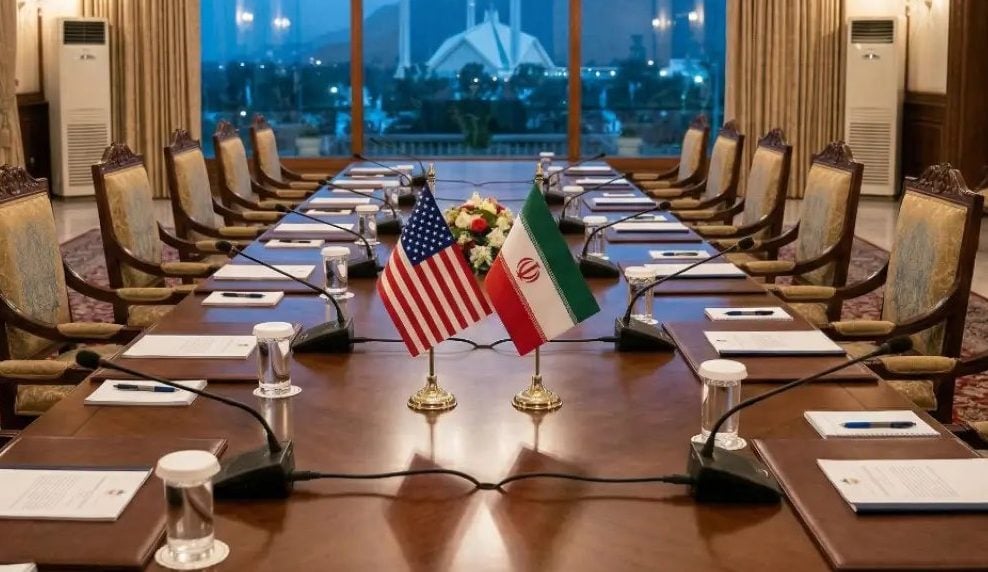
The report comes as Pakistan hosts talks between the U.S. and Iran on Saturday in an effort to reach a lasting ceasefire between both sides after reaching a two-week truce on 8 April.
A senior Iranian source told Reuters on Saturday that the United States agreed to release Iran’s frozen assets abroad—including ones in Qatar—but a U.S. official later denied the claim.
The Iranian source said that unfreezing the assets was one of Iran’s demands “in messages conveyed to the U.S. side” and that Tehran received an agreement from Washington that the funds would be unfrozen.
The Iranian noted that the move was “directly linked to ensuring safe passage through the Strait of Hormuz”.
A second Iranian source alleged the U.S. had agreed to release the $6bn frozen Iranian funds in Qatar, although the Gulf state did not comment on the matter.
The $6bn funds were initially frozen in 2018, when U.S. President Donald Trump under his first term unilaterally pulled out of the 2015 nuclear deal, known as the Joint Comprehensive Plan of Action (JCPOA)—signed under his predecessor President Barack Obama’s administration.
The money was originally held in South Korean banks as part of Iranian oil revenues before being transferred to Qatar as part of the historic September 2023 U.S.-Iran prisoner swap, which was mediated by Doha.
The swap involved the release of five American citizens detained in Iran in exchange for five Iranian nationals held in the United States, along with the transfer of the funds.
The latest claims and counter claims through media reports come as Pakistan hosts talks between the U.S. and Iran on Saturday in an effort to reach a lasting ceasefire between both sides after reaching a two-week truce on 8 April.
The high-level negotiations aim at ending the U.S.-Israel war on Iran that raged on since 28 February, threatening the region’s security.
Iran’s delegation at the talks includes Parliament Speaker Mohammad Bagher Ghalibaf and Foreign Minister Abbas Araghchi. The U.S. delegation is led by Vice President JD Vance alongside Donald Trump’s son-in-law Jared Kushner and special envoy Steve Witkoff.
Pakistan has assumed a pivotal role since the war broke out, holding talks with officials globally in an effort to reach a deal. Two days of discussions took place in Islamabad in late March between foreign ministers from Pakistan, Saudi Arabia, Egypt, and Türkiye.
Then, on 31 March, China and Pakistan announced a five-point initiative aimed at restoring “peace and stability” in the Middle East.
Some of the key issues expected to be discussed during the peace talks include the opening of the Strait of Hormuz and the inclusion of Lebanon in the ceasefire.
Israel has refused to include Lebanon in the deal, proceeding to carry out deadly bombardments in the country on the day of its announcement, 8 April. The date marked the deadliest day for Lebanon since Israel launched its latest military campaign against the country on 2 March.
Israel had killed more than 300 people within the single day, bringing up the toll to at least 1٫953, as per the latest figures released by Lebanon’s health ministry.