
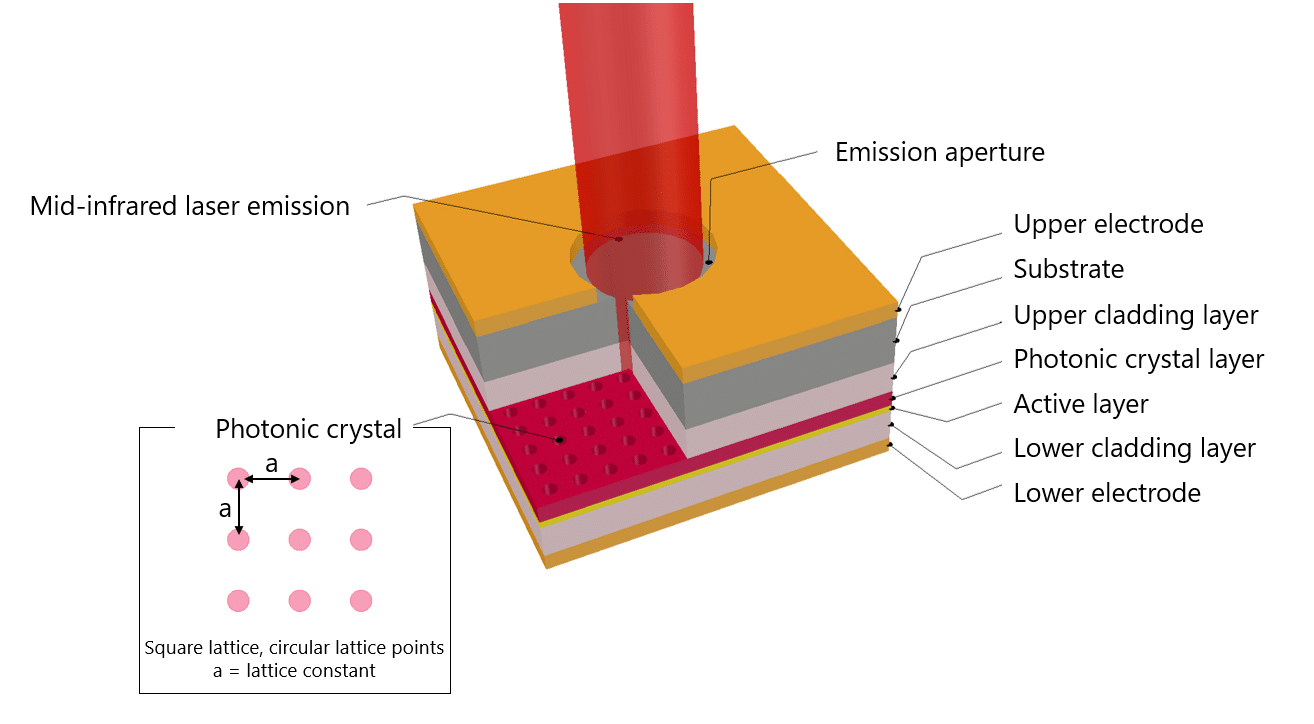
An infrared laser could shrink sensing systems while enabling precise gas detection, opening the way for compact tools to monitor environments and trace gases.
Asahi Kasei Microdevices Corporation (AKM), in collaboration with the Kyoto University Institute for Advanced Study, has successfully achieved laser oscillation in a 2 μm-band infrared photonic crystal surface-emitting laser (PCSEL). This milestone enables the miniaturization of next-generation sensing systems while maintaining PCSEL’s high directionality and narrow spectral bandwidth.
PCSEL technology, first developed in the early 2000s, was invented by a research team at Kyoto University led by Professor Susumu Noda. Compared to conventional lasers, it offers higher functionality in a compact device. In recent years, demand has increased for higher-brightness, narrow-linewidth light sources for applications such as biomolecule sensing and breath gas analysis, driving the need for small, mass-producible infrared lasers.
Together, AKM and Kyoto University worked to optimize the light source structure, culminating in laser oscillation in the 2 μm band using a PCSEL. This achievement in PCSEL technology is well-suited for high-sensitivity greenhouse gas detection, as the 2 μm wavelength band includes absorption lines associated with gases such as CO2 and CH4. By combining this property with the high directionality and narrow linewidth of PCSEL, applications are expected in fields that require high-precision measurement of trace gases.
AKM plans to accelerate research and development of 2 μm-band PCSEL technology, with a focus on manufacturability and advanced photonic crystal designs.
“These advancements demonstrate the strong potential of PCSEL for applications requiring high power and precise optical control,” said Yoshinobu Fujimoto, General Manager of R&D at AKM’s Business Development Center. “By combining AKM’s technological background with the expertise of Professor Susumu Noda and his team at Kyoto University, we are unlocking new performance capabilities that could benefit a wide range of applications.”