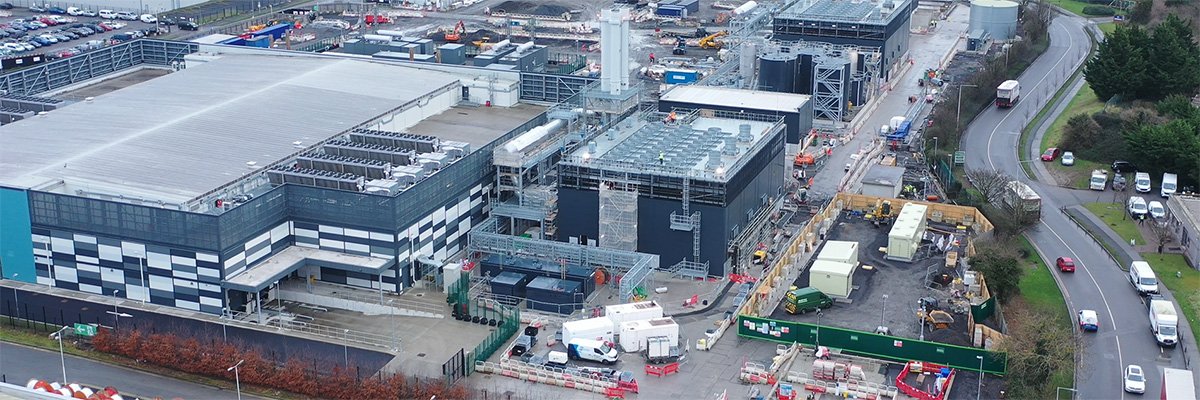
A backdrop of swirling winds and hail on a tour of what’s been billed Europe’s first microgrid-powered datacentre threw the challenge for its project partners into sharp relief.
“If we’d only known how difficult it would be,” says Ian Whitfield, Pure Data Centres Group (PureDC) chief engineering and technology officer. “Although, of course, we didn’t think it would be easy, so we’re very proud of what we’ve been able to achieve [with partner AVK-SEG].”
The end of the project is now near, having been seven years in the making, with most construction happening in the past two or three years. This is also despite denial of a grid connection – the whole of Dublin has just two electricity plants – and the long wait that followed.
“Like many others in Ireland at the time, or in Dublin particularly, we had our deposit handed back to us. We had to get creative or turn our focus elsewhere,” Whitfield says.
That meant finding other ways to power the project, starting with the 14MW DUB01 datacentre switched on in 2024. Also on a 5.73-hectare (14.2 acres) site at the Orion Business Park near the outer suburb of Blanchardstown are DUB02 (24MW) and DUB03 (16MW).
Housing ground-floor data halls that will host cloud services and compute services, and cooled with closed-loop systems – filled once for zero water consumption – the facility is anticipated to accommodate the latest tech, including support for artificial intelligence (AI) processing. Future plans include expansion to 110W, which will comprise a further 90W and incorporate another 10.1ha (25 acres).
The sustainable efforts behind microgrid switch-on
But the innovative part is the energy centre at the rear. That’s where the AVK-designed and developed microgrid supports the 54MW already in place and will support the full 110W in a few years’ time. Right now, the first capacity block of the planned three capacity-block energy centre is on, and the second is set to go live around September.
The microgrid runs on liquid natural gas (LNG) and sustainable, hydrotreated vegetable oil (HVO). The HVO chosen boasts International Sustainability & Carbon Certification (ISCC), which is more expensive but worth it for the additional sustainability benefits, according to the partners.
PureDC achieved 100% decarbonisation of natural gas consumption during 2025 through biomethane proof of concept (PoC). This means all operational natural gas consumption in the year was matched with renewable biomethane, using independently certified gas attributes and recognised Irish and European accounting methodologies.
It is working with local environmental agencies, including Ireland’s Environmental Protection Agency (EPA), to ensure operations stay within “tight environmental constraints”, Whitfield adds.
Irish Renewable Gas Guarantees of Origin (RGGOs) and European Biomethane Guarantees of Origin (GOs) certificates are sourced and retired on a MW-hour basis to match gas consumption, as well as to meet recognised sustainability, traceability, chain-of-custody, renewable gas market, EU emissions trading, RE100 technical criteria and more.
Gas Networks Ireland (GNI) mains gas is connected to the site to ensure its ability to deliver continuous critical services with five-nines availability, or just over 300 seconds of downtime a year. While the facility has multiple gas connection feeds from Ireland back into the UK and across Europe, GNI modelling suggests little impact on gas services availability more broadly, Whitfield says.
Redundancy is supplied by additional engines and duplicate power feeds from the energy centre into the datacentre, with the control system also duplicated. Backup generation is on site, supplied by dual-fuel engines.
Grid constraints a fact of life
Ben Pritchard, AVK’s CEO, emphasised that grid constraints have become a feature of development challenges, including for datacentres. In the UK, grid connection waiting times can be eight to 10 years. In Ireland, datacentres already take 21% of generated power.
Gartner predicts that AI will see worldwide datacentre power demand double by 2030, up from around 448TWh in 2025. Around 40% of existing AI datacentres will be operationally constrained by power availability by 2027.
But, says Pritchard, operators have so far largely continued to build datacentres the traditional way. And it can’t all be done with wind and solar, without building huge overcapacity.
“PureDC came to us and said, ‘We may never get a grid connection, but we need to try to make this work’. That’s the first time we saw that waiting wasn’t an option. We’d have to think outside the box,” he says.
AVK business has been around backup power generation, but only for standby power in markets such as healthcare, pharma and finance – not datacentres. It needed to transform itself, so it hired new talent and learned how to become a more strategic power systems provider with process engineering expertise.
AVK needed to devise “a tapestry of technologies” – taking in, for instance, precipitating engines, turbine technology, battery storage, complex and high-voltage control systems, and fuel cells
One design just wasn’t going to facilitate this … We needed an integrated engineering architecture with layers of innovation Ben Pritchard, AVK
“For a datacentre, you know your end goal – to design something to 100MW, for example. But the ‘ramp rate’, how the load reaches that, is undefined,” Pritchard says.
For example, the first six months of operation might only consume 1MW, so you can’t have an engine that needs to run at full capacity from day one.
Location and latency matters. System stability must be assured under fluctuating load conditions. In addition, operators must control and coordinate a variety of complex distributed systems and even different energy sources, while delivering quality of service and guaranteed availability.
“A manufacturing plant, for example, is probably operating in the 80% range of availability, which gives you an idea of the layers of technology we needed to add,” Pritchard says. “One design just wasn’t going to facilitate this. It wasn’t just about a group of gas engines. We needed an integrated engineering architecture with layers of innovation.”
The temporary 10MW first stage capacity-block used 2.5MW Rolls-Royce gas engines and will be repurposed elsewhere in the energy centre.
Stage two – from around September – will generate more power using six additional engines from Wärtsilä, adapted for a datacentre setting and to work with a battery energy storage scheme (Bess). The plan is to follow the current 9.8MW, 750rpm, dual-fuel Wärtsilä engines with three more.
The Bess charges and discharges while keeping the engines running efficiently at much lower loads as well as at full capacity when the whole datacentre and all three modular, easy-to-decommission energy centres are online in their final positions in several years.
The “minor modifications” ensure all three energy centre designs accept a hydrogen-fuel blend, with standby generators running HVO as the third layer of redundancy, with huge HVO storage tanks that had to be custom built and welded on site. There are 72 hours’ worth of HVO backup, so if mains gas fails, the engines can switch straight to HVO.
“It will still utilise battery storage. We’re relocating 10MW of battery [from the temporary scheme], and we’ll build another 10MW for a total 20MW of battery storage,” Pritchard says. “This all involves layers of technology that probably have never met before for any real purpose.”
Rainwater harvesting readiness has also been designed in. That’s about reducing mains water usage for the engines, via on-site collection and treatment.
Carbon capture could happen by the end of 2026, courtesy of last year’s AVK, Rolls-Royce and Landmark Power Holdings memorandum of understanding to deploy and commercialise carbon capture technology from Swiss CO2 recovery specialist ASCO. Sectors such as beverage manufacturing and medical still suffer from CO2 shortages.
While it’s not an exactly replicable blueprint per se, what PureDC and AVK-SEG have done is expected to guide performance parameters for future on-demand microgrids. Local conditions will dictate optimal practice and design because sometimes gas turbines might be preferred to engines, or perhaps fuel cells.
But it could be a “moment where the market starts to think about power differently”, with microgrids moving beyond being mere bridging solutions, says Pritchard, adding: “In Germany, Netherlands and UK, we have live projects in design that explore a similar structure. We’ve built something that removes demand from the grid, but that can also participate in grid activity.”
Net zero by 2040
Maria Rivas, PureDC’s director of sustainability, says it aims to achieve overall net-zero operations by 2040. Energy planning must go hand in hand with decarbonisation, while being viable, credible and compliant in the near term. The idea is to not compromise on sustainability, right down to using the most expensive, environmentally certified HVO.
It’s another step on our journey … and it’s a blueprint that hopefully others can follow Ian Whitfield, Pure Data Centres Group
All this has taken its time, especially because of the need to understand the market in full before proceeding. At the same time, regulatory alignment and related frameworks have needed to develop. European and Irish legislation had to be enacted generally, while simultaneously measurement and verification processes were starting to be developed.
For PureDC, these things were critical to secure the supply, to understand how that supply moved, and then to make sure the company could make accurate, sustainable disclosures that were regulated by the relevant departments. Meanwhile, it needed to keep the lights on in the datacentre, relying on existing infrastructure that allowed it to decarbonise yet maintain functionality, says Rivas.
“We analyse lifetime carbon up front,” she adds. “At our datacentres, we analyse what emissions are associated with building the site. We also look at the energy centres and our energy, and our zero waste to landfill, for which we certify all our sites. Resilience and decarbonisation don’t have to be decoupled.”
Whitfield confirms the project aims to “measure, monitor, reduce, and disclose” maximum emissions, including from certified Irish biomethane. For instance, the construction has been designed so connectors for district heating can be easily added if there is demand.
“We’re working closely with partners to bring and use this system as a catalyst for decarbonised heat for this area’s wider community,” he says. “It’s another step on our journey, which has been a long and very difficult journey, and we’ve not quite finished yet, but we will – and it’s a blueprint that hopefully others can follow.”
The project adds about 150 ongoing Dublin jobs, excluding construction.