
Most marketing teams I talk to are doing genuinely good SEO, and yet when they open ChatGPT or Perplexity and type in the prompts their buyers are actually using, their brand is nowhere to be found. This is the exact problem the FSA Framework was built to solve.
![Free AEO Grader: See Your Brand's Visibility in Answer Engines [Free Tool]](https://no-cache.hubspot.com/cta/default/53/d4233c10-60b6-46d7-9852-c71dde8507b6.png)
For the last decade, conventional wisdom has been, “Do good SEO, and the rest takes care of itself.” That assumption was safe, and many brands benefited from a well-executed SEO strategy (hello, revenue!). But it doesn’t work anymore.
The mismatch isn’t because SEO is broken. SEO is doing exactly what it was designed to do. The problem is that search engines prioritize ranking the best resource, and answer engines prioritize providing the best answer..
Those are two very different machines, and they reward two very different things.
Table of Contents
What is the FSA Framework?
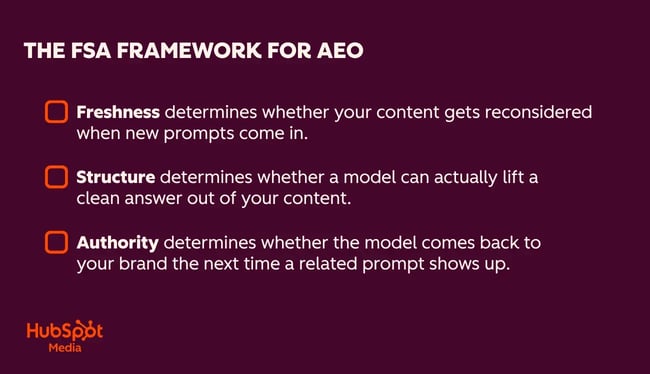
The FSA Framework stands for Freshness, Structure, and Authority — the three signals that answer engines actually evaluate when deciding which sources to cite inside a generated answer. It’s the diagnostic lens I use to figure out why a brand is or isn’t showing up in ChatGPT, Perplexity, Gemini, and Google’s AI Overviews, and what to fix first when they’re not.
Each pillar does a different job:
- Freshness determines whether your content gets reconsidered when new prompts come in.
- Structure determines whether a model can actually lift a clean answer out of your content.
- Authority determines whether the model comes back to your brand the next time a related prompt shows up.
Miss one, and the others can’t fully compensate. When all three are working together, your content stops being a candidate and starts being the obvious choice inside an AI-generated answer.
Where the FSA Framework Came From
In 2025, I started using my own website as a testing ground for answer engine optimization. I had a hunch about AEO, and no one was running the experiments I wanted to read. So, I ran them myself across ChatGPT, Perplexity, Gemini, and Google’s AI Overviews, tracking what surfaced for each prompt and — more importantly — what didn’t.
In one experiment, I updated a single page using the principles I’d been developing, and tracked AI Share of Voice across the entire window. The page was on a topic where Search Engine Journal — a legacy publisher with the kind of domain authority most marketers would kill for — had been the dominant cited source for months.
Within 96 hours, AI Share of Voice for Cassie Clark Marketing on that topic moved from around 27% to 72.7%. Search Engine Journal dropped to 0% visibility in the same window. There were no new backlinks and no promotional push. I just had a better-structured, fresher, more extractable version of the same idea.
Under traditional SEO logic, this should not have been possible. A solo strategist’s site shouldn’t displace a legacy publisher in four days. That does not happen — especially that quickly — in traditional rankings.
But under AEO logic, it made perfect sense. The legacy page had stopped being maintained, and its structure was built for crawlers, not for extraction.
When I went back through every test I’d run that year, I noticed engines were regularly skipping high-authority domains. Instead, they cited content that was recently updated, cleanly structured, referenced consistently across multiple sources, and easy to lift into an answer.
Freshness, structure, authority. The same three signals, every time, across every model.
Why We Need a New Framework in the First Place
Traditional SEO was built around a simple premise: A user types a query, the search engine identifies the most relevant pages, and those pages compete for position on a results page. Pages are the destination, and the whole job of SEO is getting your destination higher up the list than the next person’s.
That model assumed two things that answer engines no longer assume:
- The user wants a list of options.
- The user will evaluate those options themselves.
AI models don’t work that way. They retrieve information from multiple sources, synthesize it, and hand the user a single, confident answer. The user gets a summary, not a list. And inside that summary, sources are mentioned, not as a reward for ranking well but as evidence that the answer can be trusted.
So the question the engine is asking has changed completely. It’s no longer “which page should we show?” It’s “which sources help us explain this clearly and accurately?”
That sounds like a small distinction when you read it on a page, but in practice, it changes everything about what your content has to do in order to be useful to the system. Your content is no longer a destination, but an input.
And, once you internalize that shift, the FSA Framework stops feeling like a new set of tactics. It becomes the only logical response to how answer engines actually work.
Featured Resource: How AEO is changing the search landscape.
The FSA Framework Breakdown
Freshness
In AEO, freshness is a weight — one that influences how confidently a model reuses your content, how often it gets reconsidered when new prompts come in, and whether it stays eligible to appear in assembled answers at all. Stale content gets dropped from the candidate pool entirely.
The way I think about it is this: Freshness is recency, relevance, and reinforcement.
- Recency is the time-based piece. When was this last touched?
- Relevance is contextual. Does this still match how the topic is actually discussed today with the language people are actually using?
- Reinforcement is behavioral. Has this source continued to show up, get cited, and hold its place over time?
All three feed the same signal, and a page can fail on any one of them and lose ground.
What Freshness Really Means
Answer engines do not need a “last updated” badge to determine whether content is current. Instead, they notice when the language doesn’t match how a topic is being discussed now, when you reference a tool that doesn’t exist anymore, or when the surrounding topic space has evolved past what your page is describing.
In fast-moving verticals — SaaS, AI, fintech — content has roughly a 90-day shelf life before it starts losing relevance signals. For more evergreen topics, you have closer to six months. After that, you risk falling out of the answer pool entirely.
The practical takeaway is simple:
- Don’t just update the date.
- Add a current example.
- Pull in a recent stat.
- Reference something that’s actually changed in the space.
The volume of updates matters way less than their consistency and their substance. One real update every quarter beats five cosmetic changes a month.
Freshness gets your content reconsidered, but getting reconsidered isn’t enough on its own. The model still has to be able to use what it finds.
Structure
Structure for AI is different from structure for crawlers, and the two don’t always align.
AI models don’t read your page the way humans do. They parse it and scan for clean hierarchies, self-contained explanations, and clearly labeled sections they can lift into an answer without needing the rest of the page to make sense.
Content that performs well in AI answers shares a lot of the same structural traits:
- Clear H2s and H3s.
- Short paragraphs that resolve one idea at a time.
- Explicit definitions near the top of a section, before the explanation unfolds.
- Labeled steps.
- FAQ sections.
- Callouts.
If your best idea is buried three paragraphs into a section that requires the previous section to follow, the model is going to skip it. Not because it’s a bad idea, but because it can’t be extracted cleanly.
Why Structuring for Answer Engines is Different From Traditional SEO
If your content forces the model to do interpretive work, the model will find something structured in a way that is easier to break apart.
The mistake I see most often is teams optimizing structure for crawlers — meta tags, clean header hierarchy, internal links — and assuming that’s the same job. It’s not. Crawler structure focuses on navigability, while AI structure prioritizes extractability.
The right question to ask of any page is: Can ChatGPT lift a clean, accurate answer out of this without needing the rest of the page?
If the answer is no, you have a structure problem, no matter how well your headings are nested.
Authority
In SEO, authority meant domain authority. It took years to build and was almost impossible to displace once a brand had it. Entire agency business models were built around link acquisition.
In AEO, authority is now entity authority. The question isn’t “how strong is this domain?” It’s “is this brand the one that consistently explains this specific topic, across every channel I can find them on?”
Entity authority gets built one mention at a time, in a way that has almost nothing to do with backlinks. Every time your brand appears somewhere a model can learn from — a podcast, a Reddit thread, a guest post, a quote in a third-party article, a LinkedIn post, your own website — it adds to what the model knows about you.
One mention is a data point. But repeated mentions in similar contexts across multiple channels help build a pattern and create model confidence. Confidence is what gets you cited.
Why Smaller Brands Have Strong Entity Authority
Inside AI answers, smaller brands are suddenly winning fights they have no business winning on paper. Digging deeper, the reason why is obvious.
Smaller brands often create content only for their core audience and rely on social media or influencer marketing to build brand authority across surfaces, not just their own website. When a model encounters those brands repeatedly, it gains confidence in reusing the explanation.
The massive publisher, by contrast, has a hundred contributors writing about everything. None of them is building a recognizable entity around a specific, user-focused topic. Distribution is often nonexistent because traditional SEO wisdom says that domain authority is enough. When this happens, the model has nothing to anchor to.
Authority work is now closer to reputation management across channels than link building. None of this looks like an SEO campaign, but it’s exactly how you become the brand the model recognizes.
How to Apply the FSA Framework
So if this is how answer engines actually work under the hood, the next question is: What should teams be doing differently to put the FSA Framework to work?
Here’s the way I frame it for clients. SEO gets you into the room. AEO gets you chosen once you’re there. Here’s how to apply the FSA framework in practice.
1. Start with an audit — and find your money prompts
Before you touch a single page, you need to audit your visibility to know where you actually stand inside AI answers. That means running real prompts in ChatGPT, Perplexity, and Gemini for the topics tied to your pipeline — not the topics tied to your keyword list.
These are your money prompts. Think about the questions your buyers are actually typing when they’re evaluating a solution, comparing options, or trying to figure out if you’re the right fit. They usually sound like:
- “Best AEO tool for [specific use case]”
- “[Your brand] vs. [competitor] for [buyer context]”
- “How do I [solve the problem your product solves] as a [your ICP]”
- “What should I look for in a AEO tool if [specific constraint]”
Run your money prompts across multiple engines and pay close attention to whether your brand shows up at all, who’s showing up instead, and what the AI-generated answer actually says about your space. That single exercise will tell you more about your real AI visibility than any keyword report.
Pro Tip: You can measure mentions with HubSpot AEO — track prompts across ChatGPT, Perplexity, and Gemini, and see exactly where your brand stands.
Once you’ve done the initial scan, audit your top five pages through the FSA lens with an honest eye toward where each pillar is or isn’t holding up:
- Is the content current and reflecting how the topic is being discussed today, or is it quietly aging out of relevance?
- Is it structured in a way that a language model could lift a clean answer out of the first few hundred words?
- Is your brand consistently represented across the channels where buyers in your space are actually paying attention? Or are you essentially invisible everywhere except your own domain?
Diagnosis before tactics, every single time.
2. Replace volume targets with refresh targets
Maintaining and updating existing content on a consistent cadence does more for AI visibility than publishing net-new content every week. If your editorial calendar is built around how many posts you ship, rebuild it around how many of your top-performing pages get meaningfully refreshed each month.
3. Structure for extraction, not just indexing
Audit your top pages with one question in mind: Can a model lift a clean, complete answer out of the first few hundred words?
If not, restructure with:
- Definitions up top.
- Labeled sections.
- FAQ blocks.
- Comparison language for prompts where buyers evaluate you against alternatives.
4. Build entity authority across channels
Your website alone isn’t doing all the work anymore. Answer engines learn from content diversification, meaning:
- Podcast appearances.
- LinkedIn company and employee content.
- Reddit comments and threads.
- Guest articles.
- Expert quotes.
- Community participation.
The brands that build a consistent presence across multiple surfaces are the ones models start to trust.
5. Measure AI Share of Voice, not just rankings
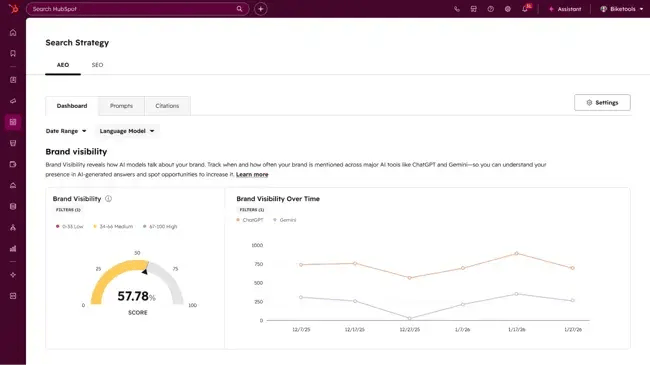
AI Share of Voice tracks how often your brand appears inside AI-generated answers compared to competing sources. It’s a zero-sum metric — when one brand gains share, another brand loses it.
HubSpot’s AEO features now let you see how your brand is showing up across answer engines and where competitors are being cited instead — which is genuinely useful as a starting point, since most teams don’t know where their gaps are until they can see the data.
6. Pick one pillar to fix first
Once you know where you stand, pick one pillar to fix first rather than trying to address all three at once:
- If your content is stale, start with freshness. That’s the fastest signal to move.
- If your content is comprehensive but dense, restructure for extractability.
- If your brand is invisible despite having genuinely good content, the problem is almost certainly entity authority, and the fix lives outside your website.
Most AI visibility problems fall cleanly into one of those three buckets. A lot of what looks like a visibility problem is actually an authority problem in disguise.
Pro tip: Pair the FSA Framework with these AEO best practices for a more comprehensive approach.
What This Means for Your Content Strategy
The FSA Framework is a diagnostic lens for figuring out why visibility is or isn’t happening for your brand inside AI answers. You can stop guessing and start working on the right thing in the right order.
The specific signals answer engines weigh will change as the models evolve. The tactics built on top of the framework will need to be adjusted as the surfaces shift. But the underlying logic — favor freshness, reward clarity, trust consistency — has held steady across every model I’ve tested, and I expect it to continue to hold as the engines evolve.
The brands that win inside AI answers over the next few years aren’t going to be the ones chasing every new tactic. They’re going to be the ones who understand how AEO actually works, diagnose their visibility gaps honestly, and fix the right pillar first.
Build on those principles, and the FSA Framework adapts as the surface changes.