
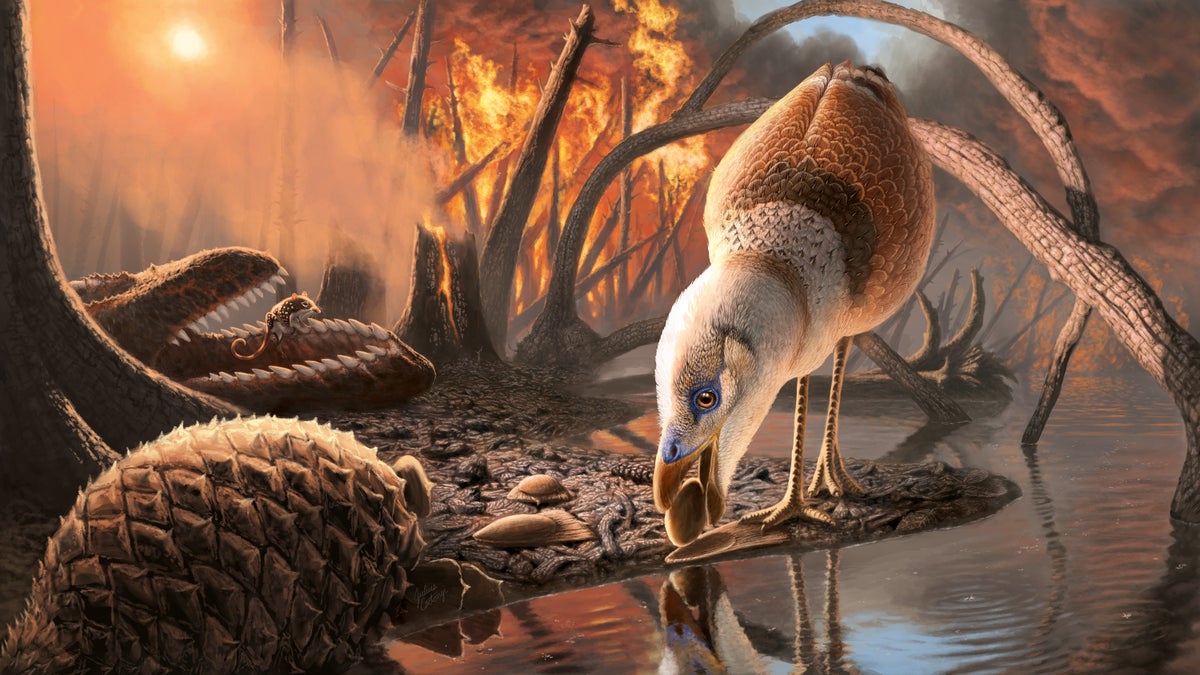
On the final day of the Cretaceous period, some 66 million years ago, Earth was teeming with a dazzling variety of dinosaurs. In North America, the superpredator Tyrannosaurus rex stalked its favorite prey, the three-horned Triceratops. In Asia, agile raptors eyed herds of duck-billed and armored herbivores, and a menagerie of miniature carnivores and plant eaters roamed the European islands. South of the equator long-necked behemoths heavier than jet airplanes shook the ground as they walked. And all over the world feather-covered dinosaurs flaunted their plumage, some flapping and flying through the air.
Then, suddenly, the Age of the Dinosaurs was over. A massive asteroid slammed into the Gulf of Mexico, triggering a chain reaction of carnage: earthquakes, tsunamis and wildfires followed by years of darkness and cold. It was probably the worst moment in Earth history, and before long three out of every four species were extinct. The asteroid was so catastrophic that it spawned one of the greatest myths in science, one so pervasive and repeated so constantly that most of us think it is true. It is the myth that dinosaurs are gone, felled one and all during the end-Cretaceous extinction.
In fact, some dinosaurs survived the asteroid apocalypse. Although canonical species such as T. rex and Triceratops perished, members of one dinosaur group managed to endure: birds. Why did birds persevere when every single other type of dinosaur died? Scientists have puzzled over this question for decades. The mystery has deepened in the past 30 years as paleontologists have uncovered scores of feathery and winged dinosaurs that were closely related to birds and similar in many aspects of biology and behavior, though not actually part of the avian lineage. Some of these dinosaurs could even fly. What, then, allowed birds alone to escape the fate of their family?
On supporting science journalism
If you’re enjoying this article, consider supporting our award-winning journalism by subscribing. By purchasing a subscription you are helping to ensure the future of impactful stories about the discoveries and ideas shaping our world today.
Recently an answer has emerged, based on new research into fossils, genetics and ecology. Many birds were flying over the heads of T. rex and Triceratops when the asteroid hit, and most died alongside their dinosaur cousins. The only birds to make it out of the Cretaceous were modern-style species. Their survival came down to circumstance: where they happened to live and the features they happened to possess served them in good stead when the world went to hell.
Researchers have long contemplated the relation between modern birds and extinct dinosaurs. In the 1860s scientists of Charles Darwin’s generation noted striking similarities in the skeletons of today’s birds and those of small meat-eating dinosaurs from the Jurassic and Cretaceous periods, which spanned the time between 201 million and 66 million years ago. In the 1990s the idea that birds evolved from dinosaurs became mainstream, bolstered by the discovery in China of dinosaur skeletons bearing feathers that had been buried by prehistoric volcanoes and fossilized in pristine condition.
Over the past 25 years farmers in China’s Liaoning Province have unearthed thousands of these feathered dinosaurs from their fields. Working with my late colleague Junchang Lü, I’ve had the pleasure of studying many of them and naming a new species, a close relative of Velociraptor that we christened Zhenyuanlong. It is a stunning specimen, with wispy, hairlike feathers coating most of its body and quills lined up on the arms to form small wings. As I gawked at the fossil in the back room of a Chinese museum, light illuminating the feathers, I truly understood the special connection between dinosaurs and birds.
These plumaged creatures tell the story of how birds evolved from dinosaurs. It was one of the grandest evolutionary transitions in the history of life: ferocious ground-living carnivores shrank their bodies, sheathed themselves in downy fluff, sprouted wings and took to the skies.
I’ve been working to understand this astounding transformation for the better part of the past two decades, starting with my Ph.D. thesis, supervised by the late Mark Norell, which produced a large family tree of early birds and their close dinosaur relatives. This tree showed that birds evolved from dinosaurs piecemeal over tens of millions of years. Many keystone features of birds today—feathers, wings, wishbones, hollow skeletons, überefficient lungs, big brains—are actually dinosaur features that have developed for a litany of reasons over a long stretch of time and were only later repurposed to form a flying machine.
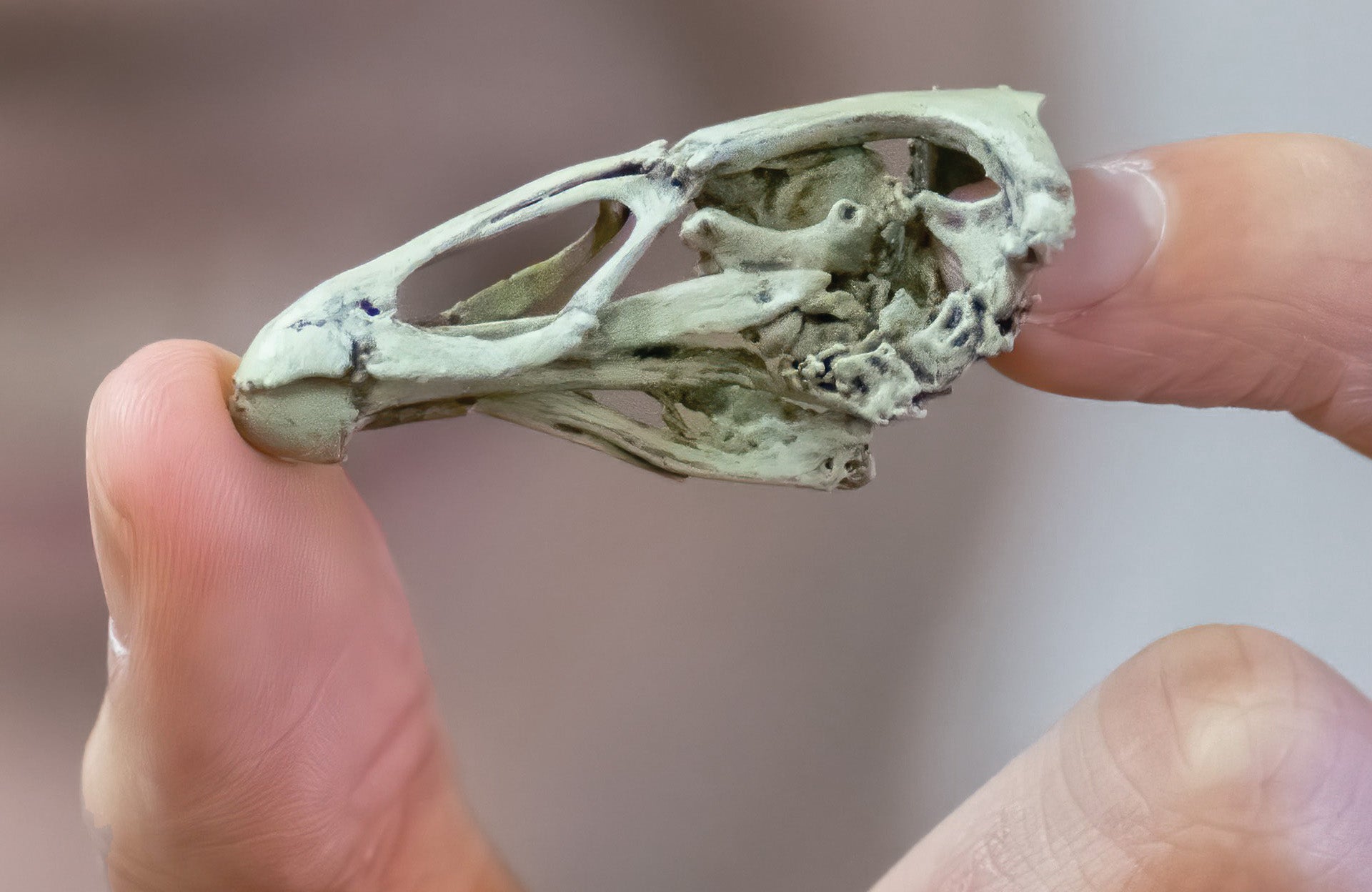
This fossilized skull of Asteriornis, nicknamed the Wonderchicken, represents the oldest known member of the family to which modern chickens and ducks belong.
Daniel J. Field, University of Cambridge
By 150 million years ago, the fossil record reveals, true birds had evolved, such as the iconic Archaeopteryx, which soared over the lagoons of modern-day Germany. One remarkable talent distinguished these birds from other dinosaurs: not only could they passively glide like some of their feathered dinosaur kin, but they also could flap their wings to provide the lift and thrust needed to get—and stay—airborne.
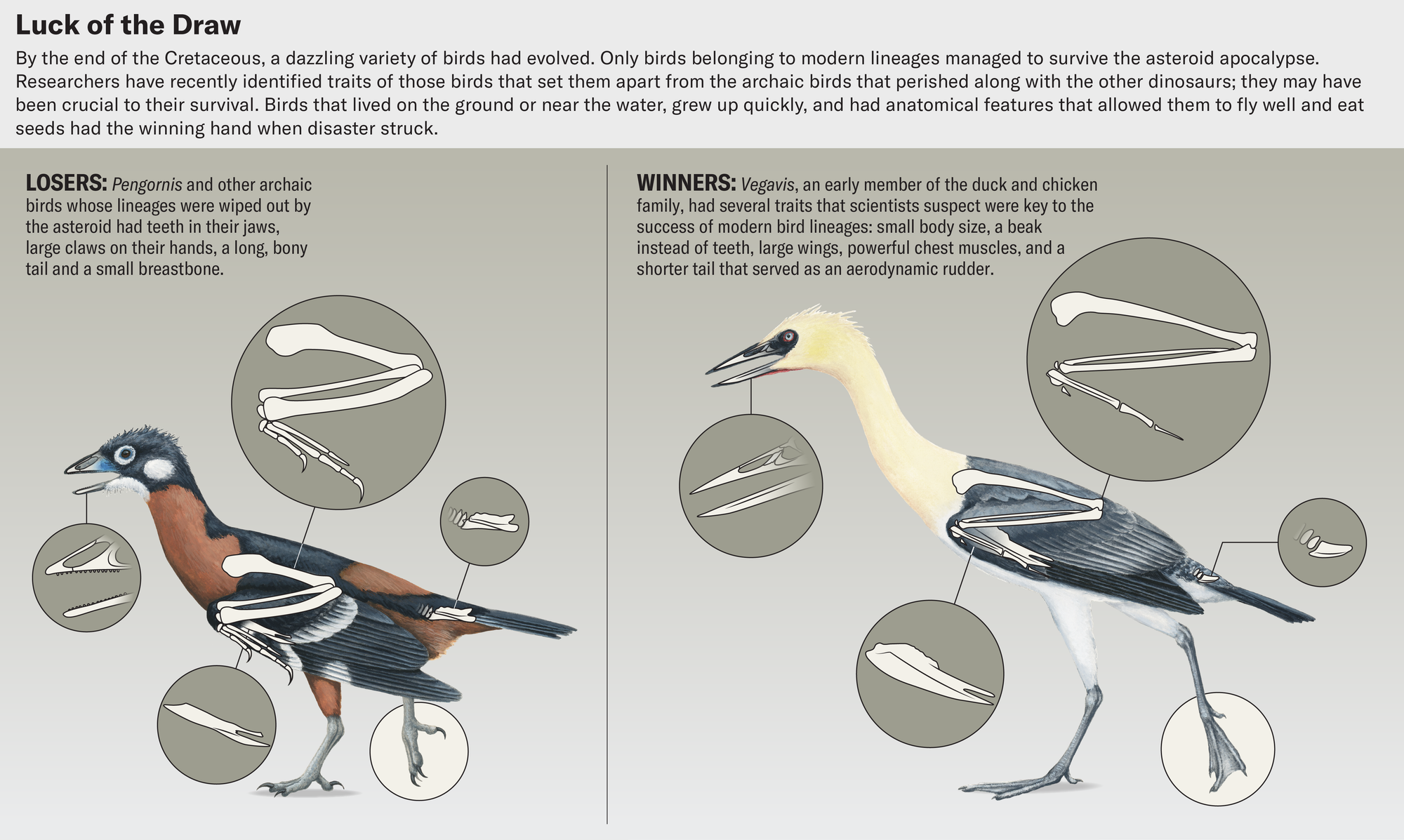
For the next 85 million years or more proper birds lived alongside their dinosaur cousins. The first ones, including Archaeopteryx, looked like miniature velociraptors, with steak-knife teeth, sharp claws and long, bony tails. Over time some birds underwent refinements that better adapted them to the air. Their arms got longer, their wings broader, their wing-flapping muscles bigger, their bodies lighter. Their tails shortened to a fatty nubbin anchoring an aerodynamic rudder, and they traded teeth for beaks. Some became warm-blooded and started growing at absurdly fast rates.
Meanwhile these Jurassic and Cretaceous birds colonized new habitats on the ground, in the water and particularly in the trees, where a group called the enantiornithines established a novel way of life, eating plants and bugs and nesting high in the canopy. By the waning days of the Cretaceous truly modern birds had appeared on the scene. Species such as Vegavis and Asteriornis, members of the same group as ducks and chickens, honked and flapped alongside many primitive, slow-growing holdovers with long tails, teeth and claws. Between the primitive holdovers and the modern newcomers, the Cretaceous boasted a staggering array of birds.
Then catastrophe struck. The culprit was a 10-kilometer-wide asteroid, a leftover crumb from the birth of our solar system that happened to intersect Earth. When the asteroid smashed into what is now the Yucatán Peninsula of Mexico, it detonated with the force of more than one billion nuclear bombs. Fire and brimstone filled the first days of the aftermath. Dust from the collision and soot from wildfires clogged the atmosphere, blocked out the sun and plunged the planet into a winter that lasted years. If you were alive that day, your entire species had only a 25 percent chance of continuing. Pterosaurs—the aerial reptiles that evolved flapping flight before birds—all died, as did the ocean-living reptiles and coil-shelled ammonites. And so did nearly every dinosaur.
Paleontologists have argued about the speed of the end-Cretaceous extinction and whether the asteroid was the killer or a wrongfully accused bystander to an extinction event that was already underway. Based on new evidence, I am confident that death came fast—instantaneously, in geological terms—and that the asteroid was indeed to blame.
For more than a decade my colleagues and I have prospected the badlands of northwestern New Mexico, where the pastel-striped rocks preserve layer after layer of dinosaur fossils leading up to the extinction. In 2025 our team, led by geologist Andrew Flynn of New Mexico State University, described a vibrant community of dinosaurs in that area accurately dated to less than a few hundred thousand years before the asteroid. They were thriving. There were meat eaters and plant eaters, ones with horns and others with duck bills, tiny raptors, apex-predator tyrannosaurs, and even a long-necked sauropod, Alamosaurus, that was one of the largest animals to ever live on land. There is no sign that anything was amiss. And then their skeletons disappear from the rocks, and only one type of dinosaur fossil remains: the fragile, hollow bones of birds.
To understand why birds endured when the nonavian dinosaurs went extinct, we first must consider the overall roster of victims and survivors—not just dinosaurs but the entirety of the animal kingdom that existed right before the asteroid struck. The overarching pattern is clear: if you were big, you died. Every terrestrial creature larger than a Siberian husky failed to make it through the Cretaceous and into the next interval of time, the Paleogene.
With this rule in mind, we can see why nonavian dinosaurs—including many of the feathered dinosaurs—were marked for death. Because of their generally hefty size, they needed to eat substantial quantities of food, which was difficult when the land burned and ecosystems collapsed. These animals could not easily burrow or shelter their large bodies from the fires and other environmental destruction that happened immediately after the impact. And most of them took several years to grow into adults, which worsened the odds that a single individual could persist through the interminable asteroid-induced winter.
Birds, however, had many of the opposite attributes. Their small size meant they didn’t need to eat hundreds of pounds of food every day and could better manage lean times. They could fly, so even if they couldn’t dig burrows, they could launch themselves far away from any immediate danger. Certainly these assets gave birds a leg up compared with the other dinosaurs and the various other animals that died. Case closed?
Not exactly, because of one nagging problem. The end-Cretaceous was not a simple story of birds surviving while the nonbird dinosaurs died. In fact, many birds were also extinguished in the fire and fury of the asteroid. Most of them—maybe nearly all of them—followed T. rex to the grave. One estimate puts the scale of bird extinction from this catastrophe at more than 90 percent. If it weren’t for some plucky survivors, birds might have gone the way of their dinosaur cousins, and there would be no sparrows at your bird feeder, fried chicken dinners or pet parakeets today. So we must reframe the question: Why did only a few birds survive?
Once again we can compare victims with survivors, this time among birds. Well-sampled rocks of the latest Cretaceous, spanning from our team’s field sites in New Mexico north to Montana and into Saskatchewan, have yielded more than a dozen distinct species of birds. They range from archaic forms that retained teeth and long tails to highly advanced members of the modern groups. The extinction is marked by a thin line in the rocks, saturated with the rare element iridium, delivered to Earth by the asteroid. Above it only a single type of bird fossil is ever seen again: members of the modern-day lineages. All other birds disappear; never would there be another bird with teeth in its jaws or sickle claws on its fingers or long broomstick tails. And that’s true everywhere in the world.
The only birds that carried on into the Paleogene are the so-called crown group: members of the modern lineages, the parts of the bird family tree that are still living and expanding today. Much of what we know about the founding members of the bird crown group comes from two recently discovered fossils dating to the very end of the Cretaceous.
The first is Vegavis, originally described from a scramble of bones embedded in a concrete-hard nodule plucked from the ice fields of Antarctica in the 1990s and supplemented last year by a breathtakingly preserved fossil skull described by Christopher Torres of the University of the Pacific in Stockton, Calif., Julia Clarke of the University of Texas at Austin and their colleagues. The second is Asteriornis—nicknamed the Wonderchicken—found inside limestone blocks wrested from a quarry near the Belgian-Dutch border and described by Daniel J. Field of the University of Cambridge and his team in 2020. Both are members of the duck and chicken family and thus firmly ensconced in the family tree of today’s birds.
Vegavis and Asteriornis are emblematic of the birds that faced down the asteroid. They were small for birds of their time, had beaks instead of teeth, and lived in or near the water. And they experienced a fast-paced life in which they grew from hatchling to adult within one year, as shown by the lack of any annual growth rings inside their bones.
Many birds were also extinguished by the fire and fury of the asteroid. Why did only a few survive?
Vegavis, which is known from more complete fossils, was additionally a strong flier with large wings and powerful chest muscles. It has been found with a petrified syrinx, the bird vocal organ, in its chest, indicating that it could have honked and squawked and made other complex vocalizations. Antarctica was warmer in the Cretaceous than it is today, but still, Vegavis was clearly a robust bird that was able to tolerate the dark winters of the high latitudes. So in many ways the first crown-group birds were special—and their uniqueness might have been the fount of their resiliency.
Were there specific reasons that fast-growing waterbirds with beaks could defy the asteroid? Recent studies by Field, Derek Larson of the University of Toronto and their colleagues suggest that two factors were critical: habitat and diet. Where you lived and what you ate might have dictated your fate at the end of the Cretaceous. Crown-group birds had the winning combos.
Let’s consider habitat first. The effects of the asteroid touched all corners of Earth, but no environment had it worse than forests. They were pummeled, first by shock waves near the impact zone and then globally by fires and acid rain over the following days and weeks. Any trees that survived the onslaught would have been slowly starved of the sunlight they needed to photosynthesize their food. A plague of fungi preserved in the fossil record marks the mass die-off of forests. It probably took hundreds of years for them to grow back once the sunlight returned.
All animals that frequented trees would have been in trouble—their shelter, nesting grounds and food sources would have disappeared. Many Cretaceous birds, particularly the archaic long-tailed species, were tree-living specialists. But not Vegavis, Asteriornis, and other early crown-group birds, which lived around the water and on the ground. Their homes would have been damaged but not destroyed.
Now on to diet. When the long winter descended, ecosystems built on a foundation of photosynthesizing plants collapsed. When the plants died, plant-eating animals had no food, so they also died. Then the meat eaters succumbed, with the losses cascading up the food chain until the entire network went kaput. But one plant resource remained available for those that could take advantage of it: seeds.
Most plants would have died quickly, and animals that ate leaves, stems, shoots, fruits, or other parts of a growing plant were out of luck. Not so with seeds. As we see in modern-day disasters, seeds can remain viable in the soil for decades and allow ecosystems to return after a fire or volcanic eruption. Because crown-group birds had sharp, mobile nutcracker beaks, they would have been able to exploit seeds as food, whereas most other animals—including the archaic toothed birds—could not.
When you add it all together, survivorship at the end-Cretaceous meant winning an unhinged game of poker. Each species sat at the proverbial table with a hand of cards: where they lived, what they ate, how they grew and behaved. But the deck was frozen—they couldn’t draw any new cards, because there was no time to adapt through the usual processes of natural selection, of genes shaping success over the generations.
Instead the rules of the game were simple but brutal: What hand did you hold when the calamity struck? If you were slow-growing, unable to burrow or shelter, lived in the trees or had to eat a lot of food (especially plants), then game over. The nonavian dinosaurs, including most feathered dinosaurs, found themselves in this situation despite their resounding dominance over the previous 150 million years. So, too, did many bona fide flapping, flying birds.
But if you grew fast, could shelter or fly away from danger, lived on the ground or in the water, and could eat seeds, then any of those assets would have been beneficial and improved your odds at the poker table. And if you held all of those cards? You had a royal flush. Crown-group birds just so happened to hold this hand, and they won the game—and with it the opportunity to evade extinction, live another day and spawn a new dynasty of dinosaurs.
After the impact, once the soot clouds cleared and sunlight brightened a blighted land, healing could begin. Winter gave way to rebirth. Seeds grew into trees, trees into forests, forests into complex ecosystems. Within a few thousand years Earth was brimming with life again. And this new world thrummed with birdsong.
In New Mexico, above those Cretaceous rocks bursting with dinosaur bones, are mudstones from the ensuing Paleogene, formed on riverbanks and in jungle swamps. These Paleogene layers are full of fossils, too—not the dagger teeth of tyrannosaurs and the giant backbones of sauropods but the jaws and teeth of mammals. Our furry ancestors held their own winning poker hand when the asteroid struck: they were tiny burrowers that were capable of growing fast and could eat nearly anything.
After patiently biding their time in the shadows, living underfoot of dinosaurs for 150 million years but rarely, if ever, getting bigger than a house cat, mammals suddenly had their opportunity. A million years after the asteroid impact there were mammals the size of cattle, and these upstarts rushed to fill ecological niches vacated by the dead dinosaurs. But they would not be alone.
Survivorship at the end of the Cretaceous meant winning an unhinged game of poker.
Every spring I venture into the New Mexico badlands, and over the years I’ve developed an eye for spotting the teeth of Paleogene mammals. But no matter how many I find, there has not been a single day when I’ve eclipsed the haul collected by my friend Thomas Williamson, recently retired curator at the New Mexico Museum of Natural History and Science. Williamson is the world expert on these mammals that took over from the dinosaurs, an accolade earned through decades of grueling hikes through the desert with his eyes glued to the ground. He is so obsessed that he would take his twin boys, Ryan and Taylor, deep into the badlands when they were young, multitasking childcare with fossil hunting. He trained them just as he would later train me.
On one of their family outings, when the twins were 10 years old, Taylor grew bored after many hours of fruitless searching. He wandered off by himself to look for rattlesnakes. Having no luck, he stopped for a bathroom break. That’s when he tripped over a trove of fossils—countless pieces of bone of all shapes and sizes peeking out of the desert floor. His celebratory screams echoed through the empty canyons, eventually reaching his dad.
Williamson later returned with a shovel to collect bagfuls of rock, which he passed through sieves at the museum, picking out each and every fossil. Among the bones were some unusual ones, paper-thin and hollow inside. One of them looked like a stub of tailbones smashed together, and others contained fused chunks of hand and wrist. These were not the bones of mammals; they belonged to a bird.
Williamson and two of his colleagues, Daniel Ksepka of the Bruce Museum in Greenwich, Conn., and Thomas Stidham, now at Austin College in Texas, gave this bird a name: Tsidiiyazhi abini. It means “little morning bird” in Navajo, a tribute to those who have called this region of Paleogene jungle turned desert home for many centuries. Living just a few million years after the asteroid, it was a tiny perching bird, a budgie-size species that had returned to the trees after the forests regrew. It was so well suited to the canopy that it could rotate two of its toes backward to grip branches, an unusual ability that gave away its identity: it was a mousebird. Mousebirds belong to the bird crown group, and six species of them are still alive today in sub-Saharan Africa.
Finding a mousebird in New Mexico a few million years after the asteroid has startling implications. Mousebirds are deeply nested in the family tree of modern birds, meaning that by the time mousebirds came into existence, many of their more primitive crown-group cousins would have already branched off. If there were mousebirds in the early Paleogene, there must have been early members of other lineages, too: flamingo and grebe, hawk and eagle, pigeon and dove, owl, and many more. Indeed, if you examine the most up-to-date genealogies of today’s birds—such as the one presented in 2024 by Josefin Stiller of the University of Copenhagen and her colleagues based on entire genomes of hundreds of species—many major groups of contemporary birds are implied to have originated right after the end-Cretaceous extinction in an exuberant burst of evolution.
With the asteroid in the rearview mirror, their dinosaur cousins and ancestors gone and mammals now nipping at their wings, the birds that bested the end-Cretaceous asteroid were free to diversify with gusto. They experimented with new flying styles and diets, expanded into uncharted environments, and fashioned the foundation of today’s bird diversity—more than 10,000 species, around twice the number of mammals.
So far this story is mostly implied by DNA and family trees. Other than Taylor’s Tsidiiyazhi and a few other scrappy specimens, we haven’t yet found many fossils of these early Paleogene birds. Doing so will be challenging because these birds were small and fragile and probably did not easily petrify into stone. But if the theory is true, then the fossils should be out there, concealed in the rocks, waiting for a new generation of paleontologists (or their kids) to find them. I’ll be looking the next time my students and I are in New Mexico.