
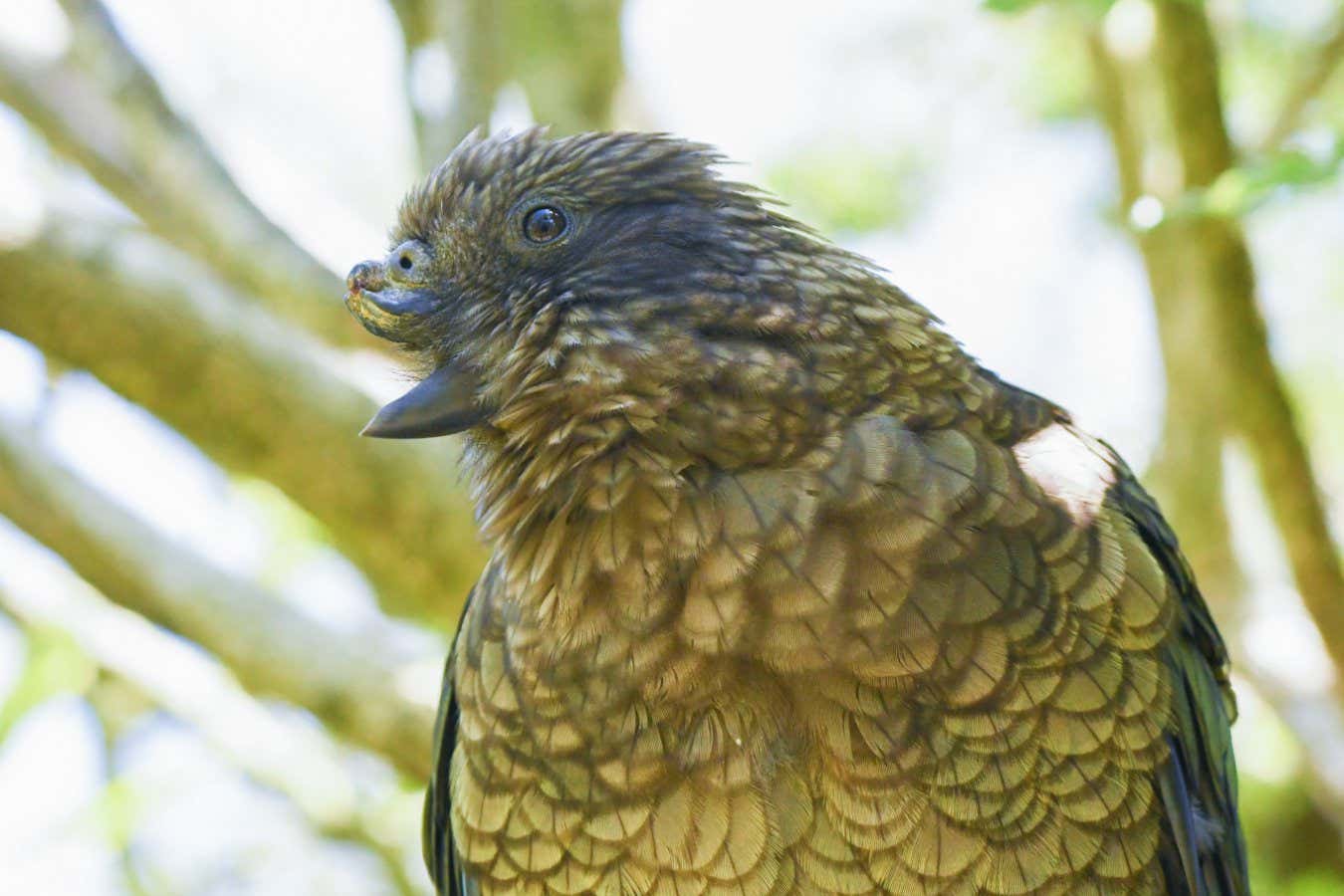

Bruce is a kea with just half a beak
Ximena Nelson
In 2013, things were looking bleak for a malnourished, undersized parrot who was missing half his beak and struggling to survive in the wilds of Arthur’s Pass in New Zealand’s South Island.
Then, says Ximena Nelson at the University of Canterbury, New Zealand, one of her students came across the struggling kea (Nestor notabilis). The bird had lost the upper part of its beak, probably due to trauma. Because the kea is classified as an endangered species, the student decided to bring him into captivity.
Little did anyone know that this was a decision that would change the bird’s life and thrust greatness upon him.
The carers at Willowbank Wildlife Reserve in Christchurch, New Zealand, named the bird Kati, assuming that such a small parrot must have been a female. That assumption also made sense because it was the top half of the beak that the bird lacked. The upper beak is huge in male kea, and used for digging. It looks “like it could bite your finger off”, says Nelson.
But a DNA test revealed that Kati was actually male, so the parrot was given a new name: Bruce – “the silliest name we could think of”, says Nelson.
This wasn’t the only surprise. Bruce is one of nine males and three females held at Willowbank. But in spite of his beak, he quickly asserted himself as the alpha male in the ‘circus’ – the collective name for a group of kea.
The key to Bruce’s success was that, without the top half of his beak, he could use the bottom portion as a weapon.
Nelson says it is not just bluffing on Bruce’s part, as his lower beak is “very straight and sharp and can be used to joust the other birds”.
The other males, most of which are over a kilogram and outweigh the 800-gram Bruce, can’t respond in kind because their upper mandibles cover their lower beaks.
“So even if they tried headbutting another bird, it would just be a blunt rounded curve that would hit them,” Nelson says. “Whereas Bruce pushes himself so fast forward against another bird that he kind of topples over.”
She adds that it’s “a serious jab, and the other birds really don’t like it. I mean, when he does that, they’re just wings in the air, jumping back as fast as possible.”
Out of 162 aggressive interactions recorded between all the male birds over a total of four weeks, Bruce always came out on top, winning each of the 36 interactions in which he took part.
He also maintained absolute control and priority over the four feeding stations in the birds’ enclosure and even co-opted lower-status birds to help clean his lower beak and preen him – something none of the other captive birds did.
The team then wanted to see what kind of toll Bruce’s dominance was taking on the males fighting for their place in the hierarchy. They found that Bruce’s stress hormones levels were by far the lowest, seemingly, because his alpha status was so secure, he only had to display aggression a fraction of the times required of the other males.
The team says, with the exception of humans, Bruce provides the first example of a severely injured animal “individually achieving and maintaining alpha male status through behavioural innovation alone”.
They also say he is living proof that a difference is not always a disadvantage, and that it proved unnecessary to repair his beak with a prosthetic.
“I really like Bruce, actually,” Nelson says. “When there is reason to fight, yeah, he’ll fight and he’ll fight hard, and scrappy. But he’s not a bully.”
Topics: