
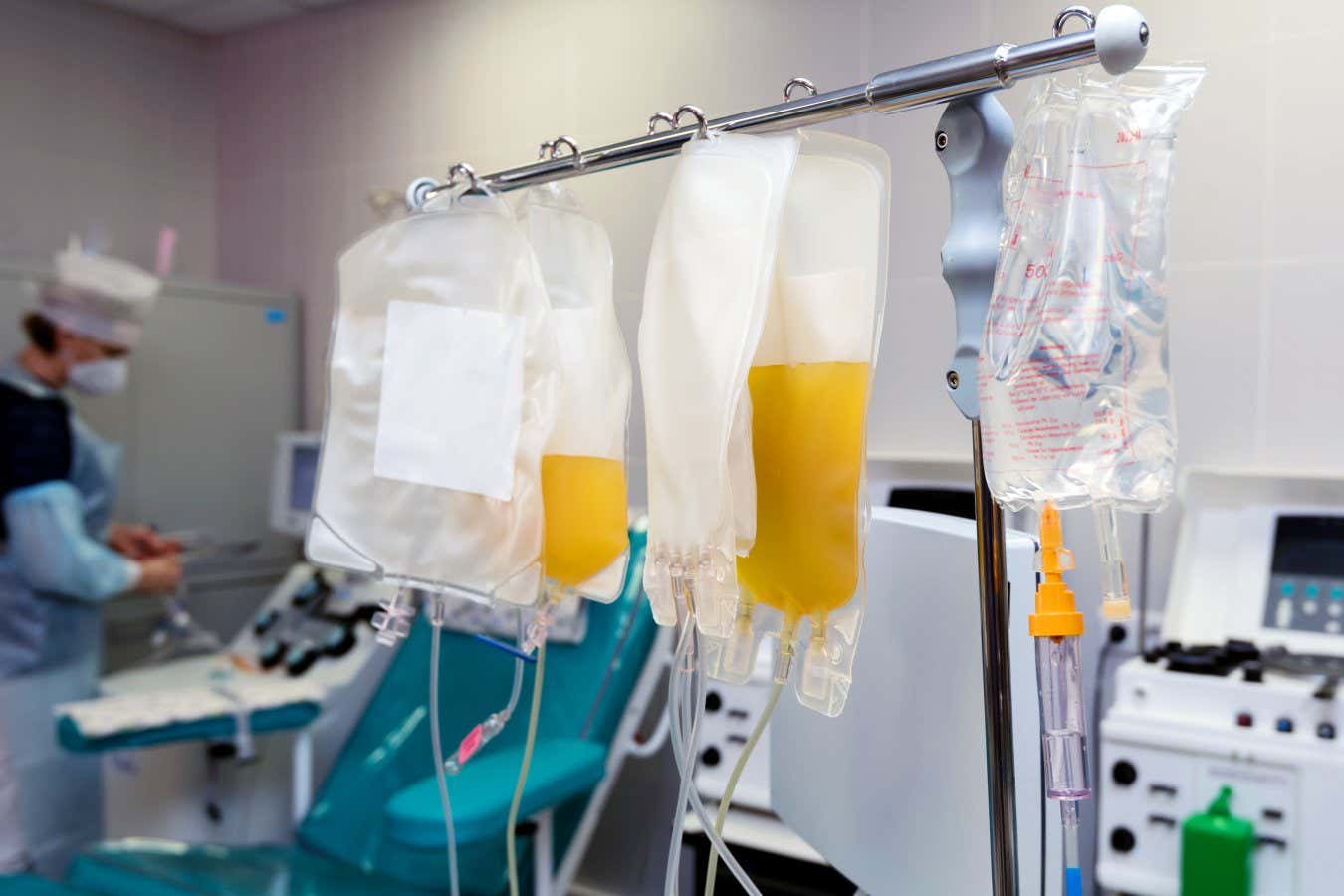

Extracting a patient’s blood plasma, removing a particular protein and then reintroducing the liquid could improve sepsis outcomes
Vital Hil/Shutterstock
People with severe sepsis could one day be treated by having their blood filtered to remove a crucial protein that seems to drive the life-threatening reaction. The approach has shown promise in animal models, with aims for a trial in people next year.
Sepsis occurs when the body’s immune system overreacts to an infection, damaging tissues and organs. It can also escalate into septic shock, in which blood pressure falls dramatically, leading to even more damage. In 2017, there were an estimated 49 million cases of sepsis worldwide. A later meta-analysis of patients in Europe, North America and Australia found that 32 per cent of people with sepsis die within 90 days, rising to 39 per cent for those with septic shock, despite treatments being available to treat the initial infection and compensate for organ damage.
But a novel approach that filters out a driver of this process could stop sepsis in its tracks. Isaac Eliaz at the Amitabha Medical Clinic and Healing Center in Santa Rosa, California, has spent decades studying a protein called galectin-3. It has many functions in healthy people, notably in regulating how cells grow, divide and die, and in activating some immune cells. Due to its multiple functions, galectin-3 has been implicated in many conditions. “It covers a whole array of diseases, from autoimmunity to cancer,” says Eliaz.
This led Eliaz to wonder if galectin-3 might contribute to sepsis. Several studies have shown that higher levels of galectin-3 are associated with a higher risk of mortality in people with sepsis.
So Eliaz and his colleagues developed a device to filter galectin-3 out of the blood. This involves inserting a line into a patient to drain a volume of blood, which is then placed in a centrifuge to separate the cells from the liquid plasma. The plasma is then passed through a filter that contains antibodies against galectin-3, selectively removing the protein. The liquid and cells are then recombined and returned to the patient.
This apheresis device has now been tested by a team led by Zhiyong Peng at the Zhongnan Hospital of Wuhan University in China, using a three-pronged approach.
First, they tracked 87 people with sepsis and 27 healthy volunteers, and found that those with sepsis had higher levels of galectin-3. Those levels then declined among those who survived.
The team also tested the blood-filtration device in two animal models of sepsis. The first involved 48 rats that developed sepsis after having part of their large intestine punctured. Twenty-eight then had their blood filtered for galectin-3, while the remainder were given sham apheresis. Of the treatment group, 57 per cent survived, compared to just 25 per cent of the controls.
The researchers also tried galectin-3 apheresis in miniature pigs that were given lipopolysaccharide, a chemical in bacteria that triggers a powerful immune response, and thus sepsis. The pigs were treated using all the methods of an intensive care unit, but 16 were also given galectin-3 apheresis and 15 had sham apheresis. Again, the survival rate was higher in the treated group: 69 per cent compared to 27 per cent.
“This is innovative, for sure,” says Djillali Annane at the Raymond Poincaré Hospital in Garches, France. “The results are consistent in the two animal models.” However, he says there is a long way to go until galectin-3 apheresis could become standard practice, for instance, understanding how galectin-3 contributes to sepsis on a mechanistic level. Annane also wants the results to be replicated by independent groups, and in other animals, such as primates.
Eliaz’s company, Eliaz Therapeutics, is now trying to secure funding for a randomised clinical trial of galectin-3 apheresis in people, which it aims to carry out in 2027.